Seeing the True Gift

God’s Faithfulness Once Again

Sometimes the greatest gift I receive is something different than the solution I am praying for.

Every good gift and every perfect gift is from above and comes down from the Father… James 1:17

Over the weekend, a billing error caused our card to be charged six times for the same purchase and completely overdrew our bank account. To make matters worse, my wife had a very important doctor’s appointment the next day. She needed money for a co-pay, gas for the car, and a prescription. None of those things could wait. I racked my brain trying to figure out a way to get some cash and ran through every option I could think of. My wife was frustrated. I was frustrated. Sometimes that frustration can turn into an argument. But we both have enough recovery to recognize that we were upset with the situation, not with each other. There wasn’t anything we could do about it late Sunday night. We discussed whether she should cancel and reschedule the appointment, but since it was a post-operation checkup to have her sutures removed, it was important. The next opening with the doctor was several weeks away. So we agreed to let it go for the night and trust God to provide a solution.

Being a single income family, we have learned to trust God as our source. He provides for our needs in all kinds of ways. God’s help is not always dramatic or miraculous. We read in the Bible about ravens bringing food to Elijah every day. But most of the time God works through very ordinary means. He often uses people, circumstances, and opportunities in our life. An extra shift at work. An unexpected sale. A phone call. A conversation. A new idea.

On Monday morning, I was waiting on payment for work I had done over the weekend. They pay through Venmo, but the payment is usually sent on Sunday. I was concerned my wife would have to cancel her appointment. Finally, the payment came through about thirty minutes before she needed to leave. Since transferring money to our account usually takes a day or two, I started looking for places that accepted Venmo directly. I found a gas station that did, so at least we could get fuel in the car. Then I remembered that Venmo has an instant transfer option. I never use it because I don’t like paying the fee, but I decided that if that was what it took, then that was what I would do. Since I never used it, I had no idea what the fee would be. I thought it would be a percentage of the payment. When I opened the app, I discovered I had been paid a little extra. It was more than enough to cover the transfer fee and get the money into our account immediately. The transfer fee was not as significant as I feared it would be either. Within minutes, my wife had what she needed for her appointment, gas, and prescription and anything else she may need.

I thanked God for providing what we needed once again. He is always faithful. Then I realized something else. He helped us handle the situation differently than we would have in the past. Instead of panicking, arguing, or trying to force a solution, we were able to be patient, trust Him, and stay open minded to possibilities we had not considered. That is a gift I do not take for granted. Sometimes God’s help comes in the form of a dramatic miracle, but more often His provision comes through wisdom, perspective, and new ways of thinking. Looking back, God provided more than what we needed that weekend. I am not referring only to the money. The greater gift was the way He helped us walk through the situation. Years ago, we might have blamed each other, argued, or tried to force an answer. Instead, we trusted Him, worked together, and remained open to solutions we had not considered. The money solved an immediate problem, but the changes in our attitudes and behaviors are the true gift. God did not change us overnight. He changed us as we became willing to trust Him and apply the principles and steps of recovery one day at a time.

Reflection

What gifts from God have you noticed in your life since beginning your recovery journey?

What Do I Want?

What Stays And What Goes

Growth isn’t always about fixing what is broken. Sometimes it’s about letting go of things that no longer belong.

But you, change the way you were living. The person you used to be will ruin you through desires that deceive you. Have a new attitude. Ephesians 4:22-23

I was listening to someone share recently about their house being flooded. After the water receded, people started calling and asking what they could do to help. One friend asked, “What do you need?” The homeowner responded, “The first thing I need to do is take inventory and assess the damage.” When he said that I knew instantly what he meant. He went on to explain that before he could do anything, he first had to figure out what was there. What was still good and what was ruined. What could be saved and what needed to be replaced. What he wanted to keep and what he wanted to get rid of. There might even be things that survived the flood just fine. Things he no longer wanted. And there were new things he wanted.

As I listened, something clicked for me. I have taken inventories in recovery for years. Usually when I think about taking an inventory, I think about answering Fourth Step questions. Those questions have helped me uncover resentments, fears, unhealthy patterns, and character defects that I could not see on my own. I knew what an inventory was. I had taken inventories at work and in recovery for years. But somehow, I had gotten stuck thinking that answering the questions was the inventory. I would answer the questions, share them with my sponsor, and gain insight in the process. What I suddenly realized was that the questions were never the inventory. They were tools that helped me break through denial and see what was already there. The inventory was always just an honest assessment of myself.

As I thought about that flooded house, I realized that is exactly what I am doing when I take inventory of my life. There are things God has been building in me over the years that I am grateful for and want to keep. There are also things I am still working on that need attention and repair. There are also things that I no longer want. Things like my need to control people and outcomes. My tendency to become defensive when I feel threatened. The walls I built to protect myself from being hurt. Those things may have helped me survive at one point in my life, but they no longer belong. Then there are qualities I want more of, like patience, humility, trust, compassion, and acceptance.

The gift I received from this story was the realization that even though some things survived the flood just fine, the homeowner no longer wanted them. It dawned on me that the same thing is true in my life. Some of the attitudes and behaviors that helped me survive no longer belong in the person I want to be. Today, when I take inventory, I am not just looking for what is broken and damaged. I am also looking for what no longer belongs and what I want in my life instead.

Reflection

What is one quality or character trait you would like more of in your life today?

A Trust Problem

Feeling Safe

My need to control uncovered a truth I was blind to. I didn’t trust God or the people who love me.

Whenever I am afraid, I will trust in You. Psalm 56:3

I was listening to a speaker and started meditating on what she said. She shared that one of the reasons she argued in relationships was because she felt out of control. As soon as I heard that, I knew that was me. It was almost like I could finish what she was saying without ever hearing it. I felt like there was a huge spotlight shining on me and God was saying “This is you pal.” I realized that my first reaction in conflict was to defend and argue my position and beliefs. And I know it was because I felt out of control. As I meditated on it more and thought back on my relationships, I realized that my initial reaction when I feel out of control was always to fight. I felt attacked and would immediately defend myself and argue my position because being in control made me feel safe.

Quite honestly this became a huge problem in my marriage. A few years back, my relationship with my wife wasn’t the greatest. Our communication was suffering. We loved each other very much, but we argued a lot. We both love God. We’re both in recovery. We were both trying to do our best. We would pray about our problems and sincerely want things to be different, but somehow we would find ourselves having the same arguments over and over again. Many of the arguments were over stupid things too, that really didn’t matter. Then those little things would turn into “a thing” themselves. It was insane. I would get frustrated and honestly couldn’t understand why we kept getting stuck repeating the same pattern. Last year, I decided to start applying some recovery principles to my marriage more intentionally. One of those principles was simply considering the possibility exists that my wife could be right. Another was accepting things as they are instead of insisting they be the way I wanted them to be. Many times that meant keeping my mouth shut and listening instead of immediately responding, defending myself, or acting like a victim. The results were remarkable. Our relationship improved dramatically. We argued less, enjoyed each other more, and experienced a level of peace that had been missing for a while. Secretly, I thought it was because I was being “recovery man” and I patted myself on the back, because in my mind I was working my recovery. Is that pride? Yes! I am embarrassed to admit I thought this way, but I am just being honest. I was told early on that true healing comes from being completely honest.

Initially, I made those changes because I wanted peace in my relationship and didn’t want to argue. I was practicing recovery principles, keeping my mouth shut more often, and trying not to react. In my mind, that was why things were getting better. And there is some truth to that. But as I reflected on what the speaker said, I began to see something I had missed. One of the recovery principles I was trying to practice was considering the possibility exists that my wife could be right. But it was only an intellectual acknowledgement, because I never really considered that she might actually be right about me. For years she told me that I wasn’t taking responsibility for my part in our conflicts. I heard her words, but I mostly dismissed them as her trying to work my program. I would apologize and not give it another thought, and secretly continue believing that the real problem was not me.

As I got honest with myself, I began to see that my need to defend myself and argue wasn’t really about being right at all. It was about trust. When I felt out of control, I felt unsafe, and when I felt unsafe, I tried to regain control by defending my position and convincing others to see things my way. What I am learning now is that I don’t have to do that. I can trust God. I can trust that the people who love me are not my enemies. I don’t have to prove my point or win every disagreement to feel safe. I can listen. I can consider that someone else might really be right, even about me. The more I learn to trust, the less I feel the need to control. And the less I try to control, the more peace I experience in my life, my marriage, and my relationships. What I once thought was a communication problem seems to really be a trust problem, and learning to trust is bringing a freedom I never found through arguing, defending, or trying to be right. And that is the gift of recovery for me.

Prayer

Father, thank You for showing me that I don’t always have to defend myself. Help me let go of the need to be in control. Teach me how to trust You when I am afraid, and to trust those who love me. Amen.

Perfect Timing

Seeing God

I’m learning to look for God in the ordinary moments of my day, not just the dramatic ones.

Your Father knows what you need before you ask Him. Matthew 6:8

As an umpire, I have all kinds of gear and equipment I wear for games. Chest protector, shin guards, face mask, steel-toed shoes, jackets for cold weather, rain gear, and different uniforms depending on the conditions. Some of it is for protection and some of it is simply part of presenting yourself professionally and showing respect for the game. Living in the desert I have to be prepared for all kinds of weather conditions, sometimes having opposite extremes even in the same day. A few months ago was one of those days. I was umpiring a tournament out of town and it was a very cold morning, so I wore my insulated jacket. As the game progressed, the weather warmed up quickly, and I took my jacket off and left it in a dugout. I worked four more games that day in much warmer weather and completely forgot my jacket.

Honestly, I didn’t even realize it was missing until weeks later when I started looking for it. I checked my car, my uniform closet, local ballfields, and even asked other umpires and coaches if they had seen it. Nobody knew where it was. I figured it was probably gone for good. Then last week, out of nowhere, I got a call from a tournament director asking if I could umpire an upcoming tournament. Before we hung up, he said, “Oh, by the way, I have your jacket.” Someone had found it and given it to him months earlier. I was grateful just knowing it hadn’t been stolen or thrown away. But what really struck me was the timing of it all.

Last night I was umpiring a playoff game. The forecast was for cold weather that eventually turned rainy. I brought my jacket with me and put it on during the game. I stayed warm and dry. Driving home afterward, I found myself thinking about how thankful I was to have gotten it back when I did. The timing was perfect. The weather had been nice for the last couple months. I really didn’t need it then. But I needed it last night. And that simple little moment reminded me how recovery has changed the way I see my life. Before recovery, I probably would have taken the timing for granted and moved on. But I have a new practice now because of my recovery. I review my day each night and look for God in it. I try to notice all the ways, big and small, that He is looking out for me, even when I do not realize it at the time. Getting my jacket back only a couple days before I really needed it reminded me that God was taking care of me the whole time. Honestly, I am so grateful and thankful for that, even more than getting the jacket back. And that is the gift of recovery for me.

Prayer

Father, thank You for all the ways You look out for me that I do not even notice at the time. Help me to slow down and recognize Your presence in my everyday life. Remind me to be thankful for the little things. Amen.

Where Do I See God Today?

His Gentle Whisper

I am noticing that God is often working in the small daily moments I usually overlook.

And after the fire came the sound of a gentle whisper. 1 Kings 19:12

Recently my sponsor gave me an assignment that stumped me. Sponsors have a way of doing that, don’t they? He said he wanted me to answer a question. It seemed easy enough. The question was, “Where do you see God in your life today?” At first, I thought that was a simple question for me to answer and would be really quick. I have a close relationship with God. No problem. But when I sat down to actually think about it and write my answer, I got stuck. I think I was expecting some kind of deep spiritual answer. Something dramatic. Some big breakthrough moment or miracle story. Instead, I sat with that question for several days, praying and really thinking about it. Where do I see God in my life today?

My answer surprised me. I wasn’t seeing Him so much in the outward dramatic things. I was seeing Him inwardly, in the small changes happening inside of me. I see Him in my morning routine. In reading recovery literature and my devotional. In listening to recovery messages on my way to work. I see Him through the people who encourage me. And I see Him in the quiet moments where I just pause and think. It reminded me of Elijah in the cave when God showed him His voice wasn’t in the earthquake, the fire, or the wind, but in the still small voice. That’s where I see God today.

What really stood out to me was how much I see God now in the changes happening inside of me. I see Him when I pause instead of immediately reacting. I see Him when I choose not to send the snarky message I was thinking about sending. I see Him in the way my thinking has changed over time. Recovery has helped me become more aware of myself, my motives, my pride, and my tendency to try to control everything. Before recovery, I usually only looked for God in the huge moments of life. Now I’m learning to see Him in the small moments too. Things like when I have peace. When I show restraint. When I gain perspective. When I can see my own growth. And when I don’t insist things have to be done my way and I surrender control. That’s where I see God today.

I also realized something else while thinking about that question. I am usually much harder on myself than God is. I keep thinking I should be doing more, praying more, reading more, writing more, and accomplishing more. There is still a residue of that corrupt core belief that I am not good enough. But I have come so far from where I was when I started. When I honestly look at my life today compared to who I used to be, I can clearly see that God has been working in me this whole time. Not perfectly. Not instantly. But faithfully. He has been changing the way I think, the way I respond, and the way I live. He has been meeting me where I am and bringing me toward where He wants me to be. And maybe that was the answer to my sponsor’s question all along. I no longer only look for God in dramatic miracles. I see Him in the small daily changes happening inside of me. That’s where I see God today. And that is the gift of recovery for me.

Prayer

Father, thank You for helping me see You in my everyday life. Help me to slow down and recognize the ways You are working in me and around me. Teach me to trust the growth process, even when it feels small or slow. Thank You for continuing to change me one day at a time. Amen.

The Master Artist

Trusting the Process

God is the Master Artist turning my chaos into something beautiful.

I pray with great faith for you, because I’m fully convinced that the One who began this glorious work in you will faithfully continue the process of maturing you and will put His finishing touches to it until the unveiling of our Lord Jesus Christ! Philippians 1:6

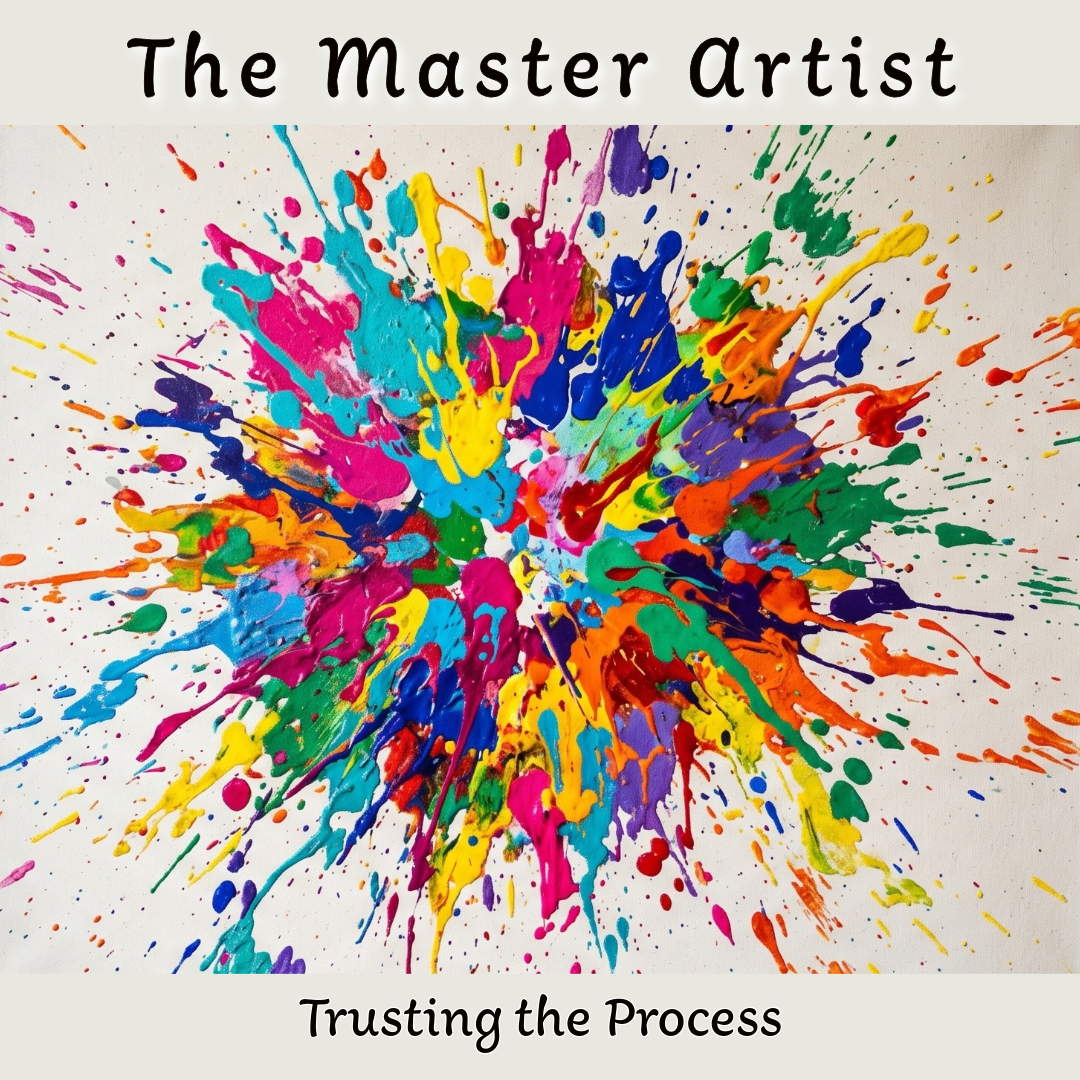
I was meditating and praying about surrendering my will to God. Something that has never come naturally to me, because growing up I learned I couldn’t trust anyone. As I closed my eyes in consecration to God, I suddenly saw this picture in my mind of a white canvas sitting on an easel. But it wasn’t clean and untouched. Paint had been splattered all over it in every direction. Different colors everywhere. It looked messy, chaotic, and completely unorganized. The edges of the canvas were still white, but the middle was a mess. It looked ruined. Like nothing good could ever come from it. My first thought was that it should just be thrown away and started over.

Then I saw a Painter step up to the canvas. Not just any painter, but a Master Artist. He studied the mess closely and then began to work with it. He didn’t throw the canvas away. He didn’t cover it up or pretend the mess wasn’t there. He started shaping the paint already on the canvas. Adding shadows, highlights, texture, and definition. He brought order to what looked random and chaotic. It started becoming something new and intricate. What once looked ruined started becoming beautiful and valuable. By working through the mess already on the canvas, He was creating something new that nobody else could imagine.

That’s when it hit me. God is that Master Artist, and I am that canvas. The paint represents the mess I made of my life. The mistakes. The wrong choices. The regrets. The places where things feel broken, confusing, and out of place. When I look back over my life, sometimes all I see is the mess. My best thinking tells me to quit, give up, or throw the whole thing away. But God doesn’t see my life the way I do. He sees the finished picture. He sees what He had in mind from the very beginning. He is not discouraged by the mess I made, because He already sees the painting He wants to unveil.

I’m learning that surrender is trusting Him as the Artist even when I don’t understand the process. I don’t have to clean the canvas before bringing it to Him. I don’t have to know what the finished picture will be or even look like. I don’t have to figure out how all the colors will fit together. My part is simply to place my life in His hands and trust Him with it. Because God has a way of turning my mess into a masterpiece.

Prayer
Father, thank You for not giving up on me when my life looked like a mess. Help me to trust You with the things I still don’t understand. Teach me to surrender to You and trust what You are doing in me and with me. Amen

I’m Not Who I Was

Not Defined By My Past

My identity isn’t who I was then. It’s who I am now.

If anyone is in Christ, he is a new creation; the old has gone, the new has come.
2 Corinthians 5:17

I’ve lived long enough to know what it feels like to be hurt. I’ve experienced difficulties, pain and trauma, even some health issues and concerns. People have hurt and mistreated me. I have been tricked, lied to and taken advantage of. I have survived experiences that left a lasting mark. They’ve caused wounds, and those wounds have left scars behind. But none of those things define me. They are unfortunately just the toll of life.

What I love about recovery is that it gives me practical tools and new skills to use. They help me heal and recover from the wounds and scars. It’s not salve that magically heals everything, nor is it a catch-all for every problem or situation. But it provides me with a different way of thinking. It teaches me to approach life differently. I am not a victim. I am not damaged or broken. I am not ruined or irreparable because of the things that have happened to me. Instead, I approach life as a whole person who has had bad things happen to me. And when I see myself that way, I’m able to confront, deal with and recover from the damage that was left behind.

I call that emotional collateral damage. It is what has happened to me as a result of the trauma and abuse that I experienced as a child. Those wounds, although sometimes still very painful, can be healed completely. It’s not like a surgery where they go in and remove the problem organ, and it’s all gone in one moment. This kind of healing is a process. It takes time. The damage and scars didn’t develop suddenly overnight and they’re not going to go away suddenly overnight either. This is what the Bible describes as the renewing of the mind and the saving of the soul. It’s a process that takes time as I grow into the full nature of a child of God.

And that’s where I live today. I’m not pretending those things didn’t happen, but I’m not letting them define me anymore either. I’m learning how to deal with what’s been left behind, one layer at a time. Sometimes that looks like choosing a different response when I feel hurt. Sometimes it’s simply talking about what I’m feeling instead of holding it in. Some days are harder than others. Some wounds are still tender and hurt when something hits them. But I’m not stuck there like I used to be. I’m healing. Not all at once, but steadily. I’m not who I was, and I’m not stuck where I’ve been. I’m moving forward into what God has for me.

Prayer
Father God, thank You for being my healer. Help me to face the hurts from my past instead of avoiding them. Give me strength to walk through them. Guide me and help me as I continue moving forward in You. Amen.

Putting It Into Practice

I used to look down on devotionals… now I’m writing one. God has a sense of humor.

God resists the proud, but gives grace to the humble. James 4:6

When I was early in my walk with the Lord, I used to look down on people who read daily devotionals. I thought that they were less spiritual. That they didn’t know how to read the Bible for themselves or seek God for themselves. They needed a book to guide them. It was pride and arrogance. I won’t deny that.

When I got into recovery, I leaned on those daily devotionals. They helped me to see things differently. They introduced ideas and concepts to me that I had never thought about. Many times reinforcing beliefs I already had but didn’t know how to put into practice at the time. And by reading about how someone else had dealt with something, it gave me an example or a model to try. And I found much success in doing so.

God has a sense of humor. This past year I have felt inspired and led by Him to write devotionals, which I’m doing. He has also shown me how they will be developed into a 365 day, daily devotional book. These postings on social media are a sample of those writings. I find that I’m growing more in writing them too. I feel like I now have an outlet for sharing with others the things He is revealing in me and has shown me. That was something that had previously frustrated me for many years. The feeling that I had all these deposits from Him inside me with no one to share them with.

I’m thankful that God never gave up on me. That He led me and guided me all the way. Even when I was obstinate and difficult. When I was rebellious. He was there the whole time. He was taking whatever I would give Him and working with it. I’m grateful that He led me to recovery where I found the balance between spiritual insight and practical application. I love Him so much for that. And when I reflect on how He’s now using me to write daily devotionals, I see His sense of humor being displayed in my life.

Prayer
Father, thank You for never giving up on me. Thank You for showing me how to put into practice and share what You are showing me. Amen.

Not Doing What I Believe

A simple question exposed something deeper in me.

If you know these things, blessed are you if you do them. John 13:17

I recently had someone ask me a question that challenged my faith and my beliefs. They weren’t doing it intentionally. They simply asked a question about something I wrote in my book. I thought about it for a moment. It was such a simple question: “What is your gift?” I was silenced. I had no response. I was stuck trying to grasp the question. I thought, What is my gift? I told them how God has used me in the past, but I was dumbfounded to come up with an answer to that question as it relates to me now.

Why was it so hard for me to answer that question? It’s because inside, I know I am not doing my gift. I’m not walking in what I feel God wants me to do. And that’s why I had no answer. I didn’t want to lie. I didn’t want to make something up. I didn’t want to be dishonest. So instead of saying something that I may no longer believe or that I no longer see in my life, I was silent. Finally, I answered with the gifts God has given me, and I thought about how active those really are in my life today. And what I came up with was this: I am not doing what I believe. That was hard to swallow. Very hard. I didn’t need to do any writing about this one. I didn’t need to pray and seek God about it either. I already knew I wasn’t surrendering all areas of my life to God.

I’m grateful that recovery teaches me to look at my progress and not perfection. So I don’t beat myself up or condemn myself for not being perfect or for not surrendering every area of my life to God at one time. Today, I’m thankful that I saw another area in my life that I can surrender. This one’s going to take some time though. It’s not going to be easy either, because it deals with my core beliefs and values. But I’m confident that God is faithful, and just as He showed me this area to surrender, He will provide me the wisdom and strength to do so as well.

Prayer
God, help me surrender all areas of my life to You and live what I truly believe. Give me the strength and courage to face and overcome the obstacles that hinder me from doing so. Help me to do Your will. Amen.

Seeking Approval

God Has Already Given It

I’m learning to stop chasing approval from people who may never give it… and instead lean into the approval God has already given me.

Am I now trying to win the approval of human beings, or of God? Galatians 1:10

Why do I seek approval from those who don’t or won’t give it? And yet I discount or dismiss approval from those who do? Why does the approval I can’t get seem to matter more than the approval I already have? When I think about it, the ones I am seeking approval from are parent figures and authority figures. And the ones who are willing to give it, I tend to dismiss or minimize, because they’re not the ones I’m seeking approval from.

This awareness doesn’t solve my problem, nor does it fix it. But it does cause me to realize that it’s a me issue and not a them issue. Granted, those parental figures who refuse to give approval have a part to play, but that’s their part. That’s not always easy for me to accept. I want it to be about them. I want them to change so I can feel better. That would be a lot easier. But by working the steps of recovery, I’m learning that I need to focus on my part. I cannot change them, no matter how hard I try. Trying only leaves me frustrated and puts me in a position where I’m tempted to manipulate and control to get my emotional needs met. My feelings get hurt and I feel less than again. That’s all about me.

Recovery has helped me climb out of that pit. By focusing on myself and what I can do. By focusing on what is within my power, and what I need to do to see that change happen. I know I have God’s approval, and when I think about that, it helps me keep things in perspective. Who is more of an authority or parental figure than God? If I have His approval, then I don’t need theirs the same way. I don’t have the solution for this right now. I only have a guide that leads me down a path toward peace. I realize this is about me and my core issues. I sometimes still feel less than and need approval. And because I can see that, I know the solution also lies within me, even if I’m not fully aware of it yet. But I have hope. Because of the tools and principles I’ve learned in recovery, and because of God helping me, I know I won’t stay stuck here. He will help me change.

Reflection
What would change if I truly believed I already have God’s approval?

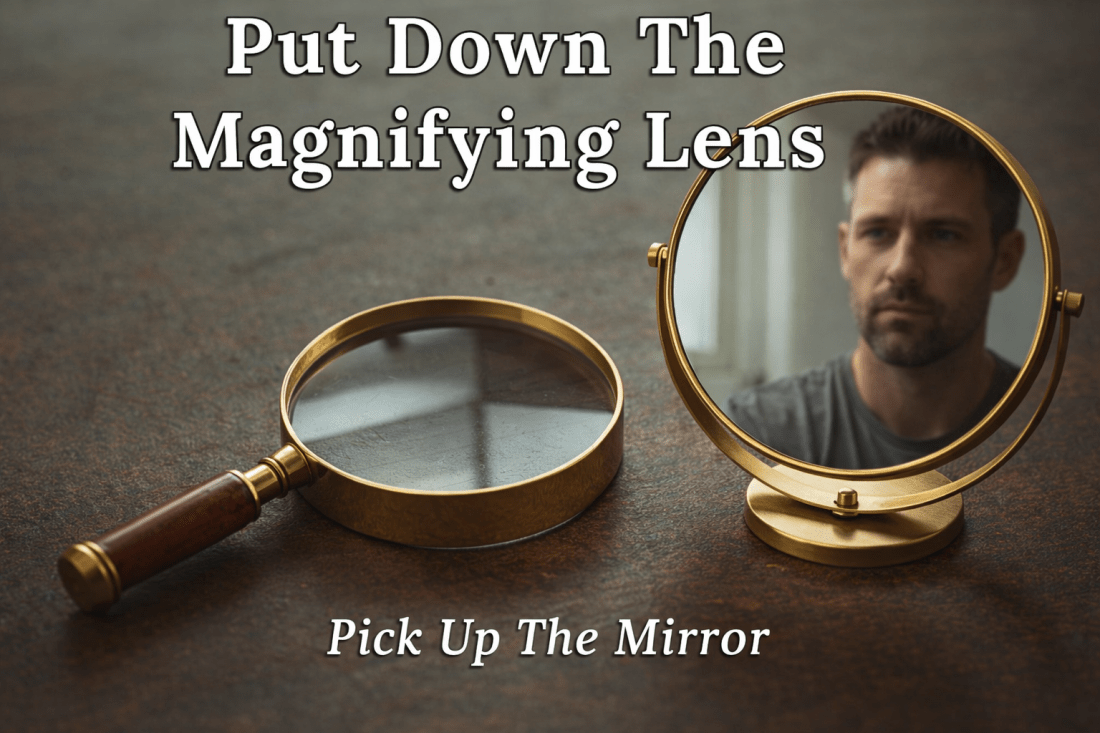
Put Down the Magnifying Lens

Pick Up The Mirror

When I put down the magnifying lens and picked up the mirror, things started to change.

If we honestly examine and evaluate ourselves then we will not be judged and punished. 1 Corinthians 11:31

One of the biggest aha moments I have had since starting recovery is seeing how the Bible talks so much about recovery. It may use different terminology, but it is absolutely recovery principles. Not surprising to me, as I have since learned that the 12 Steps were based on the Bible and are outlined in order in the beatitudes. Now I see recovery everywhere in the Bible, like this verse here. It tells me that if I look at and evaluate myself honestly and judge myself, I will not have to be judged and punished. I got hung up on the word judge in this verse until I looked it up and saw that it means if I examine myself and change, I will not be condemned. This is talking about doing an honest moral inventory, changing behaviors, and making amends. That sounds a lot like recovery just in different language. But it’s the same principle.

Too many times I used to judge others instead of myself. I was looking at what others had done to me and not at what I had done to them. I would look at myself and try to see what I had done, but I would dismiss my actions and behaviors because I had good intentions. I meant well. So I would justify my actions instead of looking at how I could change them. Good intentions did not excuse my actions or dismiss my bad behavior. That sounds a whole lot like denial to me. I once heard someone say, Once I put down the magnifying lens and picked up the mirror, my life got a lot better.

In my Christian life I’ve heard many teachings about the idea of actions versus intentions. I would walk away thinking that when I see others’ actions, I should consider their intentions and offer them grace and understanding. I see now that I missed the underlying point. The axiom is: why do I judge others by their actions while I judge myself by my intentions? I would pose a new thought process: don’t let my intentions justify my actions. Instead, let me look at my actions strictly as my actions in spite of my intentions. When I keep the focus on me and look at how I can better myself in these situations, I can always see that I have a part. My part may be anywhere from 1% to 100%, but I definitely have a part. And that’s the part I have to deal with.

Reflection

Where can I look in the mirror instead of through the magnifying lens?

A Better Father Than Me

Through My Children

The way I love my children helped me understand how God loves me.

If you, imperfect as you are, know how to lovingly take care of your children and give them what’s best, how much more ready is your heavenly Father to give wonderful gifts to those who ask him. Matthew 7:11

Sometimes I struggle with the concept of a loving, caring God. It’s hard for me to believe that God would care for me regardless of, or even in spite of, the things I do. That He would love and accept me for who I am. I start to ask myself why. Why would God have compassion for me? Why would He be there? Why would He help me? Why would He even want to? And honestly, it’s held me back in my life. I want to believe it, but I never saw it modeled in my life, so I don’t even know what it would look like.

I was pondering this today and I started thinking about my children and how I would do anything for them within my power. If there was anything they needed or wanted, I would do whatever I could to make it happen. If they’re in trouble or something’s bothering them, I want to know, because I care about them. I love them. And if there’s anything I can do to help or ease their pain, I would do it. That’s when the aha moment hit. God cares for me the same way. After reflecting on that, I realized the fact that I even have that comparison to think about parenthood and God came from God to help me and give me perspective. He is so good.

When I started to put that into perspective, I realized God is probably a better parent than I am. So if I have those feelings toward my children, and I would do anything within my power to help them, to love them, to care for them, to accept them, even if they were mad at me or even if they refused, I would still be willing and available. Why wouldn’t God be the same toward me? My obvious conclusion is He would, and probably even more so. What I’ve found is I am my worst critic. I am hard on myself. I judge myself. I consider myself not worthy. But when I look at my children, I realize there is nothing they could ever do that would cause me not to love them or care for them. Nothing. That allows me to be more gentle with myself. It helps me accept that God will never reject me, that He loves me, that He cares for me, and that He’s always there willing to help me. That matters because it gives me confidence to ask Him for help, knowing He’s there when I do. That’s part of the gift of recovery for me.

Reflection
What would change if I actually believed God cares for me the way I care for my children?

I Cannot Tell His Story

Peace Through Perspective

I can’t tell his story. But I can change mine.

Man looks at the outward appearance, but the Lord looks at the heart. 1 Samuel 16:7

What I knew about my dad was that he was a master sergeant in the Marines. He trained paratroopers. He was injured on a jump when one of the lines sliced him, leaving a scar across his abdomen. Although he never identified himself as an alcoholic, I know he drank a lot, and when he drank, he got drunk. And when he was drunk, he was often mean and violent. That’s what I experienced growing up. There were times when he wasn’t like that. But there were many times when he was. He was estranged from his biological children, and I believe he carried resentment from that into our home. For most of my life, that’s the story I told myself about him.

As I’ve gone through recovery, I’ve started to see how much of that experience shaped me. He demanded things be done right. Not just done, but done perfectly. I remember washing his diesel truck and missing a few spots on the grill. He inspected my work and instead of having me fix that one area, I had to wash the entire rig again. Hours of work, over something small. The same thing happened with mowing the lawn. It had to be cross cut, then diagonal cut. It had to be done a certain way, and if it wasn’t right, I had to start over. That mindset stayed with me. I learned to strive for perfection. I learned that getting it wrong meant starting over. And while that shows up today in doing things well, it also shows up as pressure and an impossible standard I can’t always meet. I have learned those were unrealistic expectations.

After I got into recovery and started working through the steps my sponsor pointed out something I didn’t want to see or admit. He said that I seemed to have a hatred for my dad. I denied it. I was a Christian and I didn’t have hate in my heart for anybody. But as I worked through the steps, I found that there was hatred in my heart for him. My sponsor suggested I do a fourth step just on my dad. So I did. It was a very long fourth step. It took me months.

In doing that, I realized something that changed everything for me. I cannot tell my dad’s story. Outside of what I experienced, I knew very little about him. That helped me begin to see him as a person instead of a monster. I’m not excusing what he did. But when I started to understand there was more to him than what I saw, I began to develop compassion for him. I just wish I had come to that place before he passed.

Recovery has given me a way to make amends to him even though he’s no longer here. I make a living amends by changing how I live. By letting go of the resentment. By choosing to see the good in him and not defining him by his struggle with alcohol. By accepting him as my dad, the man who raised me. Most of my life I called him my stepdad. I kept that distance. Today, I call him my dad. I love him for who he was, not what I wished him to be. And there is a peace in that I can’t fully explain. That is the gift of recovery for me.


Prayer

Father, help me to be honest about what’s in my heart. Give me the courage and strength to let go of the resentments and pain I’ve carried, and help me offer forgiveness instead. Thank You for the healing and peace that comes with that. Amen.

Connection Over Control

I didn’t realize how much I was trying to control connection… until I saw it in my dog.

Be still before the Lord and wait patiently for him… Psalm 37:7

This morning, I had another lesson from my dog. She’s a golden retriever and has the sweetest temperament. Every morning, I sit in my La-Z-Boy chair with my coffee and finish up my writing from the night before. In that quiet stillness, I lean back, put the footrest up, grab my laptop, and start typing. Like clockwork, within about thirty minutes, she walks in and sits right in front of me. She doesn’t move. She doesn’t make a sound. She just sits there and waits. When I’m done writing, I put the laptop down, drop the footrest, and call her over. I already know what she wants.

I reach down and pet her, love on her, hug her, pray over her, speak blessings over her, and tell her I love her. And when I’m done, she just walks away into the other room. What she wanted was connection. She wanted to be touched. She knew exactly what she wanted. And she let that need be known without demanding it. She showed up, sat there, and waited patiently for me to respond. God spoke to me through that. The lesson I got from that was simple and equally profound. She didn’t force anything. She didn’t act out. She simply made her need known, and then she trusted enough to wait for it. She trusted me to meet her need.

It made me stop and look at myself. Do I trust God that way with my needs? Do I just show up and patiently wait for His goodness? How many times do I not even let my needs be known? Or when I do, I come across demanding or frustrated instead of honest and vulnerable. How often am I unwilling to wait for what I want or need? Do I revert to old behaviors and shut down or try to force outcomes?

But today I saw something different. It was a simple object lesson for me. There’s a way to be honest about what I need without pressure, without control, and without fear. What I realized is… I want connection too. But a lot of times I’m either afraid to ask for it, or I try to force it on my terms and my timeline. And when it doesn’t come the way I expect, I miss it completely. I am seeing that it’s not about controlling how it comes. It’s about really being honest, showing up, and trusting God enough to receive it however and whenever it comes. That’s what I’m learning in recovery. Just being real about what I need, letting go of control, and trusting God with the timing.

Prayer
Father, help me to be honest about what I need. Teach me not to hide it or try to force it. Show me how to trust You and be patient with Your timing. Help me receive what You give, the way You give it. Thank You. Amen.

What Was So Good About Friday?

What felt like the worst day of my life… became the turning point.

Why do we call it Good Friday? It’s the day Jesus Christ died for our sins. It’s the day He paid the price for everything that had gone wrong. That’s what we’ve been told. That’s what we know. But if you really think about it… there was nothing good about that day when it was happening.

It was betrayal, pain, and loss. Jesus was in agony, knowing what was coming. He was betrayed by one of His own, denied by another, and left alone by the rest. He was beaten, mocked, falsely accused, and sentenced to die. There was nothing about that moment that felt good. It looked like the worst possible outcome.

And honestly… I’ve had a day like that too.

A time in my life where everything fell apart. I felt lost, broken, and alone. I couldn’t think straight. I cried more than I ever had. I felt abandoned, unloved, and unwanted. I didn’t want to live… but I didn’t have the courage to die. That was my bottom. That was my version of a “Good Friday,” and there was nothing good about it when I was in it.

But looking back now… I see it differently.

That was the place where everything started to change. That pain brought me to a place where I was finally willing to do something different. It humbled me enough to admit I needed help, and gave me just enough willingness to ask for it. That’s where recovery started for me. Not when things got better… but when everything broke.

I believed in God before that, but I hadn’t surrendered. Not really. When I finally did—when I let go of trying to control everything and started trusting Him—that’s when my life began to change.

So when I think about why it’s called Good Friday… I understand it now.

Not because it felt good. Not because it looked good. But because of what came out of it.

That was my Good Friday.

Reflection:

Have you had a “Good Friday” moment when life broke you enough to make you reach out for help? How did God meet you in that moment?

He was wounded for our transgressions, He was bruised for our iniquities; the chastisement for our peace was upon Him, and by His stripes we are healed. Isaiah 53:5