HOW JESUS USED THE WORD OF GOD

(An excerpt from my book Hearing God’s Voice Every Day!)

We are going to take a peek at how Jesus used the Word of God in His daily life. Here is one example that we have. Now remember Jesus was alone, all by Himself when these events happened. So how do we know about them? He told His disciples and had them record it. It must have been important for Him to specifically recall it, and have the to do so. We see the interchnage in Luke 4:1-13

1 Then Jesus, being filled with the Holy Spirit, returned from the Jordan and was led by the Spirit into the wilderness,

Jesus is our example of how we should live our lives and how we should do things. Jesus heard from God, and He used the word of God when He dealt with the tempter – the devil. Jesus is our example. Jesus was led by the Spirit into the wilderness, a deserted place. Jesus was alone. All by Himself. No other human person was with Him.

2 being tempted for forty days by the devil. And in those days, He ate nothing, and afterward, when they had ended, He was hungry.

Jesus was tempted for 40 days by the devil. Let me say that again. Jesus was tempted by the devil. Not by God. The devil is the tempter. We have the account of only three occurrences here, but it clearly says He was tempted for 40 days. He was also fasting for 40 days and afterward he was hungry. Then comes the tempter again. Are you seeing the picture here? Medical science tells us that around day 40 of not eating starvation begins and people usually start to die. He was literally starving when tempted to turn the stone into bread. He was HUNGRY.

3 And the devil said to Him, “If You are the Son of God, command this stone to become bread.”

The tempter tempts us when and where we are weak. He tempts us where we have a NEED. He challenges our status and authority, as well as our natural desire to survive and live.

4 But Jesus answered him, saying, “It is written, ‘Man shall not live by bread alone, but by every word of God.’ ”  (Deut. 8:3)

Jesus used the Word of God to fight off the temptation. No doubt Jesus was hungry it tells us so – but that He was tempted means He thought about doing it. Sometimes we think that since Jesus was God and He always was constantly thinking God’s thoughts. But it clearly says that Jesus was tempted. He thought about doing it. James 1:13-14 tells us clearly that God does not ever tempt anyone but instead, each of us is tempted by our own desires. What kept Him in check? What helped Him in the midst of this temptation to stay strong? It was the written Word of God. Jesus is That Mana. He IS the Word of God and the Bread of Life, and even He used the established written Word of God in His battle.

5 Then the devil, taking Him up on a high mountain, showed Him all the kingdoms of the world in a moment of time. 6 And the devil said to Him, “All this authority I will give You, and their glory; for this has been delivered to me, and I give it to whomever I wish. 7 Therefore, if You will worship before me, all will be Yours.”

Again, the tempter attacks Jesus in an area where He has a NEED. A desire (James 1:14) Jesus came into the world for this purpose. He came to take back the authority that Adam lost in the Garden of Eden. And Jesus thought about it. Maybe just a millisecond, but He did think about it. If Jesus never thought about doing it, then it would not have been a temptation.

8 And Jesus answered and said to him, “Get behind Me, Satan! For it is written, ‘You shall worship the LORD your God, and Him only you shall serve.’ “  (Deut. 6:13)

I love how Jesus rebukes that old slimeball. Get behind Me satan. It means do not tempt me, I reject you, your statements, your beliefs, and your quotes. It means you did not do what you attempted or tried. We have some more modern ways of saying that. Get lost, Get out of my way, Take a hike, Beat it, Kick rocks, Take a long walk off a short pier, and Don’t let the door hit you on your way out. You choose which one fits your style, but they all have the same inference.

9 Then he brought Him to Jerusalem, set Him on the pinnacle of the temple, and said to Him, “If You are the Son of God, throw Yourself down from here. 10  For it is written: ‘He shall give His angels charge over you, to keep you,’ 11  “and, ‘In their hands they shall bear you up, Lest you dash your foot against a stone.’ “

 (Psalm 91:11-12)

This part I think is the most enlightening. The enemy used the scripture to try and trick Jesus. Jesus had been using scripture the whole time. So, the enemy tries to use something that Jesus is familiar with and is a source of strength for Him, to cause Him to let down His guard. This tells us that it is not only important for us to know what the words in the word of God are, but we must also know what they mean and how to apply them.

12 And Jesus answered and said to him, “It has been said, ‘You shall not tempt the LORD your God.’ “

 (Deut 6:16)

If Jesus the Son of God in the flesh… needed to learn, know, and use the scriptures… my friends we need to as well, and even more so. Jesus whipped the devil with three verses all from the book of Deuteronomy (see citations). We have 66 books of the Bible, and we can use them all. Get behind me, devil!

13 Now when the devil had ended every temptation, he departed from Him until an opportune time.

Just because you have one victory over the enemy doesn’t mean you will never have another opportunity. The devil will keep looking for an opportune time to try and get at you. Just like he did with Jesus. This is why we need to stay tuned into God and His word. There will be another time. We need to be prepared and ready. 

But evil men and impostors will grow worse and worse, has deceiving and being deceived. But you must continue in the things which you have learned and been assured of, knowing from whom you have learned them, and that from childhood you have known the Holy Scriptures, which are able to make you wise for salvation through faith which is in Christ Jesus. All Scripture is given by inspiration of God, and is profitable for doctrine, for reproof, for correction, for instruction in righteousness, 2 Timothy 3:13-16

Every Scripture is God-breathed (given by His inspiration) and profitable for instruction, for reproof and conviction of sin, for correction of error and discipline in obedience, [and] for training in righteousness (in holy living, in conformity to God’s will in thought, purpose, and action), 2 Timothy 3:16 (Amplified Version)

The word of God is our “reed”.  It’s a standard that we use to judge all things against. Let God be true and every man a Liar. (Romans 3:4).

  • His Word is forever settled in Heaven (Psalm 119:89)
  • He has exalted His Word above His Name (Psalm 138:2)
  • His Name is Called the Word of God (Revelation 19:13)
  • Jesus is the Word (John 1:1-14)
  • God works with and confirms His Word (Mark 16:20)

God’s Word keeps us safe and secure. We can trust His word implicitly. As we continue in His word, we are His disciples (sheep) and then we will know the Truth and that Truth will make us free.

31 Then Jesus said to those Jews who believed Him, “If you abide in My word, you are My disciples indeed. 32 And you shall know the truth, and the truth shall make you free.” John 8:31-32

This may seem like a simple point, and straightforward, but I cannot emphasize it enough. As we continue in God’s word, the more we read, learn, and know, the more we will learn and know. This then makes it easier to hear God’s voice. Because we start to know God’s nature. What He likes and doesn’t like; what pleases Him; what His will is in given situations, (His Word is His will), then we can more easily know when He is speaking to us. Because we know God will never violate His word. He will speak in conjunction with what He has previously said in the past. “He is the same yesterday, today, and forever.” Hebrews 13:8. Jesus said, “to him that more will be given” Mark 4:25. And when Jesus said this, He was talking about having ears to hear. He said to watch what you hear and how you hear. And the degree of hearing is in proportion to the degree of importance you give to hearing.  (Mark 4:22-25)

(An excerpt from my book Hearing God’s Voice Every Day!)

Fear Disguised as Discernment

Faith Over Fear

I recently had to ask myself an uncomfortable question: Am I truly waiting on God, or am I stalling because of fear?

If any of you lacks wisdom, let him ask of God, who gives to all liberally and without reproach, and it will be given to him. James 1:5

Lately I have been asking myself an uncomfortable question. When I say I am waiting on God, am I really just afraid of change and settling for what feels familiar? My wife and I have been talking about a major life decision. I found myself quickly dismissing it without even thinking or praying about it. I convinced myself I was waiting on God. Counting the cost. Being wise. That language sounds scriptural and spiritual, and some of it may even be. Who was I fooling? Not my wife! She is so awesome and patient with me. Once I finally started to think and pray about it seriously, a harder question rose up. Am I truly seeking God’s direction in this area, or am I being intimidated by fear and calling it discernment? I am content with where I am. Or maybe I am just comfortable. Recovery has taught me that fear seldom announces itself and says, “Hey, look at me.” Many times it speaks in very calm, reasonable tones. Sometimes it sounds like wisdom.

Waiting on God and hiding from change can look very similar from the outside. Both involve pausing. Both involve prayer. Both involve caution. The difference is in the motive. Wisdom pauses to listen. Fear pauses to avoid discomfort. Wisdom seeks clarity. Fear seeks certainty. I realized that part of me wanted guarantees. I wanted to know how it would work out. I wanted assurances before taking any step at all. But that is not how faith works. That is not how God leads me. He asks me to take a step of faith, like Peter, stepping out on the water in the middle of the storm. There is a reason He gave me the Holy Spirit. There is a reason He is called the Comforter. Why would I need comfort or a Comforter if I were never to face an uncomfortable situation? And if I were never in an uncomfortable situation, am I really walking in faith? Scripture tells me to seek God and ask Him for wisdom. God provides the outcomes. He does give assurance according to His promises. And His promises come after I step out in faith and obedience. It is up to me to seek God’s will, and ask for direction then act in obedience.

Recovery has given me the ability to examine my motives honestly. Once I see them, I don’t beat myself up for them. I acknowledge them and admit the truth of what I see. The truth is, I am afraid. I feel uncertain about the decision. At the same time, comfort is available. I also have the desire and willingness to seek God’s will. I don’t want fear making decisions for me, and I don’t want impatience making them either. I want clarity. If God says stay, I will stay. If He says move, I will move. My responsibility isn’t to avoid the question or force an answer. My responsibility is to seek Him sincerely and be willing to act when He makes the direction clear. That cannot happen if I never even ask or seek Him. When I do that, I am practicing honesty and humility instead of control. It is liberating. Being able to recognize and see my true self – that is the gift of recovery for me.

Prayer

Father, help me recognize when I am being intimidated by fear. Teach me how to seek Your will and trust Your promises even when the path ahead is uncertain. Give me the courage to act when You make the way clear. Help me walk by faith and not by fear. Amen.

Not Good Enough?

Thinking Accurately

Sometimes the loudest voice in my head is the one telling me I’m not enough. Recovery has taught me to question that voice, inventory it, and replace it with truth. This is what learning to think accurately looks like.

Think of yourself with sober judgment, according to the measure of faith God has given you.
Romans 12:3

My wife and I have been talking about possibly moving to another area that would be closer to family. It’s a very big decision. I like my job and I like what I do. So I started looking at similar job opportunities in that area. I found several openings that match exactly what I already do. Same field. Same responsibilities. Same level. On paper, there is no difference. It is the exact same thing I am doing now. But in my mind, there is. I found myself hesitating, pulling back, and closing the page because I believed I wasn’t qualified.

I began thinking those positions were far more important than what I do now. Those companies must be more professional. The job must be bigger, more demanding, more significant. Even though I hold the same title and do the same work, I started believing I might not be qualified to do it somewhere else. That I might not measure up. That I might not perform at the level they would expect. I realized I was looking down on my own performance, quietly labeling my role as not good enough. That felt familiar, and I didn’t like the way it felt. Then I heard my sponsor’s voice in my head asking, What is the common denominator? Of course I know the answer. Me. I am seeing myself as less than again.

In my current role, I have seen real success. Under my leadership we have reached milestones the company had never reached before. We implemented strategies and achieved goals they had wanted for years but never could accomplish. I have been told directly that my leadership made the difference. That made me feel good. I felt like I was doing a good job and appreciated. Yet when I imagine doing the same job somewhere else, something inside me whispers, You’re not good enough. That surprised me. As I reflected on it, I began to meditate and pray. Then I did some writing. I was struck with my character defect of feeling not good enough. It’s right there, staring me in the face.

Recovery has taught me the only way through this is through it. It’s not just going to happen automatically. So I decided to stop and inventory what is actually there. I have done many physical inventories in my career and I understand the concept. An inventory does not judge the items on the shelf. It simply acknowledges what is there. When I apply that honestly to my life, I see that I have strengths, not just weaknesses. I have qualities I look for when I interview other candidates. I have experience. I have perseverance. I have a proven track record. I also have fear. But fear is just another inventory item. It does not get to override the reality of everything else that is there.

Today, after doing an honest inventory and applying recovery principles, I can name it for what it is: a character defect rooted in feeling not good enough. I never would have seen that before recovery. I would not have questioned that inner voice. I would have believed it was who I was. It does not just disappear. But I am aware of it now, and it no longer controls me. I recognize it, name it, face it, and release it. Humility is not thinking less of myself. It is thinking accurately about myself. God has brought healing in my life and walked me through years of growth, challenges, and victories. To deny what He has done in me is not humility. It is another layer of denial. Now, instead of believing that voice, I choose to live in the truth of what God has done in me. That is the gift of recovery for me.

Prayer

Father, thank You for showing me when old patterns try to hinder me and keep me stuck. You are my source and strength. You always see me through. Help me to see myself the way You see me. When old voices rise up, remind me of the work You have already done in me. Give me the courage to live in Your truth and not shrink back in fear. Amen.

Not My Own Higher Power

Restored Through Love

For years I tried to fix what only love could heal. Step Two slowed me down and reminded me I am not my own higher power.

for it is God who works in you both to will and to do for His good pleasure. Philippians 2:13

I was recently speaking with my sponsor about Step 2. We are working through the steps again. He asked what my thoughts were about my higher power. Thinking I knew the answer and where we were going, I started telling him about God being my higher power and describing what I believed about Him. He stopped me and said very plainly, “We don’t get to God until Step 3. We are talking about Step 2. I asked you to tell me about your higher power.” I paused. I was already jumping ahead in my mind. We were not talking about surrendering to God’s will. We were talking about believing that a Power greater than ourselves could restore us to sanity. He was slowing me down to think about what that actually means instead of assuming. He gave me an assignment to describe the qualities and characteristics of my higher power.

This was harder than I expected. I had to stop thinking about the attributes of God and instead think about what I need from a higher power to restore me to sanity. I had to change my perspective. Here is what I came up with. My higher power is loving, caring, and accepting. He understands me and listens to me. He comforts me and gives me strength when I am weak and overwhelmed. When I do not know what to do, He gives me guidance. He is bigger and more powerful than me, more knowledgeable and smarter than me. My higher power is not me. He can do for me what I cannot do for myself. He can bring healing and sanity into my life. He works in my life as I surrender and believe. My higher power loves me unconditionally.

What I concluded is that I need a higher power to help me. I cannot change on my own. For years I tried to do it myself. I made myself my own higher power. In Step 1 I learned that I was powerless over the effects of alcohol. In Step 2 I learn that I need a power greater than me to help me be free. As I listed the qualities I was looking for, I realized something. Everything I described had to do with being loved and accepted. That is where many of my character defects begin. At the core are two lies I believe about myself and have carried with me for years: I am not good enough, and I am not wanted. I have spent much of my life trying to prove myself and earn the love and acceptance I lacked growing up. In doing that, I had inadvertently made myself my own higher power. I tried to fix what only love could heal.

To be restored to sanity, I needed more than I could do on my own. I needed to know I was loved. The qualities I described about my higher power speak directly to that need. Loving. Accepting. Understanding. Guiding. Stronger than me. Not me. When I believe in a power like that, my thinking shifts. I no longer have to prove myself. I no longer have to try and be good enough. I can believe that I am accepted and wanted. I am loved. That is where my healing begins and sanity returns. That is the gift of recovery to me.

Prayer

God, thank You for accepting me as I am. Help me to be honest about my needs. I still struggle with feeling wanted and loved. I know in my head that You offer unconditional love. Please allow me to be able to see and feel it. Amen

Ask How, Not Why

Stop asking why. Start asking how. Then take the next right step.

    But be doers of the word, and not hearers only, deceiving yourselves. James 1:22

Not long ago I received some unpleasant and alarming news about my health. It was unnerving. I was scared. My mind drifted to the worst-case scenario. I convinced myself I would be disabled, that my life as I knew it was over. None of that was true, but that is where my thinking took me. I fell into a depression for several months. I kept asking why this was happening to me. I am a good person. This is not fair. I thought I was practicing acceptance, but in reality I was resisting it and slipping into fatalism, something I do not believe in. I had not accepted anything. I was feeling sorry for myself. I became reclusive. I was hard to be around. I was edgy and filled with anger. I was stuck. Prayer was hard. I did not want to talk to God. My belief system was challenged.

I was discussing my situation with my mentor, and he questioned the mindset I had slipped into. He challenged the assumption that I was disabled or that my life was over. That bothered me. I did not like being questioned. But I knew he was right. It forced me to examine myself and stop being defiant toward God. Deep down I knew He was my only help, so I began to pray again. As I talked to God about my situation, like He did not already know, I sensed Him ask, Why don’t you put into practice what you believe? I knew exactly what He meant. I had stopped practicing my spiritual disciplines. I was not using my recovery tools. I kept insisting that I needed to know why this was happening. But would knowing why actually move me forward? No. I knew I needed to move out of the why, but I did not know how. So I began asking how. How can I get unstuck? How can I change my mindset? How can I move forward from here?

What I discovered was that the how required action. I used the same recovery tools I already had and applied them to this new situation. I worked the steps around my health and diagnosis. I took small practical steps each day. As I shifted from why to how, my mindset shifted too. I accepted the situation for what it was instead of the catastrophe I had imagined. I stopped running from God and returned to my spiritual disciplines. I stopped seeing myself as a victim. The depression lifted. I began taking care of myself again. I found peace in the middle of chaos.

There are still days when I am tempted to ask why, but why has become irrelevant to me in my recovery. It keeps me where I am. Why is about the past and how is about the future. I have decided to live looking forward instead of looking back. When I ask how, I act. And action moves me out of paralysis and back into recovery.

Prayer

Lord, help me stop getting lost in the whys. Help me seek You in the how. Show me how to act, grow, and recover. Give me the courage to move forward in Your strength. Amen.

GOD’S HEARING AIDES

(An excerpt from my book Hearing God’s Voice Every Day!)

God has placed safeguards for us. These safeguards serve more than one purpose. They help us stay safe “so we are not lead astray by every wind of doctrine(Ephesians 4:14),  they help us stay strong against the enemy, they help us “rightly dividing His Word” (2 Timothy 2:15), they help us hear Him better (Hebrews 5:14), they help us develop our own fruit (John 15:5) (fruit of the spirit and spiritual fruit – two different things – but that’s another lesson), they help us to “tune in” to His frequency.

HIS FREQUENCY

The description of a radio is a great example of how this works. Think of a radio station. It is always broadcasting. If I am unable to hear station 99.1 on my radio, I have to do some troubleshooting to figure out why. Do I have a proper radio that will pick up the frequency? Do I have an antenna? And is the antenna the right kind? Am I connected to a power source either electric current or battery-operated? Do I have the radio turned on? Is the radio tuned to the correct channel and band (AM or FM)?  Once I have the signal, is it fine-tuned to pick it up clearly? Do I have the volume set to the right level? Each one of these things can cause me to not be able to hear the broadcast coming from the station. Or to not hear it clearly. I do not think anyone would automatically assume the station was not broadcasting if they couldn’t hear the station. It is the same way with God. He is always broadcasting – He is always speaking to us. If we are not able to hear Him, then we need to first check our “equipment” to make sure it’s not broken and it’s working properly and make sure that it is plugged into the power source and tuned to the correct channel.

In this analogy, our equipment or radio is our born-again conscience, the Word of God, and praying in the spirit. Our equipment is also a safeguard for us to keep us on the correct path and make sure we do not tune into a different channel or be misled or deceived in any way.

SAFEGUARDS

Let us talk about some of these safeguards. There are many safeguards God has set in order, to help and guide us. The list below is by no means exhaustive, but merely a few examples to help us think about things differently. When we begin to think from a kingdom mindset then we demonstrate the true repentance that both John the Baptist and Jesus preached. For the Kingdom of Heaven is surely “at hand”.

  • His Word
  • Our Born-Again Conscience
  • Praying in the Spirit
  • Holy Spirit
  • Meditating
  • Worship
  • Peace
  • Spiritual Mentors (Discipleship – not TV/ Radio ministers) – Relationship is involved.

For this lesson, we will address His Word and our born-again conscience. In the next chapter, we will cover praying in the spirit.

HIS WORD

Although to some it may seem self-evident that God’s word would be a basic safety net when wanting to hear from God, even though it may seem this way, many people do not connect the dots and do not understand this concept.

Having a basic understanding of God’s word helps us to know when God is speaking to us. We have a measurement tool to use and verify if the content is from the same source. We take what we hear or perceive and hold it up next to God’s word and see if they say the same or similar thing.

My son, give attention to my words; Incline your ear to my sayings. Do not let them depart from your eyes; Keep them in the midst of your heart; For they are life to those who find them, And health to all their flesh. Proverbs 4:20-22 Amplified

As we incline our ears to His Word and give priority to His word, His word will be life and health to our flesh.

I have restrained my feet from every evil way, That I may keep Your word. Psalm 119:101

This says that we must restrain ourselves from evil so that we can keep His word.

Your word is a lamp to my feet and a light to my path. Psalm 119:105

His word sheds light on our path which means He leads us and directs and guides us. A lamp to our feet means we will not stub our toe or stumble because the light is on our feet where we walk. This shows us that not only does God give us broad big picture direction, but He will also give us the small details and make sure that where we go is lit up. Of course, we have to listen to and obey His word to see this result.

You are already clean because of the word which I have spoken to you.John 15:3

His word makes us clean and pure. One of my favorite verses in the Bible is Matthew 5:8 “Blessed are the pure in heart, for they shall see God.” We are clean and pure before God when we hear His word. This gives us confidence that we can come before Him with boldness.

Heaven and earth will pass away, but My words will by no means pass away. Matthew 24:35

His word will never pass away. It says that Heaven and earth will pass away. We know from Revelation 21:1 that at the end of the age, heaven and earth will pass away and there will be a new heaven and a new earth. But His word will remain. He is the Word.

These verses above outline for us some of the ways that doing this protects us and keeps us safe. God’s words bring us life and health, they keep us from evil, and they shed light on our path so we will know God’s will for our lives. They keep us clean, and pure in our minds and souls. And they can be counted on and relied upon until the end of time – forever.

God and His word are One. Jesus is the Word of God. (John 1:1) The Word of God is God. I am not referring to the ink, paper, and binding of a book, but the words contained on the pages. The Spirit of those words. Imagine the more you know God’s word, the more you know God. I would like to add a caveat to that statement. What does it mean to know God’s word? I do not mean just being able to read, memorize and recite words. The word must get inside of you, it must be real and come alive. The word is a light that “shines in the darkness” of your heart and mind (John 1:5) “until the day dawns, and the morning star rises in your heart” (2 Peter 1:19). When this happens, it brings a spiritual understanding and establishes what you have heard. This is also called a revelation. Paul refers to this as having the eyes of your understanding enlightened so that you may know His will. (Ephesians 1:18)

Have you ever heard the phrase “it just dawned on me”? This verse in 2 Peter is where that phrase comes from. And when someone uses that phrase, they are referring to something that just became aware to them in their mind. Something they were not previously thinking about or may not have understood. Then suddenly a light bulb goes off on the inside and a fresh new perspective arises inside. That is the day dawning in your heart. That is revelation straight from God.

(An excerpt from my book Hearing God’s Voice Every Day!)

Powerless, Not Helpless

Acceptance and Responsible Action

Getting older can stir up resentment we don’t expect. Here’s what happened when I worked a Fourth Step on it.

My grace is enough for you. When you are weak, my power is made perfect in you. 2 Corinthians 12:9

Lately I have been more aware of my body. I do not have the same stamina I once had. I get tired easier. It takes longer to recover. I get sick sometimes when I seldom did before. As I get older, my body does not always cooperate with my mind the way it used to. That affects how much I can work, how much I can play, and even how I view myself as a man. I noticed something stirring underneath the surface. It began as uneasiness that would not go away. Then it turned into frustration and comparison. I would see other men my age still pushing hard, and I felt it. The old fear of not being good enough.

My sponsor taught me that when something is bothering me, I need to write about it. Thoughts become clear when they pass through our lips and fingertips. That is Fourth Step work. So I wrote about it. I asked myself why I was feeling not good enough and what I was afraid of. It didn’t take long for me to realize I was not just resentful of getting older as much as I was resentful of getting weaker. And I was afraid I would not be able to continue living the life that I was accustomed to. I was grieving the part of me who could push longer and produce more. When I dug deeper, I saw something I did not want to admit. I was angry at God. I was embarrassed to see that on paper. Aging is a natural process. I am not a victim. My life is not over. Yet I was blaming Him for something that simply is what it is.

As odd as it may sound, admitting that brought relief. God already knew what I was thinking. But my admittance was about being honest with myself. Aging exposes a new kind of powerlessness. I cannot control time, and I cannot stop my body from changing. When I resist that reality, resentment can build. When I accept it, that pressure releases. Acceptance does not mean fading away into weakness. It means making wise adjustments. I require more sleep now, so I go to bed earlier. I eat healthier so I have more energy. I exercise so my body can build endurance and strength. I keep my brain engaged and my mind active, looking for things that require mental effort. I stay connected in my relationships.

Working the Steps helps me move from embarrassment to acceptance, and from acceptance to action. I am powerless over aging, but I am not helpless. I still have choices that affect my stamina, my health, and my outlook. My goals have not disappeared. They have shifted. Because of my relationship with God, I can be honest with Him and with myself. I am not fading away. I am not stagnant. I am adjusting. I am progressing and growing in my recovery. It keeps me mentally and emotionally healthy. The decisions I make will help my body be as healthy as it can be. I can face this season with confidence instead of resentment. And that is the gift of recovery for me.

Prayer

Father, thank You that I can be honest with You about my fears and frustrations. Help me accept what I cannot control and take wise action where I can. Keep my heart free from resentment and steady in Your grace. Teach me to adjust wisely and trust that Your strength is enough for me. Amen.

The Highest Power

Admitting I am powerless doesn’t make me weak. It connects me to the Highest Power.
When I draw near to Him, He draws near to me.

Draw near to God and He will draw near to you. James 4:8

As far back as I can remember I have always believed in God. By that I mean I believed that God existed, He created everything, He was all-powerful, Jesus was His Son and He died on the cross and rose again and was the way to eternal life in heaven. But beyond that I didn’t have a relationship with God. In my thinking God was distant and removed, He didn’t interact in my life on a regular basis, let alone daily. I remember the day that I finally saw more and surrendered my life to God and accepted Jesus as my Savior. It was amazing. But if I am honest, I didn’t change the way I viewed God. He was still distant and off in the future, He wasn’t here and now. The principles of recovery walked me through a process where I began to see God more intimately involved in my daily life. Developing a personal relationship with Him is what working a recovery program is all about. I saw Him as the One True Higher Power.

It was the admission that I am powerless over my addictions or compulsive behaviors that opened me up to reach out to the fullness of God. When I asked for His power to help and heal me, I began to understand that He wants to transform me. He does so by filling my life with His love, His joy, His hope, and His presence. I learned in Steps 1 and 2 that I needed to turn my attention away from myself and instead turn it toward God. This would be my turning point. This is where healing and freedom began for me. I felt overwhelmed and stranded when I realized that I can’t heal myself. Considering I needed divine help was scary. God is the only one who has the power to replace my chaos with freedom, and I had no idea how He would close that distance.

Of course, He knew long before I did what was needed. That is why He sent Jesus to demonstrate God’s love and power here on earth. He saved me from the grip of sin and the destruction it was bringing into my life. He gave an example of how to live out that relationship with God on a daily basis. He was tempted in every area and in every way that I am, but without failure and without sin. He is not just my higher power. He is the Highest Power, because He has conquered all life can dish out. He did that for me so I could experience freedom and intimacy with Him in my own life. When I acknowledge my own powerlessness, I see His power sustaining me daily no matter what I face.

Today, admitting my powerlessness does not make me feel weak. Instead, it is exactly how I draw strength. When I surrender to God, He does not leave me stranded to face my challenges alone. I am not abandoned. He is present and active in my life. He no longer feels distant. I know He is with me. This happens when I stop resisting Him. It may seem like the opposite of what I should do, but it is simply an act of faith. I am learning that this is what trusting Him looks like. When I give up control and surrender to Him, I receive Him. He is the Highest Power.

Prayer

Lord, I give up control again today. I confess that I cannot heal myself or carry this life alone. Draw me close to You and help me stay close. When I feel weak, remind me that Your strength is enough. Thank You for being the Highest Power in my life. Amen.

Serenity Prayer

A Guided Prayer Meditation

Serenity Prayer is not just words I repeat in meetings. It is more than that. It has become a new way of thinking, practicing surrender, and living my life each day. This is how I practice it in real life. I use the full prayer.

God,

God is the source of my help, not me. I need help from a power greater than me. (Step 1) He is God and I am not.

Grant me the Serenity

I need peace and sanity in my life and I cannot get it by myself or I would already possess it. I am insane. I have crazy thinking. Things either now are or will get chaotic beyond my control.

To accept the things I cannot change.

My challenge is acceptance. Acceptance is the answer to all of my problems today. I cannot change things no matter how much I think I might be able to.

The courage to change the things I can,

Change is not easy. It is actually very hard. That is why it takes courage, courage which I do not possess on my own. I need God to give me courage. After I accept whatever it is that I can change, then I need to confront it with God’s help.

And the wisdom to know the difference.

I need God’s wisdom to help me know what I have control over and what I do not. The wisdom to know what I need to change and what I cannot change.

Living one day at a time,

It helps me to take things in small chunks. “The journey of a thousand miles begins with one step.” Confucius. I can do something for a few hours that I would not be able to do if I thought I had to do it for the rest of my life.

Enjoying one moment at a time;

I need God’s help to enjoy life, to stop and smell the roses. I mean literally stop while I am walking and bend over and smell the flowers. Not just figurative talk. I need to enjoy life and not be so negative.

Accepting hardship as a pathway to peace;

I do not like this part of the prayer. I do not want any hardship at all. Ever. But that is unrealistic thinking and it sets me up for future resentments. So I ask God to help me accept hardship and then ask Him to show me a pathway toward peace in the midst of it.

Taking, as Jesus did, this sinful world as it is;

This tells me that Jesus practiced acceptance too. He lived and operated in this sinful world and as it was. He did God’s will in the midst of chaos and evil.

Not as I would have it;

He did not insist that everyone do it His way, even though His way was God’s way. He allowed people to make their own choices. He accepted and loved them anyway, even though they did things against God’s will and His plan. I need to release my demand that others live according to my expectations.

Trusting

I ask God to help me trust. Sometimes trusting Him is easy and sometimes trusting Him is very hard. The man in the Bible said, “Lord I believe; help my unbelief.” (Mark 9:24). After I learn to trust God, it becomes easier to start trusting others. Something I never did before recovery.

That You will make all things right

I can trust that He cares about me and for me. He is a loving, caring God who will bring good and make wrong things right if I surrender to Him and His will.

If I surrender to Your will;

Surrender is the key. I need to raise the white flag and surrender to God and to His will, holding up both hands in a humble posture.

So that I may be reasonably happy in this life

Happiness is a choice. Some say happiness is temporary but joy is eternal. I believe I can be reasonably happy, and many times very happy, in this life while still living in lasting joy.

And supremely happy with You forever in the next.

Nothing gives more peace than knowing my eternal destiny is secure. That at the end of my life here on earth, I will go to heaven and be with Him forever.

AMEN

Amen means so be it. Let it happen. Or as I have heard in meetings, Let it begin with me.

Not An A-La-Carte Recovery

There Are No Shortcuts to Surrender

Recovery works when I stop trying to customize my own program and start trusting His path.

Trust in the Lord with all your heart; do not depend on your own understanding. Seek His will in all you do, and He will show you which path to take. Proverbs 3:5–6

Recovery is not an a-la-carte program.
In meetings, I have often heard, “Take what you like and leave the rest,” or the saying about being as smart as an old cow, eating the hay and spitting out the sticks. Those sayings are helpful when it comes to personalities and opinions, but they were never meant to apply to the Twelve Steps themselves. I do not get to pick which steps or principles I will follow and which ones I will ignore. If I want the freedom and healing recovery promises, I have to follow the program the way it was designed, not the shortcut version I create to fit what I think is best. My best thinking will most often gravitate to something that doesn’t challenge me or require me to change.

When I start choosing how I will work my own recovery, instead of the one encouraged by my sponsor, I start to get squirrelly. My feelings start running my life. I may convince myself that it is wisdom, but it is really just another form of control. I learned early on that successful recovery stands on three pillars. These are simple, but non-negotiable practices: working the steps with a sponsor, attending meetings regularly, and serving others. And yes, that means a human sponsor and meetings plural. Together they create the structure that helps me remain honest and continue to grow.

I might attend meetings but avoid doing step work. I might try to do step work without meetings. I might tell myself that God is my sponsor, so I do not have to be accountable to anyone else. I might skip steps, rush through them, or rearrange them to suit my preferences. Each time I do this, I am quietly saying that I know better than those who walked this path before me. That kind of pride produces limited results, slow growth, and repeated cycles or even relapse. I end up repeating the same mistakes and being forced to learn the same lessons because I refuse to walk the proven path that works. The one that has stood the test of time.

I have learned that recovery without God leaves me empty, and faith without practicing the steps leaves me unchanged. Real recovery happens when I invite God into every part of the process and use the tools He has already provided. Surrender is not just believing in God, it is trusting Him enough to follow the full solution. It is giving in and humbling myself not just to God but to the pillars of recovery. I cannot do it “My Way”. I did that before recovery. I need to do it His Way. To humble myself, accept the recovery solution and act on it. When I stop trying to force recovery based on my own understanding and stop managing the process, I can finally experience the freedom I was looking for, and the healing the program promises.

Reflection
Where am I still trying to control my recovery instead of fully surrendering to the program?

That’s A Good Question

Why Don’t I Answer It?

When I stop using a question to justify my resentment and start using it to search for truth, healing becomes possible.

Search me, O God, and know my heart; try me, and know my thoughts. Psalm 139:23

I was recently sharing in a meeting about how I used to be resentful toward my mom. When my dad passed away, I went to bury him and settle his estate. While I was there, I found out the real reason he and my mom had divorced. She had cheated on him. My dad caught her in front of our house while the three of us kids were inside. My sister was eight, my brother was six, and I was two. Learning that years later really hurt me. I was angry. Deeply resentful. For a few years after that, I barely spoke to my mom. I wondered, what kind of person does that?

Several years later I was sharing this story with a therapist. All those emotions were still there. Hurt. Anger. Confusion. I felt pressure building inside me as I talked about it. Not knowing what to do with it, I blurted out, “What kind of person does that?” I assumed it was rhetorical. I thought it would release some of that pressure and we would move on. Maybe he would even agree with me. Instead he looked at me and said, “That’s a great question. I think you should answer it.” That infuriated me. I didn’t want an answer. I wanted comfort and agreement. I could not believe I was paying someone good money to tell me to answer a question that was clearly rhetorical.

Later that evening, I told my sponsor about it. I said, can you believe that? What kind of therapist tells you to answer that question? I expected him to agree with me. Instead he looked at me warmly with what I would call stern compassion and said, “That is a good question. I think you should write about it and answer it.” I got mad at him too. Was he even listening to me? I thought he did not understand. But I wanted to get better. So I went home and wrote about it.

It was hard to write because all those emotions came flooding back all at once. Anger. Hurt. Sadness. That I’m not good enough feeling. Rejection. Abandonment. As I wrote, I kept coming back to the same question. Why would my mom do this to me? What kind of person does that? I prayed and asked God to help me see. And slowly the answer started forming. She was an alcoholic. She was an addict. She was doing what addicts do. She was thinking about her addiction, not about me. I was collateral damage. She was not doing it to me. She was just doing it, and I got hurt. That realization did not excuse what happened. But it did change something in me. I began to feel compassion where there had only been resentment. I was able to gradually process what had felt so overwhelming. That day I learned that answering the hard questions is not easy, but it is definitely worth it. Facing the ones I didn’t want to, instead of avoiding them, became the doorway to freedom. If I am willing to sit with them, God will meet me there.

Prayer
Father, help me face the hard questions I would rather avoid. Give me the courage to answer them honestly. Help me recognize resentment and surrender it to You. Thank You for the healing and freedom You provide when I give the hurts of my past to You. Amen.

Old Hurts Resurfacing

Assuming Rarely Helps

Finding my part helps me surrender old hurts.

Pile your troubles on God’s shoulders, He’ll carry your load, He’ll help you out.
He’ll never let good people topple into ruin.
Psalm 55:22

I had been trying to reach out to a friend because I knew he was going through a tough time. We are not best friends, but we are friendly, and I wanted to encourage him and maybe see if he wanted to grab coffee. I texted him, called him, and left messages, but he never responded, not once. After a while, it hurt. My feelings were hurt, I assumed he was ghosting me. I started wondering if I had done something wrong, if I had offended him somehow, or if he just did not want to be my friend anymore. I couldn’t figure out why he was ignoring me. This was not normal for him. In the past, he had always replied. In my mind, he had received every message and every call and had purposely chosen not to respond.

A couple of weeks later, I ran into another friend who is really close to him. I asked how he was doing and was told he was doing well, and then it was casually mentioned that he had a new phone number. That was it. He never received any of my messages at all. Everything I had assumed had nothing to do with me. And that is often how recovery is for me. Something happens, I get hurt, and my mind immediately fills in the story. I feel rejected. I feel abandoned. I feel like I am not good enough. I take something that may not even involve me and turn it into proof that something is wrong with me. I decided to do some writing about this, and I quickly discovered that it was my character defects being stirred. When these old feelings surface, it is almost always my part. It is my thinking. And once I saw that, suddenly everything shifted in my mind. All the meaning I had assigned to the silence fell apart. That is how my thinking works when my character defects start to surface.

Before recovery, I would have kept calling and texting over and over. I would have tracked him down, even at his work, and pressed him for answers. My denial used to convince me that I was simply asking questions, but now I realize they were really accusations. That behavior never brought me peace. It never helped me feel better, only worse. More alienated and distant. Now I have another choice, a different response. I did not broadcast my hurt. I did not act on it. I used the slogan “Let Go And Let God” and I gave it over to the Lord. Even though the hurt was real, it was my issue to confront. I used the tools I have learned here in recovery, and I had peace and didn’t lose a friend. That is the gift of recovery in my life.

Prayer
God, help me to slow down and not jump to conclusions when my feelings get hurt. Show me my part and help me surrender my troubles to You and Your care. Remind me that You will carry me through every time. Amen.

There Is No Recovery Apart From God

He Was There All Along

I resisted recovery because I didn’t think God was in it. I was wrong.

Apart from Me you can do nothing. John 15:5

For a long time, I resisted recovery and spoke against it. I did not think God was in it. I believed it was built on humanistic ideology, self-effort, and spiritual language that replaced faith with psychology. Most of what I believed came from my own assumptions and from critics who, like me, had never actually done the work. I had strong opinions without firsthand knowledge. In my mind, choosing recovery meant compromising God. What I did not realize at the time was that I was rejecting something I had never honestly examined.

That changed when I finally read the literature for myself, especially the Big Book. What I found was not ambiguity but clarity. God is not hinted at. He is named. The Big Book explicitly identifies the Higher Power as God and rejects human self-sufficiency without apology. It states that human ideas failed and reliance on God succeeded. It forces the reader to face the proposition that God is everything or He is nothing, and it rejects neutrality altogether. Recovery is presented as dependent on seeking and relying on God, not as a supplement or optional aid. The steps themselves make this unmistakable. God is explicitly named and repeatedly appealed to. There is no recovery apart from God. That is not my conclusion. That is the text’s position.

Over time, I began to see a clear pattern in my own life. When I stayed close to God through prayer, meditation, honest journaling, and active work with my sponsor, I progressed steadily. When I drifted from God, my recovery drifted with me. What became undeniable was this: I would never recover if I did not put God first, not merely include Him. Recovery requires surrender to a Higher Power. The Big Book does not leave that Higher Power vague. It calls Him God. When God is treated as optional or unnamed, recovery tends to stall. When God is sought, healing follows. There is no recovery apart from God.

Prayer
Father God, apart from You I can do nothing. I no longer want to rely on my own ideas or strength. I choose to seek You first and surrender to You fully. Keep me close to You so my recovery and my life remain rooted in You alone. Amen.

My Crazy Thinking

My thoughts lied to me again… and God met me with truth, not shame.

He will bring to light what is hidden in darkness and reveal the motives of people’s hearts. 1 Corinthians 4:5


Last week at work a couple people requested vacation time, and I felt that little resentful reaction start to rise up in me. I want vacation too. It’s one of the benefits of my job, and it grows every year, which I really appreciate. My sponsor always reminds me to ask myself, “What’s my part?” and when I finally stopped to ask myself that, my thinking started to shift. I moved from “Why don’t I ever get vacation?” to “Why don’t I ever ask for it?” That was the moment I had to get honest with myself. I’m not a victim here. I’m the one who never asks for time off. I rarely request vacation unless it’s for an appointment or some obligation. So I used an old recovery tool and did a 4th step inventory on it. I sat and really thought about it. I prayed and asked God to show me. And I asked myself why I don’t ever ask to take the vacation time I’m given.


At first I only came up with the easy surface answers. Do I have an overdeveloped sense of responsibility? No. That’s just pride pretending to be responsibility. Do I think I’m more important than I really am? Maybe. Then I stopped and asked myself, what am I actually feeling? I started noticing ideas like “What would they do if I wasn’t here?” or “Who is going to fix the problems that come up?” And that’s when fear showed up. I thought, “What if something needs to be done and I’m not there to do it?” I had convinced myself that my boss would be disappointed in me. Then the real fear hit me: “If they don’t need me, someone else could do my job. They might realize they don’t need me at all.” It brings up the old feelings that I’m replaceable, not wanted, and unloved. Underneath it all was the same familiar fear of rejection and fear of abandonment, pointing me right back to that old belief that I’m not good enough. It’s crazy thinking, I know, but don’t think at me like that. Step 2 says you’re insane too.


I’m grateful for recovery tools that help me slow down and notice when old thought patterns or uncomfortable feelings start to surface. I remind myself to ask questions like “What button is being pushed?” and “Which character defect is showing up?” After I answer these questions, I usually identify what’s going on and then deal with it. When I own that this is my issue, not anyone else’s, I begin to shift my perspective. The truth is the company survived many years before I got there, and it would survive without me there. As important as I like to think I am, they would figure it out. Once I saw that fear sat underneath the resentment, it became easier to surrender it to God and let it go. Then I made a decision to do the next right thing: ask for vacation and trust God with the outcome. And guess what? My request was granted, and I rested on my vacation without worrying about work or what might fall apart without me there to fix it. And I felt a solid peace inside because I know I handled it in a healthy way.


Prayer:
Father, thank You for showing me what was hidden under my resentment. Thank You for bringing the real motives of my heart into the light so I could see what I was afraid to face. Help me keep noticing the fears that try to run my thinking. Help me stay honest, willing, and surrendered. Give me the courage to take healthy steps, trust You with the outcome, and rest in the peace You give. Amen.

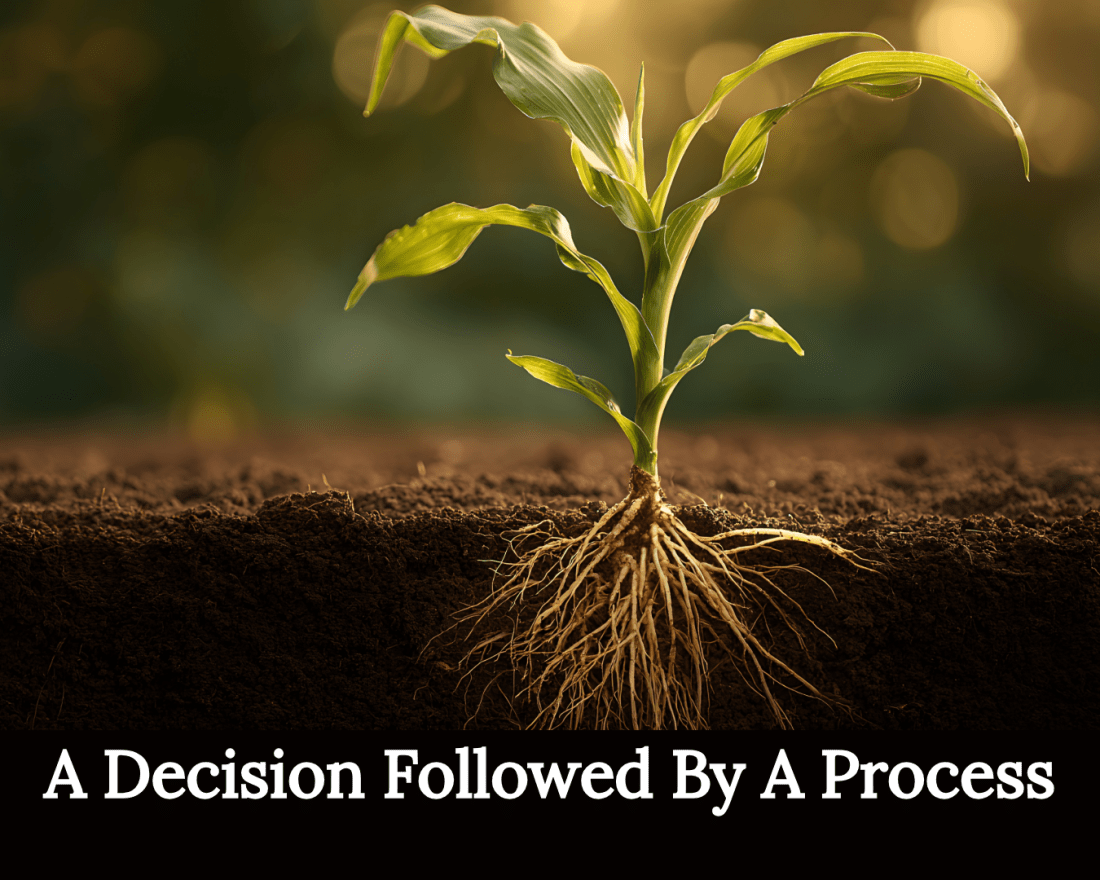
A Decision Followed By A Process

Forming New Habits

What God started in me needed action to take root.

Be made new in your hearts and in your thinking. Be that new person who was made to be like God, truly good and pleasing to him. Ephesians 4:23-24

I was reflecting on something I heard my wife say when she was sharing at a meeting. Recovery starts with a decision, but it is followed by a process. As I thought about that, I began to see how clearly it applied to my life. God set me free and delivered me from my addiction, but my behaviors did not automatically change overnight. Those behaviors had become habits, and habits do not disappear just because I had a spiritual awakening. The freedom was real, but I wanted it to be lasting. The process is what makes it stick. The decision is the planting, but doing the work is what allows it to take root. I am learning that lasting change requires a process I stay engaged with, not just a single moment I look back on.

I am realizing that renewing my mind is not a one time event. It is ongoing. It is daily. As I change how I think about situations, people, and myself, my reactions begin to change too. When I look back at times I struggled in my recovery, I can see a clear pattern. I had stepped away from the process. I was free from the substance and the behavior, but my thinking stayed the same. Without renewed thinking, old behaviors find their way back.

Working through the Twelve Steps is the process that proves the decision I made is real and has taken effect. It is the process God uses to renew my mind. The Steps gave me a way to live out that renewal in real life. Step by step, with my sponsor, I began to see myself more honestly. I took inventory of both my strengths and my defects. I faced where I had harmed others and where I was still holding onto resentment. I learned to offer forgiveness and to make amends. As I took those actions, my thinking began to change and continued to stay changed. New thoughts led to new responses, and new responses led to new habits. That is the gift of recovery for me.

Prayer
God, thank You for setting me free. Help me to always stay willing to renew my thinking each day, so that my actions continue to change and I can be the person You want me to be. I do not want to live in the past. I want to live out what You are doing in me today. Amen.