Jumping to Conclusions

When Assumption Become Facts

I did not know what happened. I just decided I did.

The first one to plead his cause seems right, until his neighbor comes and examines him. Proverbs 18:17

I have this little cloth that I put over my laptop keyboard before I close it. It keeps the oils and dirt from the keyboard from transferring onto the screen. I use my laptop every day to write, so I take especially good care of it, including that little cloth. The other night when I was shutting my laptop down to put it away, I could not find the cloth. I looked everywhere for it but could not find it. I thought for a brief minute that maybe I misplaced it, but immediately I thought, No. I always put my stuff away. So I assumed maybe the cat took it and thought it was a toy. The next morning I still could not find it. I asked my wife if she had seen it and told her I thought the cat took it. She said she hadn’t seen it, but I could have hers. I did not want hers. I wanted mine. And if I am honest, I wanted to complain about the cat taking my cloth. I had convinced myself that was what happened.

At lunchtime, when I was at work, I pulled out my laptop to do some writing. I was sitting at my desk, looked to the right, and there it was. My keyboard cloth was sitting right there in front of me. It had been there the whole time. The cat had not taken it. I had left it at work. I was glad I had found it, but then it started bothering me. Not because the cloth was a big deal. It only cost a couple dollars. What bothered me was how quickly I had made an assumption and blamed my cat. Why did I do that? Why wasn’t my first thought that I lost it or misplaced it? Actually, that thought did cross my mind, but I dismissed it immediately because I always take care of my stuff and I always put my important things away. And typically, I do. But this time I didn’t. Then I remembered that I was interrupted at lunch the day before. I had to handle a situation right away and I closed my laptop and put it away hastily.

I started thinking about how often I did that before recovery. I made assumptions. I jumped to conclusions. I decided why people did things or what they meant, and I was usually wrong. Apparently I still do it, even after years of recovery. This is where inventory helps. It forces me to look for my part instead of immediately trusting my assumptions. It doesn’t always come from a deep-seated hurt or wound from my past. Sometimes it is real simple. I had decided it could not be me, so I looked somewhere else. I did not know what happened to it. I assumed the cat took it, and then I started reacting to my assumption as if it were true. Recovery gives me another choice. I can stop, find my part, and admit when I simply do not know. That is a huge step for me. Accepting that I do not have all the answers.

And by the way, I came clean. I told my wife I found the cloth at work and I did make amends to my cat.

Reflection

What am I not seeing? What am assuming without really knowing?

He is God. I am Not

Seeing His Leading

Sometimes God’s direction looks like disappointment before I recognize that He is leading me.

A man’s mind plans his way [as he journeys through life], But the Lord directs his steps and establishes them. Proverbs 16:9

Before recovery, I wanted to seek God, but I wanted to do it on my terms. I had been hurt by church leaders and had decided I would have a relationship with God without going to church. I was willing to follow Him as long as He did not lead me back there. When I started recovery, I knew I was supposed to get a sponsor. There was one man, whom I immediately gravitated toward. He talked openly about God, and it was obvious to me that his relationship with Him was real. Here was my guy. He was someone who genuinely knew God without all the church stuff that I was trying to avoid. So, I asked him to sponsor me. He said no. I was hurt and offended. I felt just like I did when I was hurt by those church leaders. But God had something else in mind.

A few days later I showed up for one of my regular meetings only to find out it had been canceled. I desperately needed a meeting. I was lonely and honestly felt like acting out. On the way home, I saw a sign for a new recovery meeting happening that night. There was only one problem. It was at a church. Ugh. I had purposely avoided any recovery meeting held in a church. It hurt too much to even think of walking back into a church. I reluctantly walked in. A man greeted me at the door and asked what brought me there. I said, “Umm… I wanted to come to a recovery meeting.” He smiled and said, “Great. I have been waiting for you.” I could not get those words out of my mind. I listened intently when he shared, and I related to what he said. I came back the next week and asked him to sponsor me. He agreed to be my “temporary sponsor.” He was the first person I ever truly, fully trusted.

Working honestly through the steps with my sponsor, God began healing past hurts and wounds. I was able to let go of the resentments I carried toward church, and eventually I even started attending church again. More importantly, I began to feel free and clean before God again. I was no longer afraid to come before Him and be vulnerable in His presence. I had not felt that kind of freedom with God in a very long time.

I have heard people say many times in recovery that God did for them what they could not do for themselves. Looking back, I can see Him doing that for me. I chose the sponsor who fit my plan, and he said no. The meeting I planned to attend was canceled. The meeting I would never have chosen was at a church, and the man God used to change my life was waiting for me there. What I could not see then was that God had been directing my steps the whole time. I am very grateful for my sponsor. My life is truly better because of the work we have done together. I believe it would never have happened if God had not been doing for me what I could not do for myself. I am deeply thankful to Him for that.

He is God, and I am not.

Reflection

Am I still trying to seek God on my own terms? Where do I see Him moving in my life?

Barometer of Truth

Denial as Default

Just because something doesn’t make sense to me doesn’t mean it isn’t true.

Not at all! Depend on it: God keeps his word even when the whole world is lying through its teeth. Romans 3:4

For most of my life, before I joined recovery and started to actively work through the steps, I had inadvertently made myself the barometer for what was true. If something made sense to me, if it lined up with what I already knew and believed, then I would accept it. If it didn’t, I questioned it and usually found some reason to reject it. I thought I was being wise and using discernment. I was really just being arrogant and close-minded. I was relying on myself to determine truth.

Growing up in an alcoholic family, I learned that I couldn’t trust what others said. I had to determine for myself what was true. People I trusted often misspoke, made things up or simply lied, and there never seemed to be any consequences for it either. That just didn’t seem right to me. How could I ever trust someone who lied all the time? So, I learned to trust my own judgment. The problem was, I was still a child when I developed this way of determining what was true. I had limited knowledge, limited experience, and no healthy model to follow. I had to come up with my own way of figuring things out, and that became the foundation for how I judged everything. If something didn’t align with my knowledge, experience, and beliefs, I couldn’t accept it. I would reject it outright. Without realizing it, I had become the barometer for truth.

That contributed to me remaining in denial for so long. There were things about myself, the way I behaved, and what others said about me that I inherently knew were true. I wanted to change, I just didn’t know how to, so I refused to accept them as truth. If I admitted they were true then that meant I had to do something about them. But what? Instead, I told myself that was just their opinion. So denial became my default. Even though I would vehemently deny I was in denial. But the simple truth was I didn’t know how to fix it. Pretending it isn’t true and secretly hoping it would change on its own seemed like a reasonable option. That way I wouldn’t go crazy. The irony is, I had insane thinking. I just didn’t know it yet.

Working through the steps helped me with that, but honestly, “helped me” is euphemistic. Working the steps forced me to confront the truth, especially the truth about myself. With the help of my sponsor, I began to understand that I didn’t have to know how to fix something before admitting that it was true. I learned to accept reality, own my part, and trust God to show me what to do with it.

I don’t have to understand something before accepting that it could be true. I could be wrong. I could misunderstand something, which is very often the case. There are many things I don’t know, and that’s okay. My knowledge and experience are no longer the determining factor for what I am willing to accept. Before recovery, if something didn’t make sense to me, I rejected it. Today I am willing to consider that the problem wasn’t what was true. The problem was my way of thinking. I am not the barometer of truth anymore. God is. And that is the gift of recovery for me.

Prayer

God, help me to keep trusting You, for You are always truthful. Teach me to accept what is true about me, even when it’s uncomfortable and I don’t like what I see. Help me to change my thinking to become more like You. Amen.

Huge Little Thing

Sometimes it’s the little things show me just how much I have changed.

We will intuitively know how to handle situations which used to baffle us.
Alcoholics Anonymous, The Promises

The other night I showed up to umpire a game unprepared. I did not have the right uniform with me. I umpire for several different organizations, and each one has its own uniform requirements. I asked the league representative if I could work the game with the uniform I brought with me, hoping they would say yes. Instead, they asked if I had enough time to go home and change. Sadly, I did. So, I went home, changed my uniform, came back, and worked the game.

I have to admit I wasn’t especially pleased with the outcome of that conversation. It definitely was not what I wanted to do. However, I was cognizant of how differently I handled the situation than I would have in the past. I was upfront and honest. I did not try to lie or hide the fact that I was unprepared. I was vulnerable. I made my request known, and when I did not get the answer I wanted, I did not get upset. I didn’t try to manipulate or control to get my way. I accepted the answer they gave me and worked the game. Yes, I was embarrassed that I showed up unprepared. But because I did the right thing, the embarrassment slipped away. I showed up and did my job without an attitude. I maintained my emotional sobriety, and my disappointment didn’t leak onto anyone else either. And when the game was over, I had no resentments.

I felt proud of myself for the way I approached the situation. And deep down I sensed God was proud of me too. I was able to let it go. I did not dwell on it or play it over and over in my head. And that was a great gift. These little things that come up in my everyday life are huge for me because I know how I used to respond in the past. What stood out to me most was that it was not a challenge. It was not a battle. It was not something I vacillated on, and it was not a difficult decision. It wasn’t even a decision. I am so grateful for that.

Working through the steps of recovery has changed me from the inside. My responses are different. My thought process is different. My emotions are different. I am different. And that is the gift of recovery for me.

Reflection

What little things in my life show me that I am responding differently than I used to?

First Instinct

A New Heart

Being thankful even when circumstances are out of my control is how I know recovery is working in my life.

And I will give you a new heart, I will give you new and right desires, and put a new spirit within you. I will take out your stony hearts of sin and give you new hearts of love. Ezekiel 36:26

It was a sweltering hot day in the middle of a heat wave, and I had been umpiring all day. Around two o’clock, in the middle of my fourth game, it seemed like it couldn’t possibly get any hotter, but somehow it did. The game was slow and boring, and I was having a hard time staying interested and keeping my attention focused. I was exhausted and extremely hot. I felt like I could almost fall asleep standing there. I was counting the minutes until the game would finally be over. Then some large clouds drifted overhead and blocked out the sun. Almost immediately, it felt like the temperature dropped twenty degrees.

The relief felt incredible, and without even thinking about it I said, “Thank you, Lord.” I was genuinely grateful. As I was thanking God for the relief from the clouds, I quietly said, “Lord, if there could just be a breeze too, that would be amazing.” A few minutes later, a breeze picked up. I felt it moving across my sweaty skin, cooling me down even more. Once again, I thanked God. I was still hot. I was still tired. The game was still moving slowly. But now there were clouds overhead, a breeze against my skin, and I was grateful for both.

None of those circumstances were within my control. I couldn’t change the heat or make the game move faster. I couldn’t make the clouds cover the sun or cause the breeze to blow. Unpleasant circumstances didn’t just disappear when I started working recovery. They still happen. But now I get to choose what I focus on and how I will respond to what is happening around me. As I reflected on that, I realized that I was grateful for something more than the clouds and the breeze. I was grateful that my first instinct had been to thank God. There was a time when my first instinct was to look for what was wrong with everything. I could find a problem, an inconvenience, or a reason to complain without even trying.

Working through the steps has changed the way I think and what I choose to focus on. Through prayer, inventory, and deliberately looking for what is good instead of always focusing on what is wrong, my perspective has changed. I have developed a grateful heart. I didn’t have to remind myself to be grateful. I didn’t have to make myself look for something good. My first instinct was simply, “Thank you, Lord.” Gratitude had become my first instinct. And for that I’m grateful.

Prayer
God, thank You for changing my heart as I surrender to You. Help me keep choosing gratitude until it always becomes my first instinct. Amen.

Why So Much?

Taking a Closer Look

I’m realizing that I really do find what I’m looking for.

Let us look closely at our ways and examine them and then return to the LORD. Lamentations 3:40

The other day I was wondering why I always seem to have so much material to write about recovery. Almost every day I discover another lesson, another character defect, another attitude that God wants to change in me. My first thought wasn’t very encouraging. Maybe I’m still more messed up than I realize. Maybe my life is still full of turmoil. Why do I always seem to have so much material? I paused and meditated on it for a little while. I was surprised by the answer. It was pretty simple: Because I’m looking for it. At first that seemed obvious. I look for things in my everyday life that might become object lessons. But I realized there was something else going on. In my heart, I am genuinely looking for ways I can improve myself.

When I look back at the situations I’ve written about, most of them aren’t current trauma or turmoil. They’re ordinary things that happen in my everyday life. A conversation, a mistake, a disappointment, somebody’s reaction, or my own. But sometimes those ordinary situations trigger thoughts and emotions connected to trauma or turmoil from my past. Working my recovery program has helped me connect the two and recognize the cause and effect. Instead of beating myself up for what I’m feeling or how I’m thinking, I ask, Why am I feeling this way? If I can connect it to a character defect, then I surrender it to God and ask for His help. That helps me let it go. I find I’m making more discoveries and more adjustments in the moment. I don’t make as many of the same mistakes as I used to. And just as important, I don’t owe as many amends either.

It’s like I’ve developed a radar that detects things I never looked for before. That radar calls my attention to something while I still have an opportunity to address it, sometimes before it ever becomes a problem. I can keep the focus on me and remember that I’m the one who needs to change me. If I don’t like the way I’m feeling, I’m the one who needs to change my emotions. If my thinking is taking me somewhere I don’t want to go, I’m the one who needs to change the way I think. That’s not always as easy to do as it is to say, but the process itself is pretty simple. I look honestly at myself. I take an inventory. I look for my part. I admit my part. I own my part. Then I ask God to show me how to change.

God never lets me down. He always comes through with His part. And if I’m honest, most of the time there is already something inside me urging me toward what I need to do, but I sometimes suppress it or resist it. When I humble myself, become willing, and make the change, other things begin to fall into place. My emotions change. My thoughts become calm. I find peace and resolve where there might once have been chaos. Maybe I have so much to write about recovery because I’m working my recovery program. I’m looking for opportunities to grow, and because I’m looking for them, I’m finding them. That’s the gift of recovery for me.

Reflection
Am I looking for opportunities to practice recovery in my everyday life?

On The Spot

A Decision Followed by Action

I can’t change what happened in the past, but I can change what happens next.

I can do all things through Christ, because He gives me strength. Philippians 4:13

The other day I was umpiring an adult slow-pitch softball game after work. I was tired. It had been a long day, and I had not gotten much sleep the night before. Typically, there is not a lot of action and most of the calls are obvious. So, I usually do not have to move very much. However, there was a close play at third base. I called the runner out, but I was still all the way back at home plate. It was possible the fielder missed the bag, but I was not in the best position to see it. The runner was upset and said he had been safe by a couple of steps. Honestly, every player says they were safe, so I shrugged it off. But inwardly, I knew I was not in the correct position to make the call. I thought about it for a few minutes, but instead of letting my mind spin on it, I decided to change right there, on the spot.

I told myself, “I can do better. I am a better umpire than this. I am going to hustle and get into the right position. I am not going to put myself in a situation where I cannot see the play again.” I prayed and asked God to give me strength and help me do better. And He did. And then so did I. Even though I was still tired, I sensed an extra boost as soon as I began making the effort. I found that I was able to hustle, move, and get the right angle. God had given me exactly what I needed, but I still had to act on what He gave me. Before recovery, I probably would have promised myself that I would do better the next time I umpired. This time, I made the decision and immediately followed it with action. That showed me I have grown. I am not perfect, but I am making progress. I even started to have fun working again.

The lesson for me was this: I do not have to beat myself up, but I do not have to stay the same either. I can do something. I can change. I have learned in recovery that I can change my mind and do something different right then. I do not have to wait for a new game. I do not have to wait for another day. I can make a change, put it into action, and begin practicing it right there on the spot. I cannot go back and undo a past mistake, but I can learn from it and do something different so I do not keep repeating it. And that is exactly what I did. I felt better about myself afterward too. That is the gift of recovery for me.

Prayer

God, help me to recognize when I need to change and do something different. Give me the strength to do it right then. Thank you for always being faithful to help me. Amen.

Feeling Meh

Why Not Pray?

I kept waiting to feel different.
Nothing changed while I waited.
Something changed when I prayed.

Sought through prayer and meditation to improve our conscious contact with God, praying only for knowledge of His will for us and the power to carry that out. Step Eleven

I had been feeling kind of meh all week. I was a little irritable and just not quite myself. I was aware of it, and it bothered me a little, but not enough to really look at it. I had become complacent, allowing myself to be okay with not being okay. Other people seemed to notice too. Earlier in the day, someone tried to make me smile and someone else asked what was wrong because I was not smiling. Apparently, my normal is that I usually smile. Not a bad accusation. I realized that my meh attitude was leaking and my face showed it. I did not like that.

As I was driving home from work, I thought about those comments from earlier in the day. I did not want to stay meh any longer, but I did not know what to do about it. Then I had this crazy thought: Why don’t I pray? It was nothing miraculous or spiritually enlightening. I simply said, “God, help me stop feeling this way. Help me have a different attitude. Help me get my smile back.” The heavens didn’t open and angels didn’t descend on me, but almost immediately I started to feel better. The meh feeling began to dissipate. I felt at ease, and I felt a smile start to stretch across my face. I thought, I am going to have a good rest of the night. And I did.

After that, I began doing a spot inventory. Why had it taken me almost an entire week to do something about feeling off? Had I become comfortable with being complacent? Was I expecting something to change without doing anything to make it happen? That was insanity popping up again. Then I began asking myself harder questions. Why had prayer stopped being my first response? Why was I waiting until something felt off before I prayed? That is when I got honest with myself. I had to admit the truth: I had let prayer fall out of my daily routine. Missing my daily prayer time started to show, quietly surfacing in my attitude. I was irritable and uneasy, and I had lost my smile. Although I was aware of it, I did nothing to change it. I was expecting it to change on its own.

Step 11 gives me the solution: seek through prayer and meditation to improve my conscious contact with God, praying for knowledge of His will and the power to carry that out. God is the one who helped me to this point. Did I think I would suddenly be able to carry on by myself? I still need His help every day. I did not need to go back and work all the steps over again. I simply needed to recognize what had happened, correct it, and move forward. When I pray, something changes in me. I may hide things from other people or even deny them to myself, but I cannot hide them from God. Prayer brings me honestly into His presence. It humbles me and makes me willing to change. I humbled myself, asked God to help me, and He did. He met my meh with grace and mercy, and I was changed. That is the gift of recovery for me.

Prayer

God, help me make time for daily prayer. Show me when complacency tries to set in, and give me the strength to seek You even when I do not feel like it. Amen.

Letting Go

Sometimes God doesn’t just teach me through the topic of a meeting. He asks me to practice it before the meeting is over.

And the Lord’s servant must not be a man of strife: he must be kind to all, ready and able to teach: he must have patience and the ability gently to correct those who oppose his message. He must always bear in mind the possibility that God will give them a different outlook, and that they may come to know the truth.  2 Timothy 2:24-25

I attended a recovery meeting recently where the topic was letting go. The person leading opened by talking about surrendering to a higher power. They continued, saying that your higher power could be anything you wanted it to be. The group. Nature. Anything that you thought helped you. Immediately I felt myself getting edgy. And I sensed the need to defend the integrity of the program rise up inside of me. I thought “That is not what the literature says. That is not what the Twelve Steps teach.” I thought I am going to speak up so the other people in the group listening would not believe that nonsense, but instead know the truth. Hearing about that belief is what kept me from coming to recovery in the beginning. Somehow I thought it was my responsibility to set things straight. But that was the old me. I don’t act out my crazy thinking anymore.

Then it hit me. This meeting’s topic was about letting go. Why don’t I try to do that. So my next best thought was to simply leave the meeting. That way I wont cause a scene or any problems in the group. And that is when another thought entered my mind. It was a little bit firmer and direct. I know it was God. He said “Why don’t you let go of your desire to control this meeting? Let go of your desire to be right?” Instantly everything stopped. God had just given me an opportunity to practice it. I quietly chuckled to myself. The irony had not escaped me.

I quietly prayed, “Lord, help me to let go and listen. Help me get something out of this meeting.”

As I listened to others share their experience, strength, and hope, I found myself encouraged. I heard how people practiced letting go in practical ways. As I listened I realized that I was actually practicing letting go as I sat there. It was a real-life object lesson. I was a student, this was my classroom, and God was my teacher. I left the meeting grateful I was able to attend instead of resentful because some believed differently than I do.

I still believe, as the Big Book says, that there is no recovery apart from God. My convictions haven’t changed. What has changed is my understanding of what God was asking of me. He wasn’t asking me to correct others. He was asking me to surrender my own life and will to His care. I had to let go of my desire to control the meeting and trust Him to do what only He can do. The irony still makes me smile. I walked into a meeting about letting go. I assumed someone else needed the lesson, and I was the messenger. But I realized God had led me there to teach me.

I am the student.  

A Day of Discovery

I brought home a prize from the county fair. Discovering my wants mattered too.

Take delight in the LORD, and He will give you your heart’s desires. Psalm 37:4

The other day I was reflecting on my early days of recovery when one memory immediately came to mind. It was just a few months into my recovery journey. I saw the promo for the county fair and I wanted to go, so I decided to go, even if it meant going by myself. I remember driving there and sitting in my car after I parked, wondering if I should just leave and go back home. Before recovery, I never would have considered doing something like this. It wasn’t because I felt lonely or embarrassed. This was something I had chosen to do on purpose. It felt like one of those assignments that my sponsor would always give me. The only difference was this one I was giving myself. I was wondering if I could really do this recovery stuff. Could I really build a healthy life making my own right decisions?

As I walked through the fairgrounds, I meandered and drifted. I wasn’t in a hurry and I had no plan or agenda. I went wherever I wanted to go. I stopped at the exhibits that interested me. I stopped and listened to a band performing, after a few songs I moved on, even though they were still performing. In the past I would have stayed and listened to the whole set before moving on, even though I wanted to leave. I would have been concerned about what others might think about me for leaving prematurely. Not this time. Those may seem like ordinary decisions to some, but they weren’t ordinary for me. Growing up, I never got the manual on what was normal and ordinary. I was forging my own path. That day I was discovering what I liked and wanted. Then I came across a demonstration for a set of cookware. I was impressed with the presentation and quality of the product. I really wanted it, but immediately I started trying to justify why I should buy it. I remembered reading something in my recovery devotional that morning that encouraged me to do something for myself today. So I bought it.

At the time buying that cookware became a symbolic action for me. The cookware was very nice, but it was merely a representation of a day of discovery. I discovered what I liked and wanted. I gave myself permission to pursue it. The greatest gift I received that day was realizing that I could do something for myself simply because I wanted to. There was nothing wrong with thinking or feeling that way either. In fact, I learned it was actually healthy. I could make my own right decisions. Over time, as I continued working through the steps I felt empowered and confident that I could begin to trust my own decisions. I was no longer a victim worried about what other people thought of me, or even what I imagined they thought of me. I finally had permission to discover that my wants mattered and that acting on healthy wants wasn’t selfish at all. It was freeing.

Reflection

What is something I could do for myself today, just because I want to?

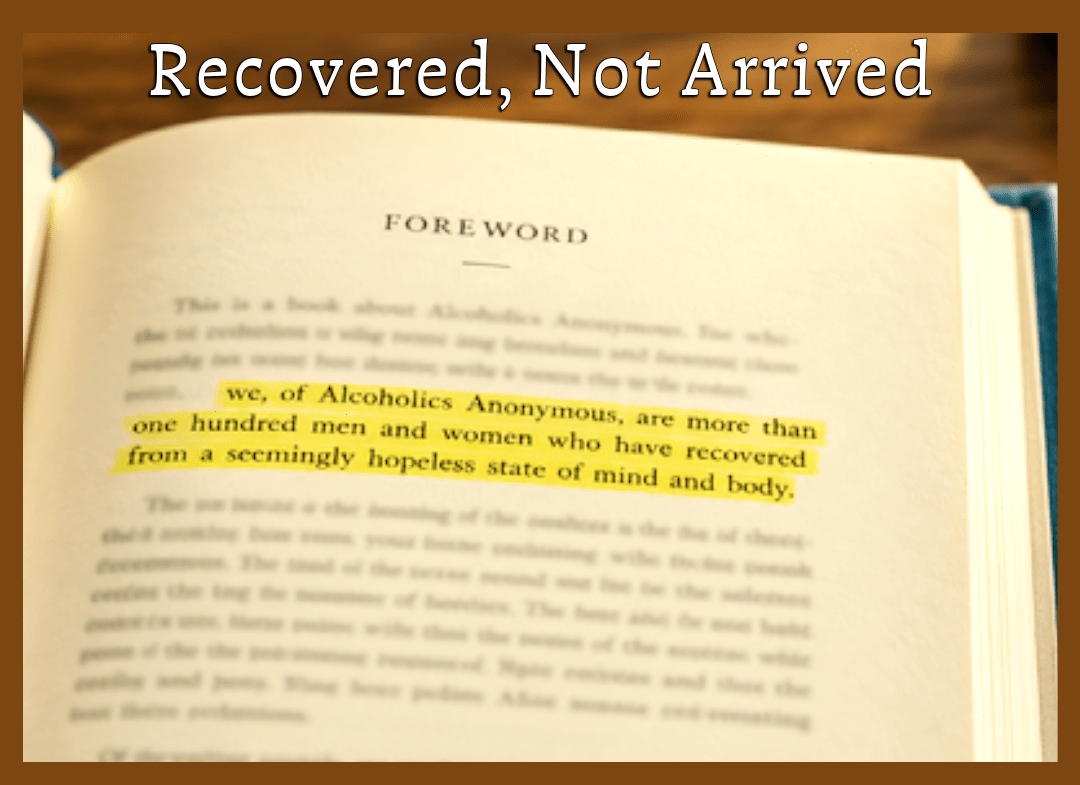
Recovered, Not Arrived

Seeking God

I am grateful that I have recovered, but transformation comes from continuing to seek God and to do His will.

“…we, of Alcoholics Anonymous, are more than one hundred men and women who have recovered from a seemingly hopeless state of mind and body.” Alcoholics Anonymous, Foreword to the First Edition

I was recently listening to a speaker talk about how the introduction to the Big Book, specifically says that we have recovered from alcohol. For whatever reason, and for a long time, I had believed the misconception that I would never be completely recovered. I have even heard people say a phrase that has become folklore and many believe it to be true.  “Once an alcoholic, always an alcoholic.” Maybe you have heard it too. I interpreted that to mean that I would always struggle and never be completely free. I thought this was the teaching of the Twelve Steps. That belief was a stumbling block for me that caused me to reject recovery for many years. I believe that God is bigger than my problems and that He would deliver and heal me completely, if He were sought. These two ideas were in conflict and created confusion for me. I could not accept the idea that there was no hope for me to ever permanently get better. I ultimately did come to recovery, not because I agreed with everything. I only came because I was in enough pain that I became willing to try something different.

So I was eager to go back to the Big Book and verify it for myself. Guess what? It really does say that we have recovered. Not just once, but repeatedly throughout the literature. I also searched for the phrase, “Once an alcoholic, always an alcoholic,” only to discover it isn’t there at all. In fact, what I found was just the opposite. When I saw that for myself, I felt relief. I felt validated. The conflict I had carried around for years suddenly disappeared. I no longer had to wonder if I would always be looking over my shoulder, waiting for it to come back. If I was always recovering, would I ever really be free? I finally saw that recovery does not oppose or contradict my beliefs. I am confident that I have recovered, but I also know that I have not arrived. I still encounter situations every day that challenge me to react. Those moments reveal areas where I still need to grow. Old ways of thinking still show up from time to time.

Recovered doesn’t mean perfected. My addiction and destructive behaviors may be gone. I am no longer living in bondage to what once controlled me. But that doesn’t mean I stop working the Steps or that I no longer seek to improve my conscious contact with God. I don’t want to settle for recovering from one malady when God wants to transform every area of my life. So I continually seek Him. It’s a lifelong journey to be relieved of the bondage of self so that I may better do His will. The freedom I thought I would never find was there all along. I found it when I surrendered to God and stopped resisting the truths He was showing me. My prayer now is that I may be able to do His will. That is the gift of recovery for me. I am recovered, I have not arrived

I do not consider myself to have “arrived”, spiritually, nor do I consider myself already perfect. But I keep going on, grasping ever more firmly that purpose for which Christ Jesus grasped me. Philippians 3:12

Why Did I Sigh?

Noticing My Reactions

The way I react is usually a clue to what’s going on inside me. It’s a good time to stop, take inventory, and ask God to show me what is really going on in my heart.

You should be looking at yourselves to make sure that you are really Christ’s. It is yourselves that you should be testing, not me… 2 Corinthians 13:5

The other day when I came home from work, my wife asked me if I had remembered to pick up our prescriptions from the pharmacy on my way home. I had forgotten. I sat down on the couch and a minute later she asked, “What’s wrong? Why are you upset?” I looked at her a little confused and said, “I’m not upset.” She said, “Then why did you sigh?” I asked, “I sighed?” “I don’t remember sighing.” She assured me I had. She thought I was frustrated with her and was being passive-aggressive. That got my attention because if that’s what she heard and thought, I needed to know why and examine my motives. That was my old manipulative behavior, so to me, that means inventory. I started asking myself some questions. Was I upset? No. Was I frustrated with my wife? No. Was I being passive-aggressive? I certainly didn’t think so. Then why did I sigh? Do I sigh so often that I don’t even notice? Is that normal for me? As I sat with it, I realized something. I do sigh a lot. Not just once in a while, but throughout the day. If I’m working on something that doesn’t go right, I sigh. If I forget something, I sigh. If I make a mistake, I sigh. I came to the conclusion that yes, I am a sigher, if that’s even a word. I still didn’t have an answer as to why I sighed though. So I decided to do a little research on why people sigh and what it may mean. What I discovered was enlightening, but not necessarily surprising.

I discovered people sigh for all kinds of reasons. Sometimes it’s passive-aggressive when directed toward others. Sometimes it’s anxiety. Sometimes it’s emotional suppression. Sometimes it’s perfectionism. I saw a pattern that I related to. I didn’t usually sigh because someone else had upset me. I sighed because I was disappointed with myself. If I forgot something. If I made a mistake. If something didn’t go as I had planned. I would sigh out of frustration. I would think, “You could have done better.” It wasn’t anyone else saying it. It was me. My sigh wasn’t directed at anyone else. It was the sound of carrying the weight of not measuring up. I knew I was hard on myself, that wasn’t new. What I hadn’t realized was how often my body was expressing feelings I was not cognizant of. I started reflecting on what I was thinking and feeling right before I sighed. I realized my disappointment wasn’t really about forgetting something or making a mistake. Those were just the triggers. Underneath them was something much deeper. It was that old feeling that I am not good enough. I was subconsciously putting pressure on myself. And when I failed to meet my own unrealistic expectations of being perfect, I would sigh.

In recovery, I have learned this is what my sponsor calls a corrupt core belief of “I am bad.” Growing up, I learned to measure myself by how well I performed. If I could do things right, keep people happy, and not make mistakes, then maybe I would be good enough to not get in trouble. Living that way is exhausting. I never saw that before recovery. Instead of asking, “Why can’t I get this right?” I ask a different question. “What am I feeling right now? What am I believing about myself?” God has never asked me to earn His love and acceptance by being perfect. He simply asks me to trust Him, admit when I’m wrong, and make amends when necessary.

Now when I catch myself sighing, I pause. Instead of ignoring it, I pray and ask God for help. I do a spot-check inventory. I ask myself, “What am I feeling right now? What am I believing about myself?” If I uncover a lie, I ask God to help me surrender it. Then I ask Him to help me accept that I am enough even when I don’t feel that way. And that is the gift of recovery for me.

Prayer

God, help me pay attention to what is really going on in my heart. Show me the lies I still believe about myself. Give me the courage to let them go. Remind me that Your truth is greater than my feelings. Help me accept that I am enough. Amen

Fighting Ghosts

Uncovering Yesterday’s Wounds

One of the gifts of inventory is discovering that my reactions aren’t always about what’s happening right now. Sometimes I’m still in a battle with a ghost from long ago.

So I run with a purpose in every step. I am not just shadowboxing. 1 Corinthians 9:26

The other night I was umpiring an adult softball game. Around here they call it a “beer league” because most of the players drink while they play. For the most part it is just a bunch of adults having fun, playing ball, and enjoying themselves. Occasionally, though, someone drinks too much. One of the players was clearly drunk and being loud, boisterous, and passive aggressive throughout the game. After the game he walked up to me on the field and said, “You know I’m just joking with you. You don’t need to take it seriously. You know I’m…” Before he could finish, I interrupted him and said, “Drunk.” His demeanor changed immediately. He became confrontational. Then I followed it up with, “I’m sorry, was that supposed to be a secret?” It was pure sarcasm. As soon as the words came out of my mouth, I knew I had crossed the line. I wanted to apologize and I did, but I don’t think he’ll even remember, but I will.

On the drive home I did a step 10 inventory. I asked myself a few questions. Why did I say that? Why did I act that way? Why did I want to call him out and embarrass him? My sponsor has taught me that when I have a reaction, there is usually something more underneath it. So, I stayed with this and as I thought about it, I remembered another incident from years ago before recovery. I was traveling to a convention for work. A coworker showed up at the airport drunk and got even more drunk at the airport bar before a flight. He became loud, obnoxious, and completely unaware of how he was acting. He had shared he was terrified of flying. Instead of showing him grace, I took advantage of the situation. I encouraged him to be even louder and more obnoxious. I encouraged him to make a fool of himself and laughed at him as he did. It was the same feeling. The same reaction. As I sat with it, I asked what was I feeling? What was I getting out of this? I was taken back to when I was a child. Growing up, the alcoholic in my life was very different when he drank. When he was drunk, there was anger, humiliation, fear, and a feeling of powerlessness. Then I saw it. Part of me still wants to fight back. The problem is, I am fighting a ghost. I am unleashing my anger on people who were never responsible for my pain. When I encounter a drunk person today who is being loud and obnoxious, that little boy in me still wants to expose them, embarrass them, and take back the power he never had. He still wants to punish them and make them feel what he once felt.

What surfaced when I did my inventory was this: the softball player is responsible for his behavior and I am responsible for mine. I need to stop focusing on the other person’s actions and examine my own. Instead of justifying my meanness and sarcasm, I have learned to ask why it was there in the first place. What I uncovered that day is just another layer of anger, fear, and pain that I did not know was still there. I’m grateful that inventory helps me find my part. It helps me uncover hurts and pains from my past that are still influencing me today. Once they’re uncovered, I can surrender them to God and ask Him to continue healing them. As I continue doing my part, God faithfully does His. He renews my thinking, heals old wounds, and helps me respond differently than I did before. That is the gift of recovery for me.

Prayer

Father, thank You for showing me another layer of what is really going on inside me. Help me to stop fighting ghosts and taking my pain out on people who didn’t cause it. Give me the courage to keep taking my own inventory, to own my part, and the willingness to let You heal what I cannot. Amen.

Choosing On Purpose

I Don’t Have To Wait

I am not limited to merely reacting. I can choose on purpose how I respond.

I call heaven and earth as witnesses against you today that I have offered you life or death, blessings or curses. Choose life so that you and your descendants will live. Deuteronomy 30:19

I umpired a softball tournament this past weekend. It was hot and dry. I had nine games to umpire. One specific game was in the heat of the day. It was midday, the hottest part of the day and it was a boring game. I was bored because there was not much action, not a lot of hitting and poor pitching.

One of the things I enjoy about umpiring girls’ softball is the atmosphere. The girls sing their chants, the teams play music between innings and they have walk-up songs when they come to bat. It’s just a different environment. Standing there in the heat during this slow game, I remembered something I have learned in recovery. If something works, I can choose to do it whenever I want. I may not be able to control the circumstances, but I can choose how I respond to them. So I decided I was going to have some fun. I started dancing and singing along with the music. The fans started chanting, “Go Blue! Go Blue!” The crowd got a little louder and a little more engaged. The players started laughing and giggling and dancing too.  I’m sure part of it was because I’m such a terrible dancer.

What struck me in that moment was how simple the decision was. Nothing about the game had changed. It was still hot. It was still slow. It was still the middle of the afternoon. The circumstances were exactly the same. The only thing that changed was me. For years I wasted too much time waiting for circumstances to improve before I allowed myself to enjoy something. I would wait for the stress to go away, the problem to be solved, or the situation to get better. I am learning that I don’t have to wait for things to improve before I decide to enjoy where I am. I don’t have to wait for an invitation or be told to do it. I can choose to have fun and be happy if I want to, regardless of the circumstances and situation.

The game eventually picked up. The teams started hitting, the pitching got better and the game became exciting. Then a nice breeze came through and brought relief from that dry heat. It felt amazing. I’m not saying those things all happened because I started dancing to the music. But I’m not saying they didn’t either. What I am saying is that life doesn’t have to be put on hold until everything is perfect. I am not limited to merely reacting. I can choose on purpose how I respond, even if that means having a little fun right in the middle of unpleasant circumstances. When I can do that, I am choosing life. I am choosing to live life. And it is surprising how often the circumstances seem to change when I choose to be alive in the moment.

Prayer

God, thank You for giving me life. Help me choose to live this life and enjoy it to its fullest each day. Teach me how to be fully present wherever my feet are. Amen.

Liking Me Too

An Unexpected Gift

The gift of recovery for me is realizing that I am still growing, healing, and changing, even after all these years.

I’m not saying that I have this all together, that I have it made. But I am well on my way, reaching out for Christ, who has so wondrously reached out for me. Philippians 3:12

At work recently, I sent a client a firm letter regarding an unpaid invoice. The bill was more than sixty days overdue, and the letter was our standard notice before sending an account to collections. The client happened to be a very good, regular client and close friends with one of our employees, so I casually asked if they knew whether there was a problem. It just didn’t seem like something this client would do. The employee shrugged and said, “How should I know?” Immediately, I felt bad. I thought I crossed a line for asking, so I apologized. I explained that it just seemed out of character for this client not to pay their bill. The employee then mentioned that they vaguely remembered the client making a payment when they first came in, but there was an adjustment to their invoice. That prompted me to do some digging. Sure enough, I discovered we had received the payment when they first came in, but it had never been applied to their invoice. The mistake was ours.

I corrected the account, applied the payment, and sent the client a receipt along with a brief email apology. Several days later the client came into the office. When I saw them, I walked over, explained what had happened, and apologized for the error. The client was gracious and seemed completely unbothered by the whole thing. Later that day, that same employee came up to me and said, “Thank you.” I smiled and asked, “For what?” She replied, “For being you. I really like the new you.” I thanked her and walked away, but her words stayed with me.

As I walked away, I felt something new rise up. The only way I could describe it is that I felt proud of myself. Not in an arrogant way, but in a healthy way. I felt grateful. Hopeful. Encouraged. Her words meant so much to me. The changes happening in me were obvious enough that someone else noticed without me pointing it out. I was happy. I was glad. I wasn’t just happy and glad that someone noticed. But the fact that someone else noticed meant these changes are real and not just imagined. I’m not thinking that things are different when they really aren’t. That was my old life. That was that denial self. This was different. It was tangible. Here is what is so cool and what I am grateful for. I have been practicing recovery for nineteen years. I am not the same person I was when I first walked into the rooms. God has changed so many things in my life over the years. Yet what struck me was that even now, after all this time, I am still growing and changing. Recovery is still working. God is still working on me.

Practicing the principles of recovery helps me see things I could never see on my own. Sometimes those discoveries come through inventory, prayer, journaling, or conversations with my sponsor. Other times they come through an unexpected comment from someone else. I just received an unexpected gift. Someone noticed the evidence of God’s work in my life. Their words reminded me that God is still helping me change. Just like He has been doing every day since I began this journey. I have not arrived or graduated from recovery. He is still changing me from the inside out. I am no longer the old man I used to be. I am becoming the man I always wanted to be. Today I can honestly say that I like the new me too.  

Reflection

What evidence of God’s work in your life can you see today that you may not have recognized before?