Suddenly Important

Asking Myself Why

The gift isn’t that I never get hurt. The gift is that I recognize it sooner and ask myself, “Why did it bother me?”

We are all in love with our own opinions, convinced they’re correct. But the Lord is in the midst of us, testing and probing our every motive. Proverbs 16:2

The other day I logged on to Facebook and noticed that someone I know and care about deeply had made several comments on the posts of a few mutual friends. Almost immediately, a thought crept into my mind. “Why don’t they ever comment on my posts? I write all the time.” I began entertaining that thought and having a full two-way conversation in my head. Before long, I felt hurt and offended. I found myself replaying old hurts and creating stories in my head. As I sat there thinking about it, I suddenly became aware that I was going down a rabbit hole. I knew where those thoughts would take me if I let them go unchecked. It was an old familiar place I had worked hard to leave behind. Then I asked myself, why was this person’s approval suddenly so important to me? It wasn’t important five minutes ago. It only became important after I saw their comments on someone else’s post.

One of the gifts I have received from working a 12 Step recovery program is learning to pay attention to what is happening inside of me. Instead of focusing on the other person, I have learned to ask myself why I am feeling or reacting the way I am. When I looked honestly at what was going on, I realized I was seeking approval. And I was seeking it from someone who either couldn’t or wouldn’t give it to me. Somehow, I had attached my sense of worth to receiving that approval. When I can recognize that, things begin to change. I stop focusing on what the other person is doing and start looking at what is happening inside of me. The issue is no longer their comments, their behavior, or their choices. The issue is my hurt feelings, my need for approval, and the old wound that has been triggered. What I was thinking and feeling was all about me being affected by my old wounds. It wasn’t about what the other person did or didn’t do. It’s my responsibility to deal with what is happening inside of me. I am not a victim. I have choices.

I once heard someone say that I cannot stop birds from flying over my head, but I can stop them from building a nest in my hair. The same is true of thoughts and feelings. I cannot always stop them from showing up, but I do not have to let them take up permanent residence. I have a choice about what I do with them once they arrive. Today, when I feel hurt, I try not to just push it away or pretend it’s not there. Instead, I acknowledge it, feel it, and ask myself why it is there. If I discover that a character defect, fear, expectation, or old wound has been uncovered, I don’t ignore it. I embrace it and try to find out what I can learn about myself and how I can grow. It is not that I never get hurt anymore. I am now able to recognize it sooner. I get to my part quicker. The hurt does not hurt as much as it once did, and sometimes it does not hurt at all. I am learning that most people are not trying to hurt me. They are simply living their lives, and sometimes I get hurt by their actions. When that happens, I now have a process. I write about it and take inventory. This helps me change my perspective. I ask God for help and surrender outcomes to Him. I am no longer responsible for the universe, He is. When I can do that, I sense His presence and His peace soon follows. That is the gift of recovery for me.

Reflection

Has something recently caused an emotional reaction you weren’t expecting? What might be underneath that reaction?

What Do I Want?

What Stays And What Goes

Growth isn’t always about fixing what is broken. Sometimes it’s about letting go of things that no longer belong.

But you, change the way you were living. The person you used to be will ruin you through desires that deceive you. Have a new attitude. Ephesians 4:22-23

I was listening to someone share recently about their house being flooded. After the water receded, people started calling and asking what they could do to help. One friend asked, “What do you need?” The homeowner responded, “The first thing I need to do is take inventory and assess the damage.” When he said that I knew instantly what he meant. He went on to explain that before he could do anything, he first had to figure out what was there. What was still good and what was ruined. What could be saved and what needed to be replaced. What he wanted to keep and what he wanted to get rid of. There might even be things that survived the flood just fine. Things he no longer wanted. And there were new things he wanted.

As I listened, something clicked for me. I have taken inventories in recovery for years. Usually when I think about taking an inventory, I think about answering Fourth Step questions. Those questions have helped me uncover resentments, fears, unhealthy patterns, and character defects that I could not see on my own. I knew what an inventory was. I had taken inventories at work and in recovery for years. But somehow, I had gotten stuck thinking that answering the questions was the inventory. I would answer the questions, share them with my sponsor, and gain insight in the process. What I suddenly realized was that the questions were never the inventory. They were tools that helped me break through denial and see what was already there. The inventory was always just an honest assessment of myself.

As I thought about that flooded house, I realized that is exactly what I am doing when I take inventory of my life. There are things God has been building in me over the years that I am grateful for and want to keep. There are also things I am still working on that need attention and repair. There are also things that I no longer want. Things like my need to control people and outcomes. My tendency to become defensive when I feel threatened. The walls I built to protect myself from being hurt. Those things may have helped me survive at one point in my life, but they no longer belong. Then there are qualities I want more of, like patience, humility, trust, compassion, and acceptance.

The gift I received from this story was the realization that even though some things survived the flood just fine, the homeowner no longer wanted them. It dawned on me that the same thing is true in my life. Some of the attitudes and behaviors that helped me survive no longer belong in the person I want to be. Today, when I take inventory, I am not just looking for what is broken and damaged. I am also looking for what no longer belongs and what I want in my life instead.

Reflection

What is one quality or character trait you would like more of in your life today?

A Trust Problem

Feeling Safe

My need to control uncovered a truth I was blind to. I didn’t trust God or the people who love me.

Whenever I am afraid, I will trust in You. Psalm 56:3

I was listening to a speaker and started meditating on what she said. She shared that one of the reasons she argued in relationships was because she felt out of control. As soon as I heard that, I knew that was me. It was almost like I could finish what she was saying without ever hearing it. I felt like there was a huge spotlight shining on me and God was saying “This is you pal.” I realized that my first reaction in conflict was to defend and argue my position and beliefs. And I know it was because I felt out of control. As I meditated on it more and thought back on my relationships, I realized that my initial reaction when I feel out of control was always to fight. I felt attacked and would immediately defend myself and argue my position because being in control made me feel safe.

Quite honestly this became a huge problem in my marriage. A few years back, my relationship with my wife wasn’t the greatest. Our communication was suffering. We loved each other very much, but we argued a lot. We both love God. We’re both in recovery. We were both trying to do our best. We would pray about our problems and sincerely want things to be different, but somehow we would find ourselves having the same arguments over and over again. Many of the arguments were over stupid things too, that really didn’t matter. Then those little things would turn into “a thing” themselves. It was insane. I would get frustrated and honestly couldn’t understand why we kept getting stuck repeating the same pattern. Last year, I decided to start applying some recovery principles to my marriage more intentionally. One of those principles was simply considering the possibility exists that my wife could be right. Another was accepting things as they are instead of insisting they be the way I wanted them to be. Many times that meant keeping my mouth shut and listening instead of immediately responding, defending myself, or acting like a victim. The results were remarkable. Our relationship improved dramatically. We argued less, enjoyed each other more, and experienced a level of peace that had been missing for a while. Secretly, I thought it was because I was being “recovery man” and I patted myself on the back, because in my mind I was working my recovery. Is that pride? Yes! I am embarrassed to admit I thought this way, but I am just being honest. I was told early on that true healing comes from being completely honest.

Initially, I made those changes because I wanted peace in my relationship and didn’t want to argue. I was practicing recovery principles, keeping my mouth shut more often, and trying not to react. In my mind, that was why things were getting better. And there is some truth to that. But as I reflected on what the speaker said, I began to see something I had missed. One of the recovery principles I was trying to practice was considering the possibility exists that my wife could be right. But it was only an intellectual acknowledgement, because I never really considered that she might actually be right about me. For years she told me that I wasn’t taking responsibility for my part in our conflicts. I heard her words, but I mostly dismissed them as her trying to work my program. I would apologize and not give it another thought, and secretly continue believing that the real problem was not me.

As I got honest with myself, I began to see that my need to defend myself and argue wasn’t really about being right at all. It was about trust. When I felt out of control, I felt unsafe, and when I felt unsafe, I tried to regain control by defending my position and convincing others to see things my way. What I am learning now is that I don’t have to do that. I can trust God. I can trust that the people who love me are not my enemies. I don’t have to prove my point or win every disagreement to feel safe. I can listen. I can consider that someone else might really be right, even about me. The more I learn to trust, the less I feel the need to control. And the less I try to control, the more peace I experience in my life, my marriage, and my relationships. What I once thought was a communication problem seems to really be a trust problem, and learning to trust is bringing a freedom I never found through arguing, defending, or trying to be right. And that is the gift of recovery for me.

Prayer

Father, thank You for showing me that I don’t always have to defend myself. Help me let go of the need to be in control. Teach me how to trust You when I am afraid, and to trust those who love me. Amen.

Rethinking Love

What Love Looks Like

Just because something is true doesn’t mean it needs to be said. Sometimes love listens quietly as someone tells their story.

Knowledge puffs up while love builds up. 1 Corinthians 8:1

Recently I was reading through Recovery: A Guide for Adult Children of Alcoholics. One section that jumped out to me was talking about not beating ourselves up for the ways we learned to love and relate to other people. It wasn’t offering an excuse for unhealthy behavior. It was offering hope. It said that if I learned unhealthy behaviors as a child, I could also learn to replace those with healthy ones. As I started thinking about that, it led me to ask myself a few questions. Where did I learn how to love? How do I know what love looks like? How will I know if I am giving love and receiving love?

As I explored those questions, I finally started to see where my behaviors came from. For years I even dismissed my behaviors by saying, “That’s just the way I am.” Somehow, in my mind, that justified being dismissive, passive-aggressive, condescending, sarcastic, or critical. The confusing thing is that inwardly I really wanted to be caring, compassionate, and loving. Many times I honestly thought I was helping people. I would tell them what they needed to do, explain how they could fix their situation, or quote a scripture verse that applied to what they were going through. I’m not saying the advice was always wrong or that the scripture didn’t apply. But just because something is true doesn’t mean the way I delivered it was compassionate, or that it needed to be said at all. I was sharing from knowledge and not from experience. Then a Bible verse came to mind. Knowledge puffs up, but love builds up. That stopped me. I realized that I wasn’t always sharing because people needed to hear what I had to say. Sometimes I was sharing because it made me feel important to have the answer. It made me feel loved.

Looking back, I don’t think my parents were trying to hurt me. I believe they loved me and wanted what was best for me. They did the best they knew how. They had their own struggles, and I cannot tell their story, but they were probably just passing on many of the things they learned growing up too. What I can say though, is that much of the attention I received as a child was critical, corrective, and often punitive. Like all human beings, I craved love. I began to associate correction, the attention I received, with love. I learned that pointing out what was wrong with people was how you showed that you cared. Because that was the kind of attention I received most often, I began to interpret correction itself as love. Since that was what I experienced, it became how I practiced love.

Today I am glad that I am learning how to love in healthy ways. By practicing the principles of recovery I can accept that love looks different than I thought it did. Love doesn’t always have all the answers. Love doesn’t always correct others. Love doesn’t always point out what is wrong. Sometimes love just accepts people where they are. Sometimes love simply listens quietly as someone tells their story. I still sense myself wanting to correct others or give them advice. The difference is that now I see it. I have a choice. Every day gives me another opportunity to practice a healthier way of loving others. And when I do that I find that I am often the recipient of that same kind of love and acceptance. And that is the greatest gift recovery has ever given me.

Prayer

Father, thank You for not giving up on me. Thank You for teaching me how to love in healthier ways. Thank You for helping me see things I could not see before. Slow me down so I can listen and accept people where they are. Help me to show compassion instead of criticism. Thank You for the love and acceptance I have received from You and in the rooms of recovery. Amen.

Not Me Anymore

A Noticeable Change

One of the things I’m learning in recovery is that having an off day does not mean I am back to being the old person I used to be.

My dear brothers and sisters, always be willing to listen and slow to speak and slow to become angry. James 1:19

The other day at work, I was having an off day. I was short with people, snippy, and clearly frustrated. We were running behind, and I was trying to figure out why. I walked into the hallway and saw two employees standing there. I asked them what their roles were for the day. They started explaining why things were behind, but I interrupted them and said quickly, “I just want to know your role today.” They answered, and I walked away frustrated. A few moments later I asked another employee the same question. She looked at me and said, “I haven’t seen you in a while. You don’t talk to us that way anymore.” The moment she said it, I knew instantly that she was right. I stopped, took a breath, changed my tone, and said, “You’re right. I’m sorry.” Then I calmly asked her what was going on, and she explained the situation to me.

As I walked back down the hallway, one of the other employees stopped me and said, “I didn’t appreciate you snapping at us like that. We didn’t deserve it.” Before recovery, I would have gotten defensive. I would have justified my attitude or blamed stress or pressure. Instead, I paused and listened. I looked at her and said, “You’re right. I was wrong. You didn’t deserve that. Please forgive me.” She smiled and said, “No problem. I figured you were just having a bad day. That’s normally not like you.” Honestly, that one comment meant more to me than she probably realized. It showed me that growth is happening in my life. Not because I never have bad moments anymore, but because those moments are no longer who I am. There is a noticeable change that I wasn’t trying to force. It just is happening. Trusting the recovery process really works.

I walked away from that conversation genuinely grateful. Grateful that people felt safe enough to confront me honestly. Grateful that I was able to hear it without shutting down or lashing out. Grateful that I could admit I was wrong and immediately make it right. But more than anything, I was grateful that my behavior stood out as unusual instead of normal. Recovery is not making me perfect. I still have off days just like everyone else. But today those moments are the exception instead of the norm. I am finally becoming the kind of person I had always hoped to be. And that is the gift of recovery for me.

Prayer

Father, thank You for the changes You are making in me day by day. Thank You that I no longer have to react the way I used to. Help me to stay teachable, honest, and willing to listen when I am wrong. Remind me to slow down and show grace to others. Continue shaping me into the person You want me to be. Amen.

Accepting Life As It Is

Surrendering Control

I’m learning that peace is not found in controlling everything around me. It is found in learning to trust God in the uncertainty.

Father, if you are willing, take this cup away from me. However, not my will but your will be done. Matthew 26:39

I have two grown children whom I love very much. Unfortunately, they both live in another state, so I don’t get to see them as often as I would like. We talk a couple times a week, usually through text messages, and most of the time I am the one who initiates the conversation. Before recovery, that would have really bothered me. My thinking was very all or nothing. “If they won’t call me, then I won’t call them.” Or, “Why do I always have to be the one reaching out?” But through recovery I am learning to accept relationships as they are instead of demanding they happen on my terms. I am learning to stop rejecting people simply because things are not happening the way I want them to happen. That is what my sponsor says is learning to live in the gray. It is somewhere in between the all or nothing thinking that used to consume me.

Before recovery, I saw almost everything as black and white. Things were either right or wrong. Good or bad. Safe or unsafe. I liked certainty because certainty felt safe to me. If something fit neatly into a category, then I knew how to respond to it. I knew how to control it. Or at least I could plan and be ready in case things didn’t go as planned. It made me feel safe. But life rarely works that way. People are complicated. Relationships are complicated. Emotions are complicated. Things don’t always go as planned. Doing a fearless moral inventory has forced me to start facing the uncomfortable truth that much of life happens somewhere in the gray.

The gray makes me uncomfortable because I don’t know what will happen. I don’t know how to protect myself. I don’t know how to be prepared for or avoid potentially being hurt. Accepting the gray requires trust. It requires patience. It requires me to accept uncertainty instead of rushing to fix it or force it into a category that makes me feel better. Which I now do, although usually reluctantly. One of the things I have discovered through step work with my sponsor is that many times my attempts to “help” or “fix” people were not as selfless as I made them out to be. A lot of it was driven by my own need to feel in control. If I could manipulate and control the situation, calm the conflict, or get the outcome I wanted, it gave me relief. What I have learned since is that my need for control was really giving a dopamine release in my brain. That release temporarily soothed my anxiety and discomfort. It made me feel better, so I sought to feel better again. It was my addiction. I was trying to feel better by managing everyone and everything around me. That realization was hard for me to admit, but by staying honest with myself in my recovery I am learning to face my motives realistically instead of staying in denial about them.

Working through the steps has helped me realize that emotional sobriety or behavioral change is not found in controlling everything around me. It is found in learning how to live honestly, peacefully, and faithfully even when things feel uncertain. I still do not like the gray. I do not like not knowing what is going to happen. I do not like feeling unprepared or out of control. But I am learning how to accept being uncomfortable instead of trying to escape it. I am learning that as I relinquish control God is present in the gray ready to help. And strangely enough, by accepting the gray areas of life, I can now see and appreciate the vibrant areas of life that are full of color, depth and complexity. And that is the gift of recovery for me.

Prayer

Father, help me to stop fighting reality and demanding that life happen on my terms. Teach me to surrender the gray areas of my life to You. Help me to stop trying to control everything around me. Help me to trust You when I feel uncertain, uncomfortable, or afraid. Amen.

Learning How to Be There

Presence Over Control

I’m learning through my recovery that sometimes the most loving thing I can do is to stop trying to fix people and just be there with them.

Be happy with those who are happy. Be sad with those who are sad. Romans 12:15

I’ve heard it said that recovery is a selfish program. And honestly, it is. In the rooms of recovery I have learned that I need to start taking care of myself. Really taking care of myself. My whole self. Taking responsibility for my actions and facing my own issues. I had to learn that I needed to put on my own oxygen mask before trying to help everyone else with theirs. Before recovery, I was always trying to help everyone else get their oxygen while I was suffocating myself and could not breathe. I rarely focused on facing my own needs or healing. I focused almost entirely on what everybody else wanted, needed, or expected from me. Or at least what I thought they did. But I am learning that if I don’t take care of myself emotionally, mentally, and spiritually, I won’t have anything healthy to offer anybody else.

Somewhere along the way, I got part of that mixed up. My wife recently had surgery, and leading up to it, I wasn’t as supportive as I could have been. I meant to be and wanted to be, but I reverted to old behavior. I kept focusing on trying to help her “not be afraid.” I wanted to fix the fear she was feeling instead of simply recognizing that fear before surgery is normal. It’s human. Instead of just sitting with her in it, reassuring her, and being present, I kept trying to move her away from what she was feeling.

In recovery I am learning that sometimes people just need support, reassurance, and comfort. Sometimes they just need someone to be there. Sometimes they may need help that I actually have the ability and capacity to give. I have learned to stop trying to fix everybody else. If I want to fix anyone, I need to focus on fixing me. I can help without fixing or being in control. I can help even if things are not done my way. I can help by just being there and letting people be who they are. I am learning, slowly, that it is healthy to still care deeply about others even when I am unsure of outcomes. And that by doing that, I am taking care of myself too.

I am grateful and thankful for my recovery program and the tools I have learned. Fortunately, by using them, I was able to correct my behavior and do just that on the day of the surgery. I was supportive. I acknowledged the fear. We prayed about it together. I assured her she was not alone in this, not just with my words but with my presence. I was just there with her, and I let her guide the emotions and conversation instead of trying to control or redirect them. I truly felt supportive, like I was showing real compassion and care. I was showing her that she was important. In short, I was showing her love.

Working through the steps of recovery, I am learning that taking care of myself is important. But healthy recovery is not becoming emotionally distant from the people I love. Sometimes the people I love are afraid. Sometimes they are hurting. Sometimes they don’t need me to fix their emotions or talk them out of them. Sometimes they just need me to sit with them, care about what they’re feeling, and let them know they are not alone. That’s something I am learning a little more every day. And that is the gift of recovery for me.

Prayer

God, thank You for teaching me how to care for myself in healthy ways without becoming distant from the people I love. Help me to stop trying to control or fix everyone around me. Teach me how to be there and listen. Amen.

At Peace With Myself

I spent years trying to escape my thoughts. Recovery taught me how to face them honestly


You will keep him in perfect peace, whose mind is stayed on You, because he trusts in You. Isaiah 26:3

The topic at a meeting I attended recently was simple: “What do I feel when I’m alone?” As I listened to others share and thought about the question, I realized that I had spent most of my life trying not to answer that question. I stayed busy all the time, always doing something. Working, studying, reading, watching TV, playing video games, just going somewhere, anywhere. I consciously kept my mind busy and active so that I didn’t have to be alone with my thoughts and deal with my feelings. I didn’t have to think about how I felt. I didn’t have to feel “those” feelings. Because if ever I was alone and quiet, then the reality of what was really happening in my life would slap me in the face. And I just couldn’t face it. Really, I didn’t know how. My best thinking came up with this idea. I would literally exhaust myself on purpose until my body finally gave out and I fell asleep doing whatever it was I was still doing. Staying up as long as I could, until the wee hours of the morning, until I could no longer physically keep my eyes open or stay awake any longer. Then when I came to, usually around two or three in the morning, I would crawl myself into bed. It was the only way I could sleep. Because if I went to bed at a normal time, I would lay there alone with my thoughts. I would never fall asleep. My thoughts and feelings would haunt me, because I had no solution and no answer. I could find no way of escape. I never just sat quietly alone with my own thoughts. It was overwhelming. So, I avoided being alone. I was afraid. Scared. Hopeless.

I was trapped inside my own thoughts and emotions. This was a lie that I didn’t realize I was living. I thought by avoiding those thoughts and feelings, I was protecting myself, but what I was really doing was keeping myself trapped. Stuck in a world of denial and escapism. I just kept kicking that can down the road. Hoping that one day I would suddenly wake up and be all better. One day turned into years, decades and a lifetime of frustration and resentment. Until one day things did finally change, just not how I expected. There was nothing magical about it though. The pain finally got bad enough that I did something different. I went to a recovery meeting. I heard others share their experiences and in their stories it sounded like they were talking about me and how I felt. I felt like I was no longer alone. There was someone else who understood. Hope began to appear inside of me.

One of the things that helped me a lot in those early days was a simple little bookmark that I read every single day. It said: “Just for today I will have a quiet half hour all by myself and relax. During this half hour, I will try to get a better perspective of my life.” In the beginning, spending 30 minutes quiet and alone was a daunting task. I couldn’t do it. But I could do 5 minutes, then 10, then 20 and eventually 30. I grew to where sometimes I could even do more. Such a gift. Little by little, recovery taught me how to sit still without running from my thoughts and my feelings. I was really running from myself. Today, I cherish my quiet times and I actually look forward to them. They are no longer filled with fear and torment. They have become a place of solace for me. It’s where I get centered. It’s where I find peace, clarity, and perspective. Recovery taught me that being alone and being lonely are not the same thing. And that is the gift of recovery for me.

Prayer
Father, thank You that I no longer have to run from my thoughts and feelings. Thank You for the peace and freedom You have brought into my life through recovery. Help me continue to remain honest with myself and with You. Thank You for helping me feel safe. Amen.

Where Do I See God Today?

His Gentle Whisper

I am noticing that God is often working in the small daily moments I usually overlook.

And after the fire came the sound of a gentle whisper. 1 Kings 19:12

Recently my sponsor gave me an assignment that stumped me. Sponsors have a way of doing that, don’t they? He said he wanted me to answer a question. It seemed easy enough. The question was, “Where do you see God in your life today?” At first, I thought that was a simple question for me to answer and would be really quick. I have a close relationship with God. No problem. But when I sat down to actually think about it and write my answer, I got stuck. I think I was expecting some kind of deep spiritual answer. Something dramatic. Some big breakthrough moment or miracle story. Instead, I sat with that question for several days, praying and really thinking about it. Where do I see God in my life today?

My answer surprised me. I wasn’t seeing Him so much in the outward dramatic things. I was seeing Him inwardly, in the small changes happening inside of me. I see Him in my morning routine. In reading recovery literature and my devotional. In listening to recovery messages on my way to work. I see Him through the people who encourage me. And I see Him in the quiet moments where I just pause and think. It reminded me of Elijah in the cave when God showed him His voice wasn’t in the earthquake, the fire, or the wind, but in the still small voice. That’s where I see God today.

What really stood out to me was how much I see God now in the changes happening inside of me. I see Him when I pause instead of immediately reacting. I see Him when I choose not to send the snarky message I was thinking about sending. I see Him in the way my thinking has changed over time. Recovery has helped me become more aware of myself, my motives, my pride, and my tendency to try to control everything. Before recovery, I usually only looked for God in the huge moments of life. Now I’m learning to see Him in the small moments too. Things like when I have peace. When I show restraint. When I gain perspective. When I can see my own growth. And when I don’t insist things have to be done my way and I surrender control. That’s where I see God today.

I also realized something else while thinking about that question. I am usually much harder on myself than God is. I keep thinking I should be doing more, praying more, reading more, writing more, and accomplishing more. There is still a residue of that corrupt core belief that I am not good enough. But I have come so far from where I was when I started. When I honestly look at my life today compared to who I used to be, I can clearly see that God has been working in me this whole time. Not perfectly. Not instantly. But faithfully. He has been changing the way I think, the way I respond, and the way I live. He has been meeting me where I am and bringing me toward where He wants me to be. And maybe that was the answer to my sponsor’s question all along. I no longer only look for God in dramatic miracles. I see Him in the small daily changes happening inside of me. That’s where I see God today. And that is the gift of recovery for me.

Prayer

Father, thank You for helping me see You in my everyday life. Help me to slow down and recognize the ways You are working in me and around me. Teach me to trust the growth process, even when it feels small or slow. Thank You for continuing to change me one day at a time. Amen.

My New Normal

Grateful For Peace

Recovery didn’t just change my habits. It changed what normal feels like.

You, Lord, give true peace to those who depend on You, because they trust You. Isaiah 26:3

When I sat down to write today’s devotional, I was completely stumped. I had nothing. No big realization. No powerful moment. No dramatic story. I started thinking back over my day, trying to figure out what I could possibly write about. But honestly, the day was uneventful. It was just a normal, calm, and peaceful day. Then I sensed that still small voice rising up inside me. I knew that was God revealing to me that most days these days are normal just like this one. And that’s life now. I was so encouraged by that.

I paused and pondered that thought for a minute. My life today is mostly made up of normal days. Quiet days. Peaceful days. Uneventful days. And as I reflected on that, I was so very grateful. A small smile crept across my face. What I now call normal used to seem impossible for me to ever achieve before. It always seemed unattainable. Like a proverbial dangling carrot out in front of me that I could never reach no matter how hard I tried. But somewhere along the way, a real actual change took place in my thinking and in my life.

Before recovery, my normal days were filled with chaos, anger, frustration, disappointment, confusion, and sadness. There was always some kind of crisis, conflict, or emotional exhaustion happening in my life. The peace I occasionally felt was temporary and fleeting. It never lasted. Calmness was unfamiliar and felt very uncomfortable because I was so used to living in survival mode. If my adrenaline wasn’t maxed out I felt like something was wrong. But my recovery program slowly changed all of that. By working the steps with my sponsor, listening to others, applying the principles, and following the recommended solution, my life began to change little by little.

Today, I have a new normal. My new normal is peace. My new normal is calm. My new normal is stability. Not every day is perfect by any means. Life still has its challenges, and some days bring bad news that try to steal my peace. But I have learned that it’s not always what happens that determines whether I keep my peace, but how I respond to it. Most days, though, are no longer filled with chaos and emotional turmoil. They are just normal days. And I am deeply grateful for that. That is the gift of recovery for me.

Prayer

Father, thank You for the peace You have brought into my life. Thank You that my life is no longer filled with constant chaos and confusion. Help me to continue trusting You and responding to life in healthy ways. Teach me to protect the peace You have given me and not take these normal peaceful days for granted. Amen.

Freedom Through Honesty

Seeing What Was Already There

What I thought would destroy me was the very thing that led me to freedom.

You shall know the truth, and the truth shall make you free. John 8:32

Like most people in recovery, I first came because of a broken relationship. I was hoping to learn how to fix it. I remember when I had the aha moment. I was frustrated and telling my sponsor, “I’m getting mixed messages and I’m confused.” He smiled and said to me, “You’re not getting mixed messages. She said plainly she didn’t want to be with you anymore. How is that a mixed message?” I said, “Because we still live together.” He said, “That is not a mixed message. She told you her truth. You just don’t want to believe it.” When he said that, it finally sank in. Almost like it had been there the whole time, but was invisible to me. Looking back, I think he had probably been trying to help me see that for a while. I was so stuck in denial that I could not see it, even from him. I wasn’t confused. I wasn’t lacking information. I was choosing not to believe what was being said to me plainly. That day I realized something I wish I had learned much sooner. When people tell me their truth plainly, I need to believe them. They mean it. I could have saved myself so much frustration, anger, and pain if I had learned that one sooner.

What I slowly began to realize in recovery was that I was not confused nearly as much as I was in denial. Denial had such a grip on me that it was easier to believe what I wanted to be true than what I could clearly see right in front of me. It was almost like I had brainwashed myself into believing my version of reality instead of accepting what was actually happening. Facing reality meant facing pain, grief, and loss, and at the time I did not think I could handle that. I kept hoping things would change. I kept believing that if other people would just change their thinking, change their behavior, or come around to my point of view, then everything would be okay. So I poured enormous amounts of energy into trying to manage outcomes, force conversations, control situations, and hold things together that had already fallen apart. The more I fought reality, the more exhausted, frustrated, angry, and emotionally drained I became. I even pushed away one of the closest friends I ever had because he tried to tell me the truth.

Recovery has taught me to open my eyes and look honestly at what is happening in my own life. What surprised me was that accepting painful truth actually brought me more peace and serenity than denial ever did. What was uncomfortable and painful was actually the very thing that led me to freedom.

As I continued working my recovery, I started realizing this way of thinking went all the way back to my childhood. Growing up in an alcoholic home, pretending things were okay often felt safer than admitting they were not. Denial became normal to me. But recovery taught me that honesty is safer than illusion. Today, I still do not enjoy painful truths or difficult situations, but I try not to explain them away anymore either. I try to face what is real, bring it honestly to God, and trust Him enough to walk me through it instead of hiding from it. I have learned that acceptance brings far more peace than denial ever did. And that is the gift of recovery for me.

Prayer

Father, thank You for bringing me through my denial and revealing the truth to me. Give me the courage to face difficult truths honestly. Help me to trust You in the midst of them. Thank You for the comfort You give me to help me through it. Amen.

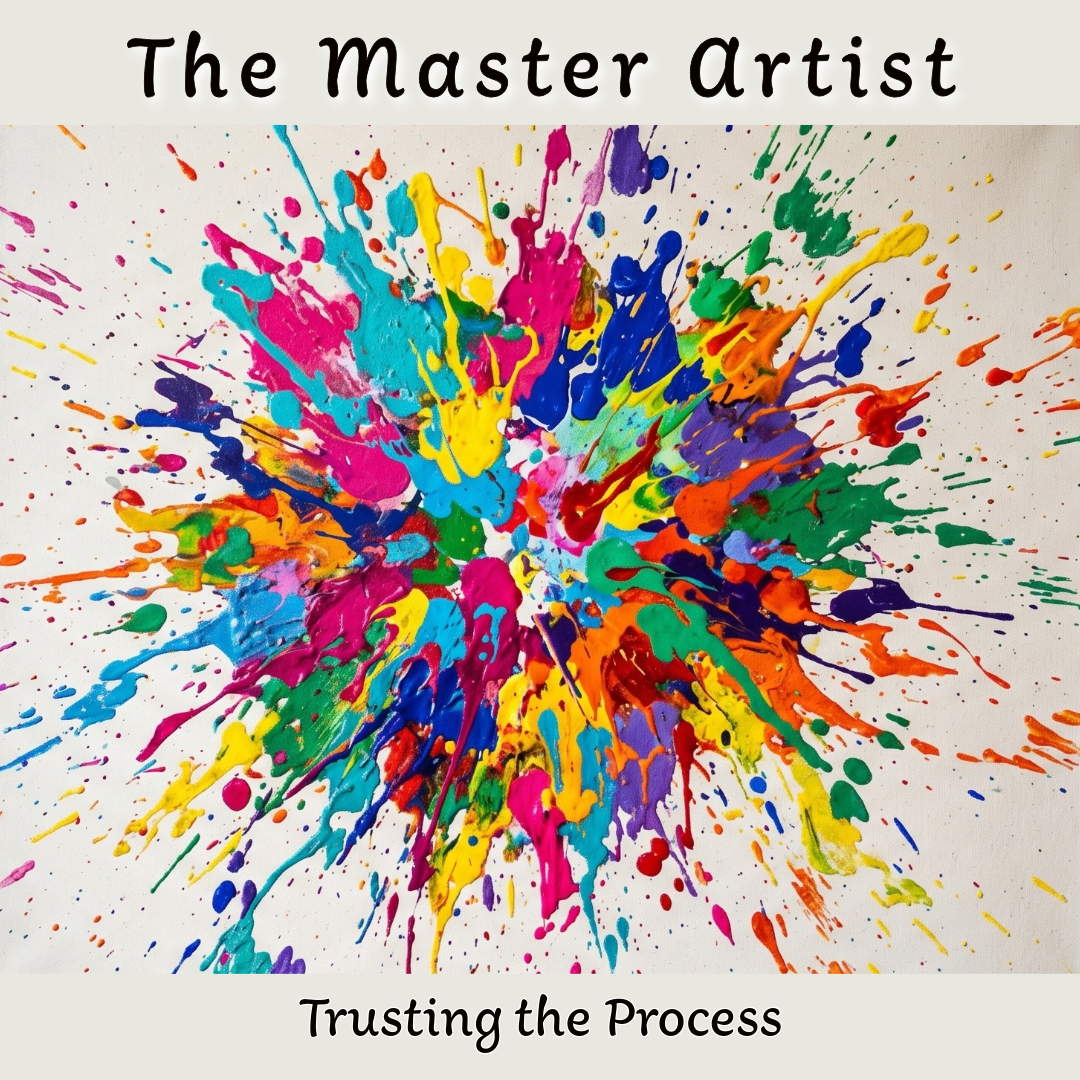
The Master Artist

Trusting the Process

God is the Master Artist turning my chaos into something beautiful.

I pray with great faith for you, because I’m fully convinced that the One who began this glorious work in you will faithfully continue the process of maturing you and will put His finishing touches to it until the unveiling of our Lord Jesus Christ! Philippians 1:6

I was meditating and praying about surrendering my will to God. Something that has never come naturally to me, because growing up I learned I couldn’t trust anyone. As I closed my eyes in consecration to God, I suddenly saw this picture in my mind of a white canvas sitting on an easel. But it wasn’t clean and untouched. Paint had been splattered all over it in every direction. Different colors everywhere. It looked messy, chaotic, and completely unorganized. The edges of the canvas were still white, but the middle was a mess. It looked ruined. Like nothing good could ever come from it. My first thought was that it should just be thrown away and started over.

Then I saw a Painter step up to the canvas. Not just any painter, but a Master Artist. He studied the mess closely and then began to work with it. He didn’t throw the canvas away. He didn’t cover it up or pretend the mess wasn’t there. He started shaping the paint already on the canvas. Adding shadows, highlights, texture, and definition. He brought order to what looked random and chaotic. It started becoming something new and intricate. What once looked ruined started becoming beautiful and valuable. By working through the mess already on the canvas, He was creating something new that nobody else could imagine.

That’s when it hit me. God is that Master Artist, and I am that canvas. The paint represents the mess I made of my life. The mistakes. The wrong choices. The regrets. The places where things feel broken, confusing, and out of place. When I look back over my life, sometimes all I see is the mess. My best thinking tells me to quit, give up, or throw the whole thing away. But God doesn’t see my life the way I do. He sees the finished picture. He sees what He had in mind from the very beginning. He is not discouraged by the mess I made, because He already sees the painting He wants to unveil.

I’m learning that surrender is trusting Him as the Artist even when I don’t understand the process. I don’t have to clean the canvas before bringing it to Him. I don’t have to know what the finished picture will be or even look like. I don’t have to figure out how all the colors will fit together. My part is simply to place my life in His hands and trust Him with it. Because God has a way of turning my mess into a masterpiece.

Prayer
Father, thank You for not giving up on me when my life looked like a mess. Help me to trust You with the things I still don’t understand. Teach me to surrender to You and trust what You are doing in me and with me. Amen

One Step at a Time… Again

Back to Basics

Drift doesn’t announce itself. It just shows up quietly. Before I even notice.

So, if you think you are standing firm, be careful that you don’t fall! 1 Corinthians 10:12

This week after meeting with my sponsor, I realized something that caught me off guard. For the first time, I hadn’t completed all my work and assignments. I had been so busy that I completely forgot to finish it. It wasn’t a relapse. It wasn’t a slip. It wasn’t even a major issue. But it got my attention. I didn’t like it, not at all. It borderline scared me that I could drift and be completely unaware of it. It made me stop and think. Why did I forget to finish my work? I didn’t even think about it. That’s when I have to stop and be honest with myself. Something has changed, and if I don’t catch it here, it will only grow and get worse.

I’ve learned to pay attention when something feels a little off. I look to see if I’m too busy, a little more distracted, a little less focused, or starting to think maybe the old way could work. That’s when I need to ask myself some questions. Am I still attending the same number of meetings? Am I still doing my step work? Am I still praying and seeking God? When I really look, I usually find something in these basic areas has shifted. It’s a symbiotic relationship. It’s simple cause and effect. When my recovery disciplines start to slip, my thinking soon follows. And vice versa. That awareness has become a check and balance system for me.

This is where this mindset helps me keep going. If I’ve done this before, I can do it again. I don’t have to feel discouraged or beat down. I don’t have to entertain lies. I don’t have to feel like I’ve lost everything. This stuff really works if I apply it to my life. So I go back to the basics, to what got me here. One moment. One hour. One day at a time. That’s how I started, and that’s how I continue. The journey of a thousand miles begins with one step… the next right step again.

I don’t say this because I’ve relapsed or slipped. I say this because I don’t want to. I’ve seen this work in my own life. I know that I know that I know that I know that if I do my recovery disciplines, they will work. I feel better about myself. I know I am changing. That brings me peace, happiness, and serenity. That gives me confidence. It allows me to throw my shoulders back, lift my head high, have a smile on my face, and keep going on. My life isn’t over. I’m still moving forward. I’m still growing. And that is the gift of recovery for me.

Prayer
Father, thank You for helping me see when things start to drift. Help me stay aware and honest with myself. Show me where I’ve slipped and give me the willingness to go back to the basics. Keep me grounded in the disciplines that brought me here. I don’t want to go backward. I want to keep moving forward with You, one step at a time. Amen.

When I Changed, Everything Changed

From Control to Peace

The change I was chasing didn’t start with them. It started with me.

First clean the inside of the cup and dish, and then the outside will also be clean. Matthew 23:26

I was listening to a newcomer share their story, and it brought me back to when I first came into recovery. I can still remember all the times I tried to fix the addiction of my qualifier. I destroyed their drug of choice. I left books, articles, and magazines out on the coffee table, opened to the exact page I wanted them to read. I underlined lines so they would see it. I left Bibles open with verses highlighted, hoping something would finally click. I knew that I could not change them. Any change would have to come from their own self-awareness. I was hoping my “hints” would nudge them and help them discover it on their own, that they needed to change. These were my hints about the damage addiction was causing, not just to them, but to our relationship and our family.

At the time, I was at my wits end. I was depressed, alone, sad, and angry. My life and family were falling apart. In recovery, we call that out of control and unmanageable. I really thought I was helping. I thought if they would just change, everything would be better. I would be happy. Our life would be better. Our family would be whole. I believed the solution was to fix them. I see now that what I called helping was really control and manipulation.

Since working through the steps of recovery, I have discovered how I used these same tactics in my dealings with other people, not just the addict. Friends, coworkers, subordinates, supervisors, customers, basically everyone I met. I was trying to get them to do what I wanted, what I thought was best. I did this through manipulation and control. I may have gotten an initial response, but seldom did it ever stick, and many times resentment was left behind. I was always left frustrated. I have learned that this was a form of pride showing up because of my low self-esteem. I didn’t think I was good enough, so I overcompensated by making myself, in my own eyes, the one with the answers. I felt uncomfortable not knowing how to deal with situations where I wasn’t in control. Trying to be in control of everything and everyone is what made me feel safe.

Recovery has taught me to focus on me so that I can have peace and happiness even in the middle of chaos. That kind of thinking wasn’t immediate. I didn’t come into recovery wanting to change myself. I wanted to change the situation. By that, I mean I wanted to change them. I thought I was right and they were wrong, and that became my problem. Over time, attending meetings, working the steps, and meeting with my sponsor, something started to shift. I began to see things differently. Think differently. And because of that, I began to experience the peace I had been chasing. Even though the other person didn’t change at all, I changed. I just noticed one day things looked different. They were suddenly better. I felt different. I was happy. I started liking who I was. That was a first. When I changed, everything else changed. That is the gift of recovery for me.

Prayer
Father, thank You for leading me to recovery. Thank You for showing me things I couldn’t see before. Help me to keep focusing on my part. Help me stop trying to control everything and everyone else. Teach me how to trust You fully. I surrender to You and Your will. Keep changing me from the inside out. Amen.

Practicing Sobriety in All Areas

Small Changes Matter

Recovery isn’t just emotional. It shows up in how I live every day.

I discipline my body and keep it under control so that after preaching to others I myself will not be disqualified. 1 Corinthians 9:27

Several weeks ago I woke up feeling off. I was off-balance, nauseous, and dizzy. I didn’t know why. It caught me off guard and honestly, it scared me. I did a little reading and found it could be something as simple as dehydration, exhaustion, or poor diet. I had stayed up way too late the night before and hadn’t eaten or drunk any water, so it made sense to me. But it still scared me. I drank some water, had a light snack, and laid down for a nap. When I woke up, I felt much better. I wasn’t quite 100%, but I knew something wasn’t right before, and something needed to change. As I thought about it more, I started to realize this is part of my recovery too. I saw that I could practice sobriety in my physical habits, not just my emotional life.

It was a wake-up call for me. I’ve known for a while, and I’ve even written about it, that I need more sleep. I need to eat better. I need to exercise. But knowing it and doing it are two different things. I might have had a day or two where I got enough rest. A day or two where I ate better. Once in a while, I even tried to exercise. But there was no consistency. And the truth is, this is just as much a part of my recovery as the emotional healing. It’s not a sickness. It’s a lifestyle. Habits. Bad habits.

The 12 steps gave me a practical, structured way to deal with my emotional life. They helped me face things, process them, and begin to heal. There was a decision, followed by a process of small actions. I finally saw that I needed that same kind of structure in my physical life too. Not because something is wrong with me, but because something needs to change. I can’t keep living one way and expect to feel another. This isn’t about being perfect. It’s about being intentional.

So I made a decision to put structure in place. I created a schedule and committed to follow it. It included set times for bed, waking up, connecting with God, exercise, and writing, and a conscious choice to eat better. This was my personal structure, not counting everyday life, work, or responsibilities. This was about me learning to be healthy in my body as well as my soul.

So far it’s been working, and I feel so much better. I’m recognizing my progress in this area and not demanding perfection from myself. I’m not expecting overnight change, and I’m not going to beat myself up if I slip. I’m taking one step at a time, one day at a time, and I keep moving forward. I am breaking old habits and replacing them with new ones. One thing I didn’t expect is how much my self-esteem has grown. I feel better about myself and who I am. That’s the gift of recovery to me.

Prayer
Father, thank You for showing me what I need to change. Help me to follow through and not just know what to do. Give me strength to discipline my body in my daily habits. Teach me how to take care of this body You’ve given me. Amen.