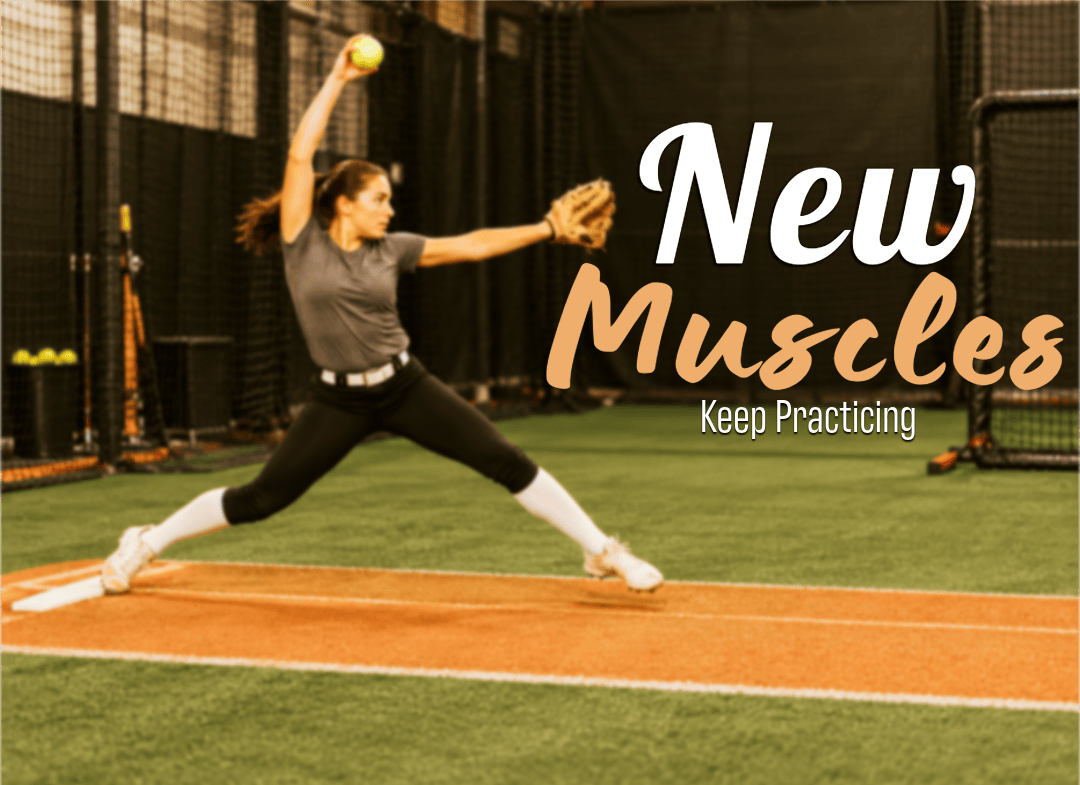
New Muscles

Keep Practicing

I don’t have to get it right the first time. I just have to stay willing to learn and not give up.

No discipline is enjoyable while it is happening. it’s painful! But afterward there will be a peaceful harvest of right living for those who are trained in this way. Hebrews 12:11

My daughter plays softball and has always wanted to pitch. She and I have been working on it together. Recently, I noticed that she was getting much better, so I had her work with a pitching coach. The coach showed her several drills and made some changes to the way she was pitching. Almost immediately, I could see a big difference in her velocity. The ball had more pop than before, but her accuracy wasn’t nearly as good. Before the lesson, she could throw the ball consistently over the plate, but she wasn’t generating much power. The coach told her not to worry about that yet. First, they were working on developing the proper motion and momentum. The accuracy would come later.

The next day my daughter told me how sore she was. Her legs, hips, and wrist all hurt. She had only worked with the coach for about an hour, and we had practiced much longer before without her being sore afterward. The difference was that now she was using her muscles differently. She was learning movements her body wasn’t used to, and those muscles needed to be developed.

As I thought about that, I realized how much it resembles my recovery. Everything doesn’t always go as I anticipate when I first try something new. I was uncomfortable the first time I shared at a meeting. I fumbled all over my words. The first time I did a Step 4 inventory, I stalled because I was afraid to do it wrong. After a few weeks, my sponsor finally said, “Okay, next week we are doing this.” The first time I tried to set a boundary with someone, it was not pretty. I was rude and offensive even though I wasn’t trying to be. I had never really set a boundary before, so I didn’t know how. I even announced, “I’m setting a boundary with you.” I was developing my recovery muscles, but I didn’t know how to use them effectively yet. Just like that coach, my sponsor encouraged me to keep practicing and not worry so much about being a little off target. We could work on accuracy later.

Working the steps has helped me learn to do things I had never done before and to do old things in healthier ways. The first attempts can be awkward. Sometimes it even hurts. But that does not mean I should give up. I can learn from what happened and try again. Today I understand that I don’t need to do everything “right” the first time. In fact, sometimes it helps me when I don’t. It keeps me humble and teachable. Growth can be uncomfortable when I am using muscles I have never used before. But if I keep practicing, what once felt new and awkward can eventually become my new normal and simply the way I live.

Reflection: What am I learning to do differently that I want to become my new normal and the way I live?

Put Them Out

Protecting My New Life

I had to separate myself from old influences that were not good for me. Not everybody liked it. Not everybody understood it. But I had to do it for me

But when the crowd was put outside, He went in and took her by the hand, and the girl arose. Matthew 9:25

I often say that I love finding recovery principles in the Bible. The truth is, they are really biblical principles that recovery uses. I just see them from a recovery perspective now. There is a story about Jesus raising a little girl from the dead that reminds me of this. Jairus came to Jesus asking Him to heal his daughter. On the way to the house, word came that she had died. Jesus continued on, but He only allowed Peter, James, and John to go with Him. When He arrived at the house, people were crying, mourning, and wailing. Jesus told them the girl was not dead but sleeping, and they laughed at Him and ridiculed Him. That means they dismissed, belittled, and minimized Him and what He said. So He put them all out. Everybody except the girl’s mother and father and the three disciples had to leave. These were not just random people standing around. This was Jairus’ home. Family, friends, and important people in their lives were there, and Jesus still put them all outside. I don’t think they were happy about being put outside, and they probably didn’t understand why He did it either.

There have been times in my recovery when I have had to do something very similar. I have had to remove myself from people, places, situations, and influences that were not healthy for me. Some of those changes were drastic, but I did not want to stay anywhere close to the life I had been living. I wanted to get so far away from it that going back would not even be an option. Drastic times required drastic measures. I changed where I went. I changed who I spent time with. I stopped doing things that connected me to my former life. Instead, I surrounded myself with people who wanted to walk this new path with me, people like my sponsor, accountability partners, and other people I’ve met in the rooms of recovery. They encouraged me, challenged me, and helped me keep moving forward. And I was able to help them too. For me, I could no longer allow anyone or anything to pull me back toward my former life. A life I no longer wanted to live. Not everybody got to come with me, and I needed to put some people out too. Not everybody liked it or even understood it. But I was doing this for me.

And I have reaped the benefit of those decisions. My environment changed. My thinking changed. My relationships changed. The life I had known before began to disappear. In many ways, it died. And something new began to live. That is what I see when I read this story today. Jesus knew what He was about to do, and He was very selective about who was allowed to go with Him and who was allowed in the room. I have learned that I need to be selective too. There are people and influences that strengthen my faith, my recovery, and my life with God, and there are others that could pull me back toward my former life. I have a responsibility to guard what God is doing in my life. I take that seriously. And I have never looked back.

Reflection

Are there people, places, or influences in my life that continue to pull me toward a life I no longer want?

Learning To Grow Up

No More Proving

I’m learning that my worth isn’t tied to what I do. I don’t have to earn love and acceptance. I’m starting to see I can slow down, rest, and still have value.

When I was a child, my words and my feelings and my thoughts were those of a child; now that I am a man, I have no more use for the ways of a child. 1 Corinthians 13:11

I was doing some step work and writing about having boundaries with myself, and it started taking me deeper than I expected. I began asking myself tougher questions. They were hard to ask and even harder to answer. My first instinct was to just move on and be content with the awareness, but I had that little nudge inside me telling me I was close to something and I just need to keep going. Why do I push myself past exhaustion? Why do I feel like I always have to be doing something? Is that tied to my character defects? Feeling like I am not good enough? Rejection? Do I feel like I have to do good in order to be loved? When I honestly work the steps, I learn more about why I do the things I do. As I slow down and look at my motives, I start to see there is something deeper driving me. This stuff is real, and it really helps me. I understand why they call it a “Fearless” moral inventory. Fear almost stopped me from pursuing these feelings.

I can see how easily I place my value and worth on what I do. I want to be successful and productive. And if I am honest, since I am not financially wealthy, there is a part of me that thinks maybe I would be considered successful by doing good things, helping others, and ministering through my writing. None of those things are wrong, but I can see how I have tied my worth to them. If I am producing, I feel okay. If I am not, something feels off. I rationalize that even if what I do doesn’t produce wealth financially, maybe I would still be considered successful by enriching others’ souls. The amazing thing about step work is that once I uncover the truth about why I do what I do and find my part, I begin to see what I can do to change unwanted behaviors. Most of the time, the change first shows up in how I am thinking, not in what I am doing. It is learning to see myself and others differently. I begin to be open-minded and realize that most of my problems come from inside of me, from how I perceive what is happening in my life. There is no looking for fault or blame but simply taking responsibility to change.

I did not cause the psychological damage that was done to me, and I was powerless to stop it as a child. But I am not a child anymore. My desire now is to stop reacting like one emotionally. That is where recovery becomes practical. It teaches me how to pause, how to look at what is really driving me, and how to make a different choice. I can see now that I have been trying to prove my worth by what I do. I do not have to prove my worth or value anymore. My identity is in God. My value and worth come from Him. I rest knowing that He loves and accepts me because He is good, not because I am. I am learning how to grow up, not just physically, but emotionally and spiritually. And even now, as I write this, I feel like I am close to something new. I sense a new awareness emerging. I am just starting to see my motives more clearly. And as I learn to rest in God, I begin to accept myself as I am. That is me growing up.

Prayer

Father, help me stop trying to prove my worth. Teach me to rest in who You say I am. Thank You. Amen.

Safe With Me

Trusting Myself

How I treat myself matters. Recovery is teaching me to take better care of myself.

No one abuses his own body, does he? No, he feeds and pampers it. That’s how Christ treats the church, Ephesians 5:29

Lately I have been overextending myself. In my mind I think I am like the energizer bunny and I can just keep going and going. My body though has a different response, and if I am not careful, I will run myself into the ground. I get run down and more susceptible to getting sick. It starts by staying up way too late trying to get everything done I want to do. Even in practicing my recovery, I stay up late reading, writing, and editing. I am also trying to write a book. Consequently, I don’t get enough sleep, and I am tired the next day, not always at my best and not performing at my best. I also find that I can be less patient and short with people. My intent and heart is good, but I am not practicing healthy boundaries with myself. My intentions do not justify my actions. I am not treating myself with care and respect.

I was reading some literature this past weekend. In it the person mentioned that they set boundaries with themself. I paused. I had to reread it a few more times. It didn’t quite click with me at first, but I knew there was something there. Something I needed to hear and see. As I sat with it, I began to connect it to my own life. I have learned about boundaries, and I have set them with other people. But I never thought about setting a boundary with myself. I used to think boundaries were only about other people. Who I let into my life and how I allowed them to treat me. Boundaries helped me determine what I would tolerate and what I would say no to. But I am learning that some of the most important boundaries are the ones I need to set with myself. Was I being too hard on myself? Why do I push myself past exhaustion? Am I trying to prove something? I did not realize that I was the one who was mistreating me.

As I prayed and meditated on this, I began to see how I talk to myself and how I treat myself. I would replay mistakes and blame myself, and that would lead to shame. I would expect perfection and then feel disappointed and discouraged when I couldn’t live up to such an unrealistic expectation. I am simply being human. Sometimes I would excuse behavior I knew was not healthy. I was being codependent with myself. I crossed my own lines constantly. A healthy boundary with myself means I take responsibility for my actions without condemning myself. I rest without feeling guilty. I tell myself the truth without exaggeration. I am learning to stop crossing my own lines and calling it okay.

When I run myself down, I feel it. I feel it in my body, in my attitude, and in how I treat other people. This is not just about being tired. It is about how I am choosing to treat myself. I don’t want to keep living like that. I want to feel safe with myself so that I can trust myself. I am learning to slow down, to stop when I need to stop, and to take care of myself in a way that actually supports my recovery. That means I don’t keep pushing past my limits and calling it good. I am responsible for how I treat myself.

Prayer
Father, help me treat myself the way You treat me. Show me where I push too far. Teach me to slow down, to rest, and to live in a way that supports my recovery. I want to be safe with myself so I can trust myself. Thank You. Amen.

Detachment With Love

Care Without Control

I thought detachment meant pushing people away. I had to learn it meant loving without managing.

    Each one should carry their own load. Galatians 6:5

Detachment is separating myself emotionally from another person’s behavior. There are healthy attachments and unhealthy attachments, and detachment is breaking free from the unhealthy ones. When I first heard about detachment, I was eager to practice it. I heard it talked about in the rooms and how it was the solution for breaking free from the hold. I learned already I had developed unhealthy attachments and I wanted the freedom spoken about. What I mysteriously missed though was the “with love” part. I heard detachment and I was ready. I did not hear with love.

The first time I tried to practice detachment, I did it by setting a boundary. I was new and thought detachment and boundaries were the same thing. I had never done either before, and when I finally did, it was clumsy and ugly. I remember telling my mom I was getting divorced. She started crying. I had been here before. At first I was angry. I thought she was using her tears to control my emotions and maneuver me into comforting her. I saw it as another attempt to shift the focus away from what I was going through. I was already hurting. I did not want the divorce. My family was being ripped apart. My future felt uncertain. So many emotions were surfacing that I did not even know what I was feeling, except sad and alone. I didn’t have anything left to comfort her. I had heard about detachment and boundaries and wanted to practice what I was learning. Instead of pausing and sorting through my own emotions, I reacted. I said, rather gruffly, why are you crying? This isn’t about you. This is about me. I even said I was setting a boundary and would not be manipulated anymore. She stopped crying and went silent.

Like I said, I was new in recovery and still learning. I had successfully set a boundary, but it wasn’t detachment and it wasn’t with love. Internally I was a kid again. I was still trying to feel safe by controlling the environment. I was trying to protect myself from being engulfed by her feelings because I could barely manage my own. That was not detachment with love. That was fear wrapped up with new language. I was more addicted to approval than I realized. Addicted to her reaction. Addicted to feeling secure based on how she responded to me. As I began to work through the Steps and grow, I stopped looking to other people to determine my value. I have intrinsic value because of my Creator. My sponsor says forgiveness is the best form of detachment, and I think he is right. When I forgive, I let go of trying to control what is not mine.

After working through the Steps with my sponsor, I can honestly say that today things are different. If someone I love starts crying, I pause. I check my urge to control their emotions. I let them have their feelings, and I let myself have mine. I don’t have to fix them or silence them. I don’t have to correct them either. When I need to set a boundary, I do not have to announce it. I just live it. It is for me, not for them. I say what I mean and mean what I say without being mean when I say it. I practice acceptance. The Serenity Prayer helps a lot with that. I offer forgiveness. This is how I know I am practicing detachment with love: I can care without control. That shows love and respect for them and for me.

Prayer
Father, teach me to practice detachment with love. Heal the wounds inside me that cause me to control instead of trust. When I feel uncomfortable, help me pause instead of react. Give me courage to forgive those who have hurt me. Amen.

Yes and No

Finding Balance

In recovery I learned that fear-based no and guilt-based yes are both extremes. Healthy boundaries mean saying what I truly mean.

Let your Yes be Yes, and your No, No. Matthew 5:37

Before recovery I said no to everything. No was my first response. I was a no person. I did not open myself up to invitations. I did not try new things. I stayed guarded. In recovery I began to say yes, but before that, no was how I survived. Why did I say no all the time? I took an honest inventory, and I saw it again. That old character flaw. Not being good enough. I was afraid that if I said yes or opened myself up to an invitation, I would be rejected. And why would I purposely subject myself to that? Growing up in an alcoholic home, I developed survival traits. Those traits kept me safe. But they also kept everyone out. I couldn’t trust anyone. I did not take things at face value. I did not give others the benefit of the doubt. I assumed I would be hurt or let down if I did. So I said no. And I only said yes when I was in control. That was the vicious cycle I lived in. And I never even considered there was another way.

In recovery I began to say yes. Yes to invitations. Yes to new people. Yes to new experiences. Yes to meetings. Yes to service work. Yes to life. And when I started saying yes, I experienced things I had never experienced before. I made new friends. I went new places. I was becoming a different person and I liked it. I began to identify my emotions and appreciate them. Saying yes was good for me. It helped me grow. It helped me soar even. But then I started learning about boundaries. And I realized that as much as I needed to say yes, there were times I needed to say no as well. In recovery, I am learning that I don’t have to stay in either extreme.

It was such an odd paradigm shift and paradox. Before recovery I never said yes. Always no. But in recovery I began saying yes every time, even when I meant no. I said yes when I meant no because I felt guilty and afraid. I liked my new life. I liked how I was growing. I did not want to regress back to my old life. And so I overcorrected. I went from fear-based no to guilt-based yes. I was confused and tired.

I am grateful for my friends in recovery and my sponsor who helped me stay centered and grounded. They taught me that yes and no are both healthy boundaries. Neither is good or bad in itself. Accepting invitations and new adventures is exciting and invigorating. Saying no kept me safe, but it did not lead to growth or learning anything new. Saying no out of fear left me stagnant and alone. Saying yes out of guilt left me exhausted and resentful. Working through the Steps is teaching me balance. I am learning to say yes when I mean yes and to say no when I mean no. When I do, I am able to live a well-rounded life without guilt and fear.

Prayer

Father, help me say yes when I mean yes and no when I mean no. Take away the fear and guilt of my past. Teach me how to consistently practice balance in my recovery. Thank You for helping me. Amen.