Unconditional Love

Holidays and family can get complicated, but God’s love is never ending.

This is what real love is. It is not our love for God. It is God’s love for us. He sent His Son to die in our place to take away our sins. 1 John 4:10

During the holidays, it can be so stressful. Dealing with family dynamics and dysfunction is challenging. Unresolved hurts and disturbing memories of the past, as well as new wounds that spring up and bring with them unbearable pain and resentment. Love then feels and becomes conditional, which leads to more hurt and even deeper resentment. And it continues on toward a never-ending downward spiral.

I am so glad that God never said He will only love us under certain conditions. He gave the ultimate sacrifice and still loves with abandon, without reservations or regrets. I’m glad He doesn’t need to protect Himself from us hurting Him more. This is what rejection looks like, but God never rejects those He loves, no matter what they do in return, whether real, imagined, or perceived. (Hint: we are those He loves)

Love does not return hurt for hurt. Love gives and gives and gives and gives and gives and gives. And then gives and gives and gives some more. Love never stops giving. That is what forgiveness is. It is giving love in advance of any wrongdoing, even when it is not deserved or reciprocated. Love gives even when it is not requested or asked for.

In these times we can be reminded that God is a perfect parent and find comfort in His care. His love is perfect toward you. He accepts without expectation, He loves without condition, and He forgives when it is not earned or requested.

Prayer: Lord, thank You for loving me without conditions and without hesitation. Help me love my family the same way. Teach me to forgive quickly, give freely, and choose love even when old hurts rise up. Let Your unconditional love flow through me today. Amen.
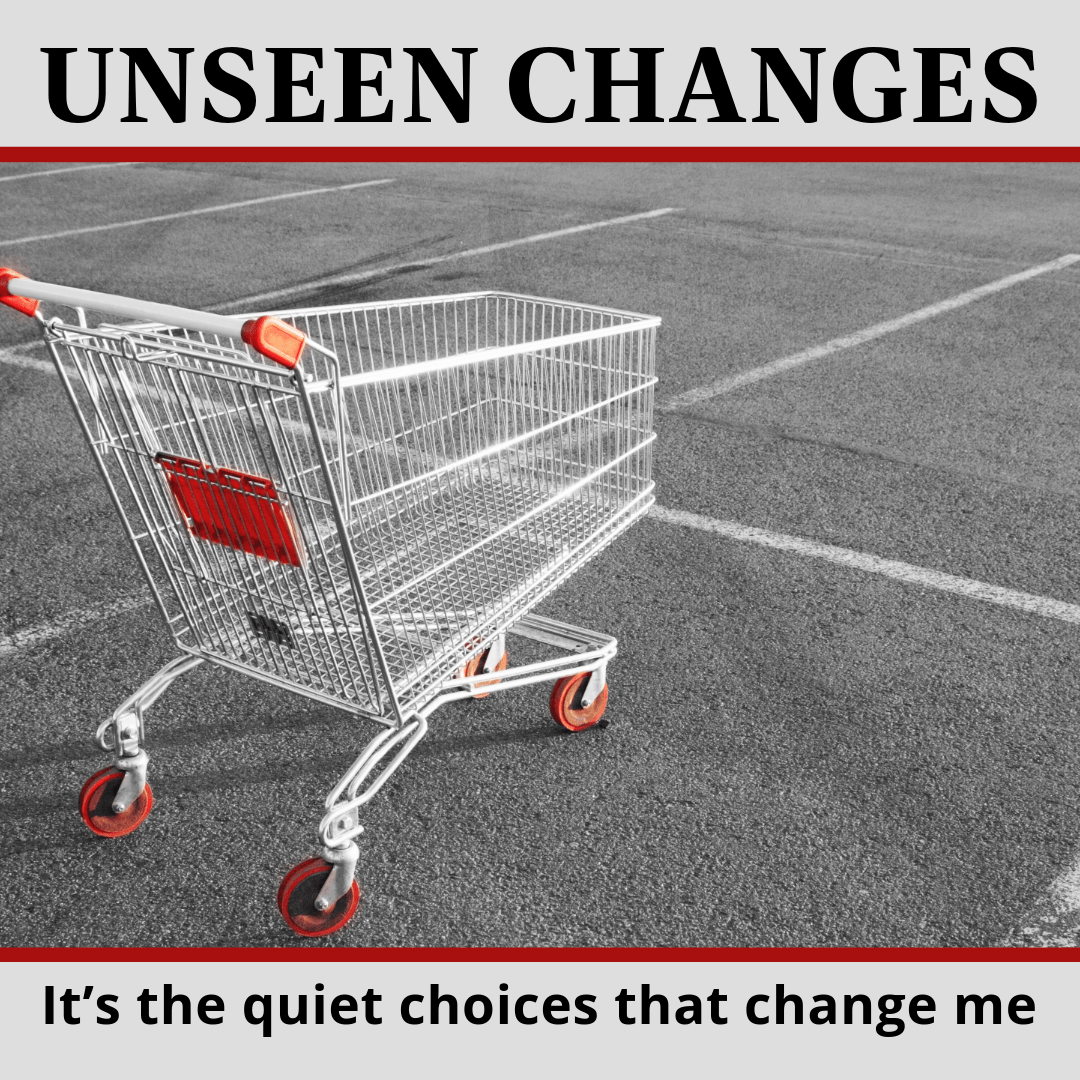

Unseen Changes

It’s The Quiet Choices That Change Me

Whoever can be trusted with very little can also be trusted with much. Luke 16:10

The other day I went to the store to pick up a few things. When I was leaving, I started to take my shopping cart back to the holding area. On the way, I saw another cart sitting off to the side, left behind. I decided to grab it and take it with me. Then I thought, maybe this is one of those times when I’m doing a good deed and not being found out about or doing something I don’t want to do just for exercise, like I’ve read so many times on the Just for Today bookmark. Then another thought hit me: How would anybody know if I did a good thing if nobody saw me do it and I didn’t tell anyone? Does this even qualify as something good? It was just a shopping cart that someone left behind. Was I making more of it than it really was?

Then it dawned on me. I wasn’t doing this for anyone else to notice or to pat me on the back. That was the point. And that was the gift. I was doing it for me. I’m learning that real change isn’t just about stopping the wrong things and starting the right ones, but about understanding why I do what I do. I wasn’t returning the cart to prove anything. I was doing it because I’ve started to think differently, to notice and care about things I never used to before. Someone once said that honesty and integrity mean doing the right thing when no one is watching. That’s the whole point, isn’t it? It’s not about being seen or praised. It’s about becoming someone who now thinks differently and acts differently. When I do the right thing quietly, that’s when it’s most real.

As I pushed the carts into the holding area, I felt a small smile cross my face. My shoulders straightened, and for a moment I stood a little taller. It wasn’t pride; it was peace. Something in me had shifted just enough to notice. I realized I wasn’t just returning shopping carts; I was living recovery, finally becoming the person I always hoped to be, one simple act at a time. Change isn’t always loud or dramatic. Sometimes it comes in the stillness, as a small and gentle reminder from my Higher Power to choose what’s right when no one’s watching. That moment reminded me that the work God is doing in me is real. I don’t need to prove it; I just need to live it.

Prayer: God, thank You for showing me that real growth happens in the little things. Help me notice the still, small moments where You are shaping me into someone new. Teach me to live honestly, not for attention or approval, but to have peace within and with You. Amen.

Hearing With My Heart

Listening To Understand

People’s thoughts can be like a deep well, but someone with understanding can find the wisdom there. Proverbs 20:5

Last week at work, a colleague and I had different ideas about how to solve a situation. We both thought we were right, and we both dug in a little. A couple of days later, they hinted that they were open to trying something different. The part that got me was that their new idea sounded vaguely similar to what I had originally suggested. I thanked them and started to walk away, but they stopped me and asked, “Really? You’re going to let it go that easily?” That question hit me harder than I expected. Inside, I realized that I was waiting for something else. I wanted them to acknowledge it the way I wanted it said. I wanted the neat little package with a bow on top. I wanted them to acknowledge that they were acquiescing. It took me a minute, but I finally realized that I was letting my pride get in the way of working together.

Recovery is teaching me that my way is not the only way, and sometimes not even the best way. I am learning that expecting people who are not doing recovery work to act or communicate with the same tools I am learning is unrealistic. Not everyone speaks directly. Not everyone apologizes clearly. Not everyone labels their thoughts or feelings the way I am learning to. Some people hint, imply, or suggest things in their own way. When I expect them to say it the way I want it said, and they do not, I end up feeling hurt or frustrated. I start listening to my pride instead of staying open minded. Pride tells me that if the words do not match my preferred version, then I am being disrespected. I start thinking they are trying to manipulate me, and sometimes they might be. But most of the time, that is just my old way of thinking trying to sneak back in, not my recovering mind.

What I am discovering is that I need to listen beneath the surface. I need to hear what is being communicated, not just how it is phrased. My colleague was trying to apologize, even though they never came out and said that. They were agreeing with my idea. They were offering movement. They were offering collaboration. And I almost missed it. Pride has a way of narrowing my view and making me judge the package instead of recognizing the gift. God helps me apply the principles of recovery to slow down, breathe, and look again. When I do that, I can hear what is actually being communicated and not just what is spoken. In this way I am becoming open minded and learning to live at peace with others.

Prayer: God, help me hear people with humility and understanding. Teach me to listen beneath the surface, to recognize the heart behind the words, and to stay open to the wisdom You are showing me. Help me let go of my old thinking and walk in peace with those around me. Amen.

Why Am I the One Who…?

Small Frustrations Show Me… Me.

So if you know of an opportunity to do the right thing today, yet you refrain from doing it, you’re guilty of sin. James 4:17

The other day at work I went to get some water, and the machine was empty again because no one had changed the bottle. I had to change it, and right away I felt that familiar frustration rising up. Why am I always the one who has to change it? Why doesn’t anyone else do it? I changed the bottle, got my water, and moved on with my day. Later at home I went to throw something away and the trash was overflowing. I had the same exact feeling and the same exact thought. Why am I always the one who has to empty it? But when I stopped and looked at the facts, it wasn’t true at work and it wasn’t true at home. I’m not always the one doing it. Something else was happening in me.

As soon as I felt that surge of annoyance, something deeper came forward. I didn’t just feel frustrated. I felt unimportant. I felt not good enough. I felt like my needs didn’t matter. And when I caught myself at home with the trash, I asked myself, “I felt this earlier… when?” And then it was like watching a movie in my mind. I saw the water bottle situation at work play out again, and I realized this wasn’t about water or trash. This was about me. My timing. My expectations. My need for things to go how I want them to go. And underneath all of that was a struggle I face every day without even noticing. I feel unseen when life doesn’t go according to my plan.

Recovery is teaching me to pay attention to these patterns. My sponsor always tells me that when I notice similar feelings popping up in different situations, to look for the common denominator – or in my case, the dominionator, because I struggle with control. What I’m learning is that if I slow down and just do the next right thing, even when it interrupts my plans, life gets simpler and my day becomes more peaceful. I don’t have to get stuck in resentment or old behaviors. I can pause, breathe in, and remember that God shows me these moments so that I can grow and become what He has planned for me. And for that I am supremely grateful.

Prayer: Father, help me see the moments where I can do the next right thing. Give me a willing heart to accept things that don’t go my way and teach me to surrender the small things. Thank You for using these everyday moments to help me grow. Amen.

Warning Signs

Paying Attention To God’s Alerts

No one really knows all the mistakes he makes. So forgive my hidden faults. Psalm 19:12

The topic in my meeting last night was what do you do when you mess up. And I was thinking about that. I have a hard time because I don’t know when I mess up my denial keeps me from seeing it. That’s the whole reason I ended up coming to recovery in the first place, I didn’t think I had any problems. I didn’t think I ever messed up. So the thought of what to do when I do is hard. I have tools I practice now that help me. They are my warning signs that steer me on my recovery road. They alert me before I enter into dangerous or unsafe territories. When I see patterns, by that I mean maybe more than one person tells me the same thing. I realize I’m the common denominator, so that tells me I need to look at myself. When I feel uneasy in my spirit or in my heart, that is a sign that I need to look deeper at what’s going on. If my conscience won’t let me rest and I keep thinking about something over and over, that’s a good sign that I need to look inwardly at what’s going on.

For me, it’s never been an issue to apologize or make things right when I knew things were wrong or I messed up. I have always been quick to repent. My problem has always been recognizing that I’ve done something wrong. When I offend someone, when I hurt them, or when I am insensitive to their feelings or point of view, I usually don’t see it. So recovery helps me to recognize the signs. When I see these signs I pray asking God for help, I write about it, asking why this is bothering me. Writing usually leads me to figuring out how I really feel about things. I honestly examine my actions and ask myself, What is my part? I ask God to show me how to make a proper amends and ask Him to open the door and show me the timing to do so.

This gives me peace and confidence. When I can do this, then I can trust that I’m hearing God and following His will when I take the next right action.

Prayer: Father, thank You for being patient with me as I learn to see what I used to miss. Help me pay attention when something feels unsettled inside me. Teach me to recognize my part and trust You to guide my steps. Show me how to make amends with honesty and humility. Thank You for giving me peace as I follow Your will. Amen.

People Are More Than Their Cover

Seeing Value Beneath The Blemishes

You are our epistle written in our hearts, known and read by all men. 2 Corinthians 3:2

The other day I ordered a few books online. After managing bookstores for over twenty years, I’ve learned to take good care of my books. I never bent the covers back, folded the corners of pages, or wrote in the margins. I always treated them with respect and took good care of them. So when my order arrived, I was excited to open it. The listing said the books were in “excellent” or “very good” condition, and in my mind that meant clean pages, no writing, no dog-ears, just a well-cared-for book that might have been read once or twice. But when I opened the package, one of the books I was most excited to read had writing in the margins, lots of underlining, many dog-eared pages, and a handwritten dedication on the inside cover. My first reaction was disappointment. In my estimation, this was not in either excellent nor very good condition. I even thought about contacting the seller to let them know.

Then a thought crossed my mind: Am I happy to have the book? The answer surprised me, yes, I was. Some of the titles I ordered were out of print and hard to find, and I was grateful to have found them at all. I realized that even with its imperfections, I still had what I wanted, the words, the message, the content inside. And who knows, maybe some additional insight or wisdom could be gained from the previous owner’s experience and notes. My disappointment wasn’t really about the book. It was about my expectations. I had decided ahead of time what “excellent” meant, and when it didn’t match my definition, I felt let down. Once I realized that, something shifted inside me. Gratitude replaced frustration, and peace followed right behind it.

As I thought about holding that “imperfect” book in my hands, I realized how much its flaws and defects told a story other than the one contained in its pages. The folded corners, the writing in the margins, even the dedication inside, they were signs that someone else had found value in its pages and loved it before I did. In a way, those shortcomings gave the book more character and value to me, not less. That thought made me smile and led me to a deeper realization. If I could see the beauty in something imperfect like that book, why was it so hard to do the same with people? I started to see how often I expect others to meet my standards, to see things my way, to share my values and priorities, maybe without even realizing that I have them. And when they don’t, I feel disappointed, frustrated, or even angry. But people are not books, and you really can’t judge them by their cover. Some of the ones who look worn or imperfect hold the greatest wisdom and grace. Every day I’m learning to appreciate others for who they are, not for how closely they align with my expectations. When I can do that, relationships become more about acceptance and gratitude than judgment, and love becomes something I can give and receive freely.

Prayer: God, thank You for reminding me that people are not meant to meet my expectations. Teach me to love, accept, and appreciate others just as they are. Help me to let go of judgment and choose gratitude instead. Amen.

Stop Pretending

Sometimes the biggest step in recovery is letting people see the real me.

The Lord does not look at the things people see. People look at the outside of a person, but the Lord looks at the heart. 1 Samuel 16:7

One of the things I love about recovery is that line in the reading that says there are no professionals here. There are no experts. To me that means no one is judging how well I do recovery. It is just a group of people trying to break free from the obsessions and dependencies that weigh us down. I do not have to impress anyone. I do not have to be good enough. I just need to show up, be present, and try the recommended solution to find freedom from the things that have held me prisoner. It comforts me to know that I am not alone on this road. Others have walked it before me, and their honesty encourages me to keep going. If I practice the solution, I can find the serenity they have found.

What I am learning is that recovery puts us all on level ground. Nobody gets to stand above anybody else. The person shaking from withdrawal and the person shaking from fear are not so different. Pain is pain, and it seems to be a great motivator for change. My obsessions will make me sick and destroy me if I ignore them. I imitate a confident have-it-together person on the outside but on the inside my thoughts and feelings are quite the opposite. And healing begins when I can merge the two into one. When I stop pretending to be someone on the outside that I am not on the inside, true transformation unfolds. When I focus on what is going on inside of me instead of trying to fix someone else, I feel the weight begin to lift, and I can breathe a lot easier.

The beauty of recovery is that God meets me right in the middle of all this honesty. He does not ask me to be stronger or have it all figured out. He just asks me to be willing. I do not have to arrive. I do not have to impress anyone. I just need to keep showing up as the person I really am, not the version I used to perform. And when I do that, I heal in ways I never expected. I start to become a better version of me. God uses the honesty of other broken people to help me grow, and He uses my honesty to help them. That still amazes me. When I stay open, willing, and connected, I experience the freedom and serenity that is promised.

Prayer:

Father, thank You for loving me, even though You see my heart, the real me. Help me to stop pretending and let go of the need to perform. Give me the courage to be honest, not just with You, but with others and especially myself. Teach me how to be the person You created me to be. Thank You for setting me free and filling me with Your peace. Amen.

Recovery On the Go

God speaks in quiet moments, even behind the steering wheel.

Your ears will hear a command behind you saying, “This is the way. Walk in it.” Isaiah 30:21

Yesterday I had an early morning doctor appointment, and it threw off my whole rhythm. I had to leave the house much earlier than normal, which meant no time for my regular routine. Every morning I grab a cup of coffee, sit in my chair, read, pray, meditate, and get centered. It is my anchor. When I realized I would not have time for any of that, I was frustrated. I had not even thought about how this appointment would affect my morning ritual. I rushed to get ready and headed out the door with my mind still irritated.

As I drove, I felt God prompting me with a question, why was I so bothered and upset by this? I said to myself it was because I missed my devotion time, but inwardly I knew there was something deeper, there always is. As I got quiet, I saw it. It was control and insecurity. My routine helps me feel safe and grounded. Then another new thought came to me. Why not have my “me” time right now while driving? I could not read, but I could still pray. I could still meditate. I could still think about how to live the principles today. That simple shift opened up something new in me. I realized I do not have to be tied to a specific ritual for it to count. I can connect with God and focus on my recovery anywhere, anytime. These tools travel with me. My spiritual life is not limited to one chair and one timeframe.

By the time I reached the appointment, I felt great. I was more centered than when I left the house. I gave myself grace and remembered something important; I have a program. The program does not have me. Routines may help me, but they do not own me. Missing one reading does not mean I failed. It simply means I get to practice flexibility and trust that God meets me wherever I am. If I want, I can always read later. When I am flexible and embrace new ideas, I am learning and growing. I am improving my conscious contact with God. It is when I connect with Him and not a routine that I truly feel safe.

Prayer:

Father, thank You that my recovery tools travel with me. Help me stay flexible and open so I can connect with You anywhere and in any moment. Teach me to trust You more than my routines, and remind me that You always meet me right where I am.

I Didn’t Need Permisssion

Consider yourself challenged.

Confess your faults one to another, and pray one for another, that you may be healed. The effectual fervent prayer of a righteous person avails much. James 5:16

In recovery, I’m learning how to face my hurts, habits, and hang-ups without letting them define me. I’m learning to humble myself and share my struggles with people so that I can be healed from their effects. This is my story from last November, and how powerful the tools of recovery really are in my daily life.

It’s common these days on November 1 for people to start the “30 Days of Giving Thanks Challenge” on Facebook. I really wanted to do it. I thought, “What a great idea! And why didn’t I think of that?” Then came the next thought, “How come no one challenged me? I want to do that.” As the days went by and no one invited me, I felt hurt and angry. In my mind, no challenge meant no invitation. That old feeling of not being good enough kicked in again.

Then I had an epiphany. Why not use the tools I’ve learned in recovery? For me, those tools aren’t just about stopping destructive habits like drinking, drugging, smoking, sexing, or gambling. And yes, those same tools have helped me stop all of that. But I can also use them to help me stop crazy thinking and feeling hurt.

So I can make a choice to join the challenge simply because I want to and because I’m thankful and grateful for so many things in my life. Once I made that decision, it was easier to do. I suddenly had clarity of mind. I saw that it was pride that had kept me from doing it in the first place. Because it wasn’t my idea, I was offended that no one asked me to do it. I thought that if I joined in now, I’d just be doing what everyone else was doing. Like there’s something wrong with that, right? My thinking was jacked up. I mean, I get hurt and mad when I’m not invited to a party I didn’t want to go to in the first place. What?! Don’t laugh! Okay, but just a little.

As soon as I started, I felt the healing come. The hurt started to fade, and peace flooded my mind and soul. The book of James says that when I humble myself and confess my struggles and shortcomings to another person, God gives me His grace, and I am healed. That’s when my prayers become effective.

For anyone else like me who needs an invitation, here it is. Consider yourself challenged.

Temporary Sponsor

He comforts us in all our troubles so that we can comfort others. When they are troubled, we will be able to give them the same comfort God has given us. 2 Corinthians 1:4

Like most of us, when I first came into recovery, I didn’t know what I was doing. I had spent years trying to manage life on my own, and it wasn’t working. I kept hearing in the meetings, “You need a sponsor.” I didn’t know what that really meant or entailed, but the pain was a great motivator and I was ready to stop hurting.

Back then I had met two men that I connected with. One from my traditional recovery group and one from a Christ-centered recovery group I recently started attending. I asked the man from my traditional group to sponsor me, but he said no. That rejection stung, but God was already working behind the scenes. The next week, I asked the other man. He said he’d be my temporary sponsor. At first that too hurt my feelings and felt like more rejection, but I was hurting, and at that point, I didn’t care. I just knew I needed help. What I didn’t realize was that “temporary” would turn into one of the most life-changing commitments I’d ever make.

We began meeting twice a week, once at night to do step work and another morning for coffee and conversation. I didn’t realize it then, but those moments were doing more than teaching me about recovery; they were teaching me how to be honest, accountable, and real. My sponsor didn’t preach at me. He didn’t try to fix me or tell me what to do. He just listened, guided, and modeled the kind of peace I had been missing. He shared pieces of his own story that made me realize I wasn’t alone. For the first time, I felt safe enough to be honest about my past and the pain I had carried for years. Through those early meetings, God began to show me that healing happens in relationship, not isolation. I started to see that He uses people to help people, and that letting someone in didn’t make me weak. It made me human.

Through that process, I began to trust. Not just my sponsor, but God working through him. Each time I opened up, something in me began to change. I started to realize that I didn’t have to have everything figured out. I just needed to be willing. I wasn’t used to that kind of safety or love. It wasn’t about control; it was about surrender. When he challenged me to face myself in the steps, I listened. And slowly, the walls I had built around my heart started to crumble. What began as a temporary arrangement became a lasting foundation. God used one man’s willingness to listen to bring about permanent change in me.

Now I understand that the commitments I make in faith, even small ones, give God room to work in big ways. When I said yes to a “temporary” sponsor, I was really saying yes to healing. God met me in that step of obedience and turned it into transformation.

Prayer

God, thank You for using people to help me when I couldn’t help myself. Thank You for those who guide me with wisdom, grace, and honesty. Help me stay willing to listen, to trust, and to take the next right step You put in front of me. Amen.

Honesty Brings Healing

Confess your trespasses to one another, and pray for one another, that you may be healed. James 5:16

I remember sitting across from my sponsor one night as we were going over the Fourth Step. His office was quiet except for the soft click of the heater turning on and off, breaking the silence between us. Near the end of our time, my heart started to race and my hands felt heavy in my lap as I tried to find the courage to speak. I had shared a lot that night, things I had never said aloud before, but one truth still sat heavy inside me. I kept waiting for the right moment, hoping maybe he would move on, but he didn’t. Finally, I just blurted it out, something I had hidden and carried in silence for years. For a moment, I couldn’t look at him. I waited for disappointment, maybe even pity, but instead, I saw compassion. My sponsor didn’t flinch or look away. He looked steadily at me, and I saw a small smile on his face. I didn’t feel judged, but accepted. He simply told me that moments like this are what recovery is all about. It is when grace meets honesty and shame finally loses its grip.

Step Five scared me. Admitting to God, to myself, and to another human being the exact nature of my wrongs felt like stepping into a spotlight I wasn’t ready for. I didn’t understand how it worked or why it mattered. Wasn’t this just another way to be reminded of my failures? But something shifted the moment I began to speak the truth out loud. Writing things down was one thing, but saying them made them real. My voice trembled at first, but the more I spoke, the lighter I felt. It was as if every secret I released created room for grace to breathe. Each time I pulled something out of darkness, the weight I had been carrying started to lift. I was learning to let go of the lies I believed about who I was and to hand my shame over to God. That is the humbling process James wrote about when he said to confess our faults and pray for one another so that we may be healed. What struck me most was that the verse does not say forgiven; that is already done. It says healed. Healing began the moment I stopped hiding.

Today, I still practice what I learned back then. When I am honest about my struggles, I stay connected to God and others. Healing did not stop that night; it keeps unfolding every time I tell the truth, listen with compassion, or pray with someone who is hurting. When someone sits across from me and begins to share what they have been carrying for years, I can see the same mix of fear and hope that once filled my own heart. I ask God to help me show His love by being present and accepting, without judgment or hurry. Each time I listen, I am reminded of where my healing began, in the simple act of being honest and letting someone in. I do not fully understand how God does it, but He never fails to bring freedom when I do my part. The honesty that once terrified me now keeps me free. The same grace that healed me keeps me whole, one day at a time.

Prayer

God, thank You for meeting me in my honesty. Give me the courage to keep bringing things into the light, trusting that healing happens when I do. Help me to listen with the same grace that once set me free, and let my life be a safe place where Your love restores others. Amen.

Don’t Hold It In

What keeps me from asking honestly for what I need?

Let your Yes be Yes, and your No, No. Matthew 5:37

I remember a time I was doing step work with my sponsor, and I had to go to the bathroom. I kept holding it because, for some reason, I was afraid to ask if I could be excused. I don’t know why. We were both adults, both working a program based on honesty, yet I sat there fidgeting, tapping my foot, hoping he’d notice. I was giving all the clues, silently wishing he would say, “Hey, do you need to use the bathroom?” But he didn’t. Finally, I couldn’t hold it any longer. I apologized and said, “I’m sorry, I need to go pee. Can I be excused?” My sponsor burst out laughing, a big deep belly laugh, and said, “If you gotta go pee, go pee!”

When I came back, he told me he had known the whole time that I needed to go but was waiting for me to speak up for myself. He said he could see all the “tells” I was giving. Then he asked, “Why did you wait so long?” I thought about it and realized what I had been doing. I was trying to use manipulation to get my needs met. I was hoping someone else would read my mind and take care of me instead of taking responsibility for myself. It was a simple situation that revealed a deep pattern in me. My sponsor taught me that day that part of recovery is learning to speak honestly about what I need and to take appropriate action instead of waiting for others to figure it out.

That lesson has stayed with me. These days, when I need to use the restroom, I just excuse myself. Even in a meeting, a phone call, or a conversation, I can speak up for myself without guilt or fear. No one has ever chastised me for it or looked at me differently. People always understand. But the freedom goes deeper than that. I am learning that God gives me permission to take care of myself. I no longer have to manipulate or hint to get my needs met. I can be direct, honest, and at peace.

Prayer

Lord, thank You for teaching me that honesty begins with myself. Help me to speak up for what I need with humility and courage. Keep me aware of the old habits that try to sneak back in, and teach me to trust that You and others can handle the truth. Amen.

Feeling Left Out

God is healing the parts of me that learned to expect disappointment.

The Lord is close to the brokenhearted and saves those who are crushed in spirit. Psalm 34:18

The other day was my daughter’s thirteenth birthday and plans for her party fell through. In my attempt to console her disappointment, it brought up memories I hadn’t thought about in years. My birthday is in December, and for anyone born that month, you probably already know what I’m going to say. For everyone else, let me explain. A December birthday often means you never have a birthday party because it’s “too close to Christmas.” If I heard that once, I heard it a thousand times. I understand now, as an adult, that it’s a busy time of year with family gatherings, work parties, holiday expenses, and a dozen other things. It can be a lot. But as a ten-year-old kid, all I heard was that I wasn’t important enough to celebrate.

Many years I received the “combo gift,” with the line: “This one’s for Christmas and your birthday.” Which usually meant it was a Christmas gift with a different tag. One year I decided to return the favor. My brother’s birthday is in May, so when Christmas came, I handed him a gift with a card that read, “This is for Christmas and your birthday.” He looked confused and said, “But it’s not my birthday.” I said, “Exactly.” He didn’t get it, but I did. I felt left out. Both of my brothers, born in May, had birthday parties almost every single year. I remember my tenth birthday was supposed to be my first real party, where kids from school were invited. I was so excited. Then I came down with the mumps. The party was cancelled, and I never had a birthday party until I was an adult. I was crushed. After that, two things happened. First, I stopped getting my hopes up for anything. I told myself it was better not to expect much, just another broken promise waiting to happen. Second, I became impossible to buy a gift for. I don’t know how to accept a gift graciously, and even if I was given a gift I had always wanted, I still feel left out and hurt. I don’t like that about myself, but it’s the truth. This is one of the things about working recovery, is that I have to face the hard things even when I don’t want to or don’t like what I learn about myself.

I hadn’t realized how much of those childhood hurts are still with me even today until they begin to surface. Every time someone overlooks me or doesn’t notice my effort, it stirs up that feeling of rejection. The good news is that I never have to stay in that state of mind. I can change, and God provides the power to do so. He is healing those broken places and replacing them with His peace and presence. I can’t hope for a happier past, but I can learn and grow from it and expect a happier future.

Prayer:
God, thank You for revealing to me the pain I’ve hidden for so long. Help me face old memories without fear, knowing You are already there. Teach me to receive love without suspicion and kindness without doubt. Thank You for healing my hurts and giving me Your peace in their place. Amen.

Learning to Trust

Taking one small step toward trust, even when I’m afraid.

When I am afraid, I will trust in You. Psalm 56:3

Growing up, I had no idea what trust was. I learned early on that people could say one thing and do another, that “I love you” didn’t always mean safety, and that promises were often broken. I learned to survive by relying on the only person I thought wouldn’t lie to me – me. But since I had never really known love or trust, I was relying on a skewed version of what my limited understanding could comprehend. I built walls to protect myself from being hurt again and called it strength. Even after I came to know God, I still kept control of the details, just in case He didn’t come through the way I hoped.

When I came into recovery, I brought that same lack of trust with me. I didn’t know how to open up or let anyone in. I told myself it was safer to keep my guard up and just listen. I didn’t trust people, and if I’m honest, I didn’t trust God either. I believed in Him, but I didn’t believe He would show up for me. Deep down, I was afraid that if I really depended on anyone, they would eventually let me down, just like before.

As I kept coming to meetings, I began to notice something different. People shared openly about their struggles and didn’t seem ashamed. They were honest about their pain, but they also had peace. That was new to me. Little by little, I started to believe that maybe it was safe to be real too. People seemed to listen without judgment and didn’t try to fix me. The more I shared, the more I began to feel accepted. Trust didn’t happen all at once, but each time I opened up, the walls I had built started to tumble down. I started to believe what was shared in the readings, that this was a safe place and what is shared here stays here.

As I learned to trust people, I began to realize that God was using them to teach me how to trust Him. Each time someone listened without judgment, encouraged me, or showed up when they said they would, I caught a glimpse of God’s character. I started to see that He had been faithful all along, even when I couldn’t recognize it. Through the consistency of others, I experienced the steady love of a God I once doubted. Trust was no longer an idea I tried to understand; it became something I was learning to live.

Today, I’m still learning to trust. It’s not something I’ve mastered; it’s something I practice every day. Each time I let someone in, each time I choose honesty over self-protection, my hope in people grows a little more. I’ve learned that trust doesn’t mean I won’t get hurt. It means that even if I do, I don’t have to stop trusting. I can’t stop, because it’s in trusting others that I feel loved, and love is always a risk. It’s a risk to love others, and it’s a risk to let them love you back. But it’s a risk worth taking.

Prayer

Father, thank You for being patient with me as I learn to trust again. Help me to lay down my fear and let others in. When I’m tempted to close off or pull back, remind me that You are safe, and that You often show Your love through people. Teach me to love courageously, to trust even when it feels risky, and to see Your faithfulness in every step I take.

I Can Be Compassionate

Be kind and compassionate to one another, forgiving each other, just as in Christ God forgave you. Ephesians 4:32

I love my qualifier, who struggles with alcoholism. For a long time, I confused control with love. I believed that if I could fix them, everything would finally be okay. I thought their happiness would bring me peace, but it only left me frustrated, anxious, and exhausted. I thought I was showing love, but what I was calling love was distorted. I was attempting to fix and control what only God could heal.

Today I am learning that the solution isn’t in fixing others but in trusting God and keeping the focus on changing myself. I do this by learning to forgive, making amends, serving, giving back, living one day at a time, consciously being present in each moment, and being grateful. Working the steps of recovery has introduced me to a loving, caring God. Because of that relationship, I can “let go and let God.” I can trust Him with my qualifier. My part is to focus on my own recovery and take only my own inventory.

I can have unconditional love for someone with a seemingly unlovable disease. I can separate the person I love from the disease I hate. Loving without conditions doesn’t mean loving without concern. I’ve learned that accepting doesn’t mean liking, and that by accepting them exactly as they are, I can stop expecting. I can have boundaries, and I don’t have to accept unacceptable behavior. Detaching with love allows me to care without control and to love without losing myself.

I can be compassionate, gentle, kind, and understanding. I can allow them to experience the consequences of their decisions, good or bad, without interfering. I can stop depending on them for my happiness and peace, and instead look within for both. I can treat them with the same respect and kindness I would offer anyone, with or without their disease. I can live in the present moment, without heartache for the past or fear of the future. Because of my ongoing recovery from the family disease of alcoholism, I have gifts I never would have known otherwise. I can be grateful for them today. I get to have a loving relationship with my qualifier, and they get to live their own life. I can express my spirituality by showing how merciful God is through my attitude and actions in all my relationships. I can actively and willingly practice these principles in all my affairs. Peace and serenity have come as a result of living a life of spiritual recovery and working the twelve steps of the program. Today I can be compassionate, gentle, and kind, not because my qualifier changed, but because I have.

Reflection
What does compassion look like for you today—especially toward someone you’ve tried to fix or control?