A Gut Feeling

Guided by His Spirit

God rarely shows me the whole path. He often gives me peace for taking the next step.

The true children of God are those who let God’s Spirit lead them. Romans 8:14

We recently came up on our ten-year anniversary of living in our house, and I started reflecting on how God had led us here. At the time, the house we were renting had been foreclosed on without our knowing, and we were suddenly given until the end of the month to move out. We loved that house, the neighborhood, and our neighbors, so being forced out was extremely hard. On top of that, we only had a few weeks to move.

We quickly found another house that we liked, except that it reeked of cat urine. The property manager assured us they would eliminate the smell, so we put down a deposit and waited for it to be ready. We both had a gut feeling that we should wait. But every time we went back to the house, the smell was still there. After two weeks of them repeatedly promising to fix it, and only four days before we were to move in, they told us they were not going to fix it. Time was running out. We needed a place to live and did not have another plan. Walking away from that house at that time did not make any sense at all, but that is exactly what we did. We did not know what would happen next, but we had an inner knowing that we had to say no to that place and, at the same time, keep waiting.

We were all packed and ready to move but had nowhere to go. I started wondering if we had made a mistake. My wife and I got online and found a new listing, one that had just been posted. I sent an inquiry, and the property manager contacted me right away. Once again, both of us had a gut feeling, only this time there was more peace and a knowing with it. We thought this could be why we had been led to wait this whole time, even though it didn’t make sense. When we met with the property manager, I was honest and vulnerable about our situation. He listened, told us he had been doing this a long time, and said he went by his gut. We knew right then it was time to move forward. We rented the house on a handshake and moved in the very next day, with no time to spare. Had we found something sooner, we would have missed this place because it had only been listed that night. That gut feeling to wait really had been God leading us the whole time. This house was what we had been waiting for all along.

God rarely shows me everything at one time. He usually just shows me the next step. There are times when things do not make sense to me. But when I know in my knower that God is leading me, there is always peace that accompanies it. I have learned to pay attention to that inner sensing. It’s that inner prompting, that gut feeling that remains and brings peace, especially when things do not make sense. When I follow that knowing, that is when I know I am following His Spirit.

Reflection
Where have I seen God’s Spirit leading and guiding me, even when I did not understand it at the time?
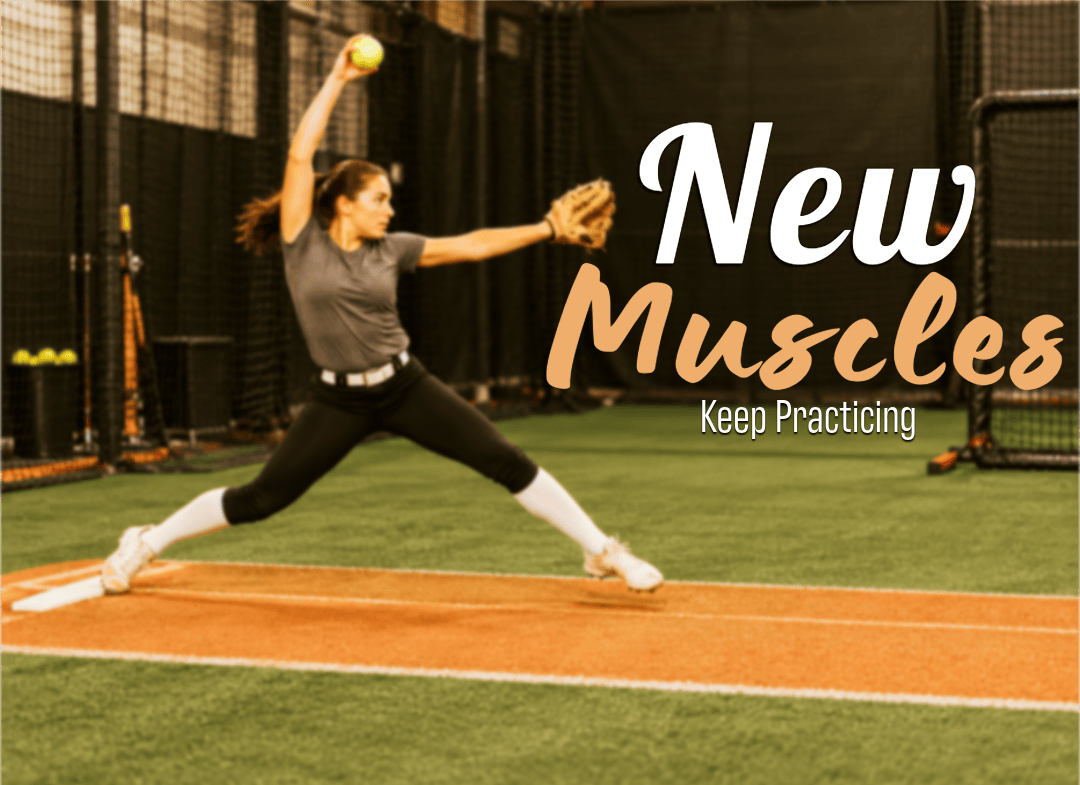

New Muscles

Keep Practicing

I don’t have to get it right the first time. I just have to stay willing to learn and not give up.

No discipline is enjoyable while it is happening. it’s painful! But afterward there will be a peaceful harvest of right living for those who are trained in this way. Hebrews 12:11

My daughter plays softball and has always wanted to pitch. She and I have been working on it together. Recently, I noticed that she was getting much better, so I had her work with a pitching coach. The coach showed her several drills and made some changes to the way she was pitching. Almost immediately, I could see a big difference in her velocity. The ball had more pop than before, but her accuracy wasn’t nearly as good. Before the lesson, she could throw the ball consistently over the plate, but she wasn’t generating much power. The coach told her not to worry about that yet. First, they were working on developing the proper motion and momentum. The accuracy would come later.

The next day my daughter told me how sore she was. Her legs, hips, and wrist all hurt. She had only worked with the coach for about an hour, and we had practiced much longer before without her being sore afterward. The difference was that now she was using her muscles differently. She was learning movements her body wasn’t used to, and those muscles needed to be developed.

As I thought about that, I realized how much it resembles my recovery. Everything doesn’t always go as I anticipate when I first try something new. I was uncomfortable the first time I shared at a meeting. I fumbled all over my words. The first time I did a Step 4 inventory, I stalled because I was afraid to do it wrong. After a few weeks, my sponsor finally said, “Okay, next week we are doing this.” The first time I tried to set a boundary with someone, it was not pretty. I was rude and offensive even though I wasn’t trying to be. I had never really set a boundary before, so I didn’t know how. I even announced, “I’m setting a boundary with you.” I was developing my recovery muscles, but I didn’t know how to use them effectively yet. Just like that coach, my sponsor encouraged me to keep practicing and not worry so much about being a little off target. We could work on accuracy later.

Working the steps has helped me learn to do things I had never done before and to do old things in healthier ways. The first attempts can be awkward. Sometimes it even hurts. But that does not mean I should give up. I can learn from what happened and try again. Today I understand that I don’t need to do everything “right” the first time. In fact, sometimes it helps me when I don’t. It keeps me humble and teachable. Growth can be uncomfortable when I am using muscles I have never used before. But if I keep practicing, what once felt new and awkward can eventually become my new normal and simply the way I live.

Reflection: What am I learning to do differently that I want to become my new normal and the way I live?

Life Is Good

Learning to Enjoy It

The gift of recovery for me is simply recognizing that life can be really good.

God richly gives us everything to enjoy. 1 Timothy 6:17

For the past few months I have been leaving my house around eight in the morning and not getting home until about 10:30 at night. It has been exhausting. Today was the first day in a long time that I was coming home at a reasonable time, and I caught myself wondering, What am I going to do tonight? Then a recovery thought came right into my mind: Be in the moment and enjoy the moment. I actually got excited about that thought. It made me happy because recovery is working in my life. I am learning to let my head and my heart be where my feet are. Tonight I get to spend the evening with my wife and daughter. I don’t have to have an agenda. I don’t have to have a plan. I don’t have to accomplish anything. I can just relax and enjoy their company and their presence. That is relaxing. That is rest. And I couldn’t be happier. There was a time when I wasn’t able to even recognize what good was. And living life seemed like a chore. It wasn’t fun.

When I first came into recovery, my life was filled with chaos, turmoil, stress, and damage. All of my energy went into dealing with problems, putting out fires, trying to control situations, and worrying about what might happen next. Working through the steps of Recovery, I learned how to deal with those things. But I also learned something else: I can enjoy the good things in life too. I now recognize when life is peaceful. I notice what is beautiful. I enjoy being home with the people I love without needing something else to happen. There doesn’t have to be a problem to solve or something that needs my attention. Life is really good. I am learning how to recognize it, appreciate it, and enjoy it.

That didn’t just happen overnight. It has been the result of continually working the steps with my sponsor and applying recovery principles to my life on a daily basis. I have heard it said that I cannot think my way into better behavior, but I can act my way into better thinking and feeling. I practiced these principles long before they became part of my regular thought process. My thinking began to change little by little. I am experiencing some of the sanity promised to me in Step Two. The chaos that once filled my life doesn’t define my life today. I have peace and actually recognize it when it is here. I have a life that is good, peaceful, and enjoyable. Tonight, that looks like coming home earlier, being with my wife and daughter, and simply being grateful to be there. And that is the gift of recovery for me.

Prayer

God, thank You for my life. Thank You for the good things You have placed in my life. Show me how to keep my mind and heart where my feet are. Help me notice the good in my life and be grateful. You are good and You are good to me. Thank You. Amen

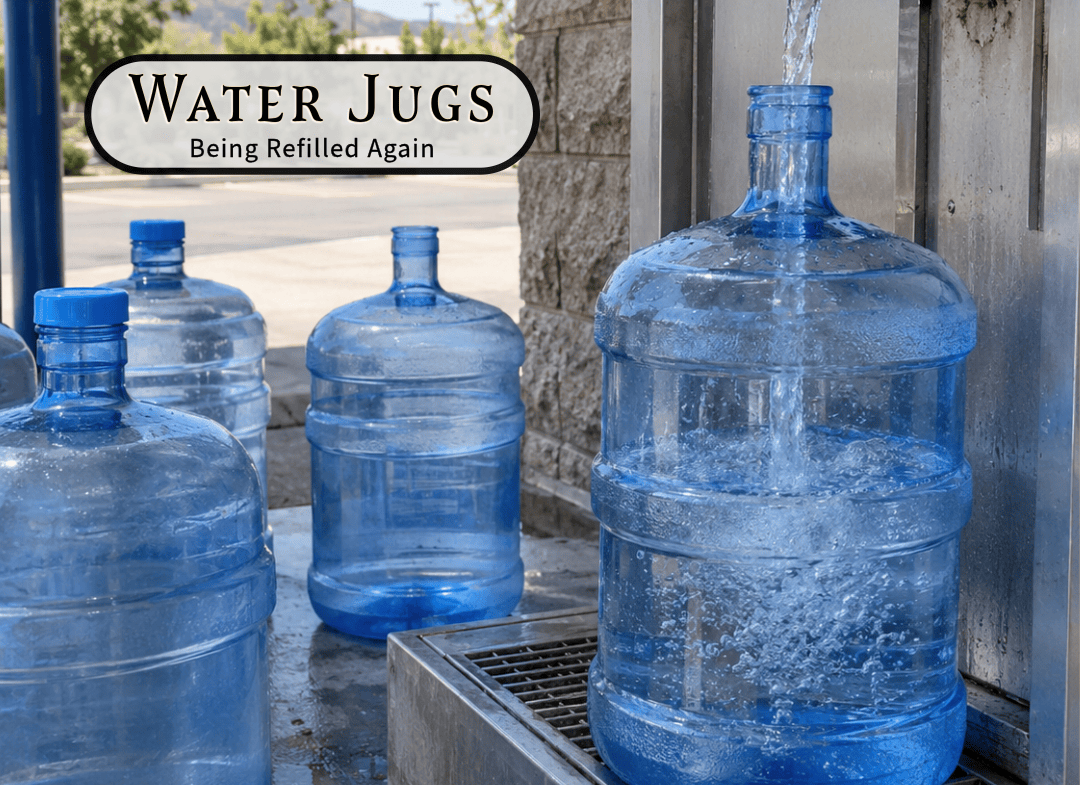
Water Jugs

Being Refilled Again

I cannot live today on yesterday’s prayers. I need to keep coming back to God to be refilled.

But those who trust in the Lord will renew their strength; they will soar on wings like eagles; they will run and not grow weary; they will walk and not faint. Isaiah 40:31

The drinking water where we live is not very good, and there have been enough questions about the quality and safety of it that we choose not to drink it. One of my weekly chores is to gather up our water jugs and take them down to the filling station. So every week I load the empty jugs into my car, drive down to the water station, fill them up, and bring them home. It usually takes about an hour out of my day. I will admit, it is inconvenient. There are plenty of other things I would rather do with that hour. But if I do not refill the jugs, eventually we run out of water.

The other day, while I was loading all the jugs into my car, I started thinking about how much those empty jugs reminded me of my recovery. I need to continually be filled too. Working my recovery program is not something I started years ago and can now just leave alone. My spiritual life is not something I can fill up once and expect to stay full forever. Life is sometimes draining. Stress, responsibilities, and relationships often require effort and energy. After a while, I start running low again. If I am not paying attention, I can get empty before I even realize it. That is why Step 10 is so important to me. It keeps me looking at myself and honestly assessing where I am, what is going on inside me, and what needs my attention. The jugs do not stay full just because I filled them when I bought them or even because I filled them last week, and neither do I.

Step 11 is where I continue going back to God. Through prayer and meditation, I seek Him, listen for His direction, and allow Him to replenish what life has drained out of me. I cannot live today on yesterday’s prayers. I cannot depend only on what God showed me last week, last year, or years ago when I first entered recovery. I need Him today. That does not mean everything I received before is gone. It means my relationship with God is active and ongoing. Just as those water jugs need to be refilled regularly, so do I. And when I am practicing Steps 10 and 11, then Step 12 becomes a natural outcome. I have something to share with others because I continue to receive.

Maybe that is why filling those water jugs every week struck me differently today. I have done it countless times, and I will have to do it again. They will get emptied, and I will need to refill them next week. That is not failure. That is how they are meant to be used. That is their purpose. The same is true for me. Recovery is not about getting filled once and staying that way forever. It is about continuing to pay attention, staying connected to God, and continuing to practice what keeps me spiritually and emotionally healthy. I need to keep coming back to the source to be refilled. God is my source.

Prayer

God, I need You today and every day. Help me stay close to You and be honest about where I am. Fill me with Your Spirit, strength, wisdom, and direction. I commit this day to You. Amen.

Still Finding Layers

Free From Old Beliefs

Sometimes the hardest beliefs to uncover are the ones I have already worked on before.

And you will know the truth, and the truth will set you free. John 8:32

I was listening to a recovery speaker recently when she mentioned that her first sponsor had agreed to be her “temporary sponsor.” That caught my attention immediately. I stopped. Temporary sponsor? My first sponsor had used those exact words with me almost twenty years ago. For all these years, I had thought that was something specific to me. Then she said her “temporary sponsor” ended up sponsoring her for years. That caught me even more. I started wondering if “temporary sponsor” was actually a term. Was this really a thing? I discovered that it was. And I was not so unique and special as I had assumed. Suddenly I realized I had misunderstood this from the very beginning and had carried that misunderstanding with me all this time.

When I was brand new to recovery, I had no idea that offering to be someone’s temporary sponsor was a common way to help newcomers get started and begin working the steps. All I heard was the word temporary. With my best thinking at the time, I translated that into, I am not good enough for a real sponsor. I have to settle for a temporary one. This is not going to last. I secretly carried that inside. So even though my sponsor never treated me like I was temporary or less than, I kept waiting for the other shoe to drop. I wondered when he would finally tell me our time was up. I never asked what he meant by temporary because I was afraid of what the answer might be. Instead, I filled in the blanks myself. He sponsored me for two years, and even after I moved away, he continued sponsoring me long distance for months. He never ended the relationship. I did.

Looking back, I can see how an old corrupt core belief was still operating underneath everything. I had already done a lot of work in recovery around the faulty thinking that I am not good enough. My sponsor calls the deeper belief underneath that the corrupt core belief of “I am bad.” Yet I was discovering that another layer of it was still there. His actions never supported the story I had created in my head. He showed up. He invested in me. He stayed connected. Yet I continued interpreting the relationship through an old belief I had never challenged because I was afraid to ask.

Finding out after all these years that temporary sponsor was actually a common recovery term did something in me that I still cannot fully explain. It was like another layer of the onion had been peeled back. Nothing dramatic happened. I just noticed a little more rest inside me. A little more confidence. A little less suspicion that something was wrong with me. I am learning that even after years of recovery, there can still be old beliefs quietly influencing how I see myself and the world around me. Recovery has helped me challenge that corrupt core belief many times, but apparently there was still more underneath it. There may still be more. Today I am simply grateful that truth reached another place in me where an old lie had been quietly living for years. And that is the gift of recovery for me.

Reflection

What old belief may still be shaping the way I see myself today?

Put Them Out

Protecting My New Life

I had to separate myself from old influences that were not good for me. Not everybody liked it. Not everybody understood it. But I had to do it for me

But when the crowd was put outside, He went in and took her by the hand, and the girl arose. Matthew 9:25

I often say that I love finding recovery principles in the Bible. The truth is, they are really biblical principles that recovery uses. I just see them from a recovery perspective now. There is a story about Jesus raising a little girl from the dead that reminds me of this. Jairus came to Jesus asking Him to heal his daughter. On the way to the house, word came that she had died. Jesus continued on, but He only allowed Peter, James, and John to go with Him. When He arrived at the house, people were crying, mourning, and wailing. Jesus told them the girl was not dead but sleeping, and they laughed at Him and ridiculed Him. That means they dismissed, belittled, and minimized Him and what He said. So He put them all out. Everybody except the girl’s mother and father and the three disciples had to leave. These were not just random people standing around. This was Jairus’ home. Family, friends, and important people in their lives were there, and Jesus still put them all outside. I don’t think they were happy about being put outside, and they probably didn’t understand why He did it either.

There have been times in my recovery when I have had to do something very similar. I have had to remove myself from people, places, situations, and influences that were not healthy for me. Some of those changes were drastic, but I did not want to stay anywhere close to the life I had been living. I wanted to get so far away from it that going back would not even be an option. Drastic times required drastic measures. I changed where I went. I changed who I spent time with. I stopped doing things that connected me to my former life. Instead, I surrounded myself with people who wanted to walk this new path with me, people like my sponsor, accountability partners, and other people I’ve met in the rooms of recovery. They encouraged me, challenged me, and helped me keep moving forward. And I was able to help them too. For me, I could no longer allow anyone or anything to pull me back toward my former life. A life I no longer wanted to live. Not everybody got to come with me, and I needed to put some people out too. Not everybody liked it or even understood it. But I was doing this for me.

And I have reaped the benefit of those decisions. My environment changed. My thinking changed. My relationships changed. The life I had known before began to disappear. In many ways, it died. And something new began to live. That is what I see when I read this story today. Jesus knew what He was about to do, and He was very selective about who was allowed to go with Him and who was allowed in the room. I have learned that I need to be selective too. There are people and influences that strengthen my faith, my recovery, and my life with God, and there are others that could pull me back toward my former life. I have a responsibility to guard what God is doing in my life. I take that seriously. And I have never looked back.

Reflection

Are there people, places, or influences in my life that continue to pull me toward a life I no longer want?

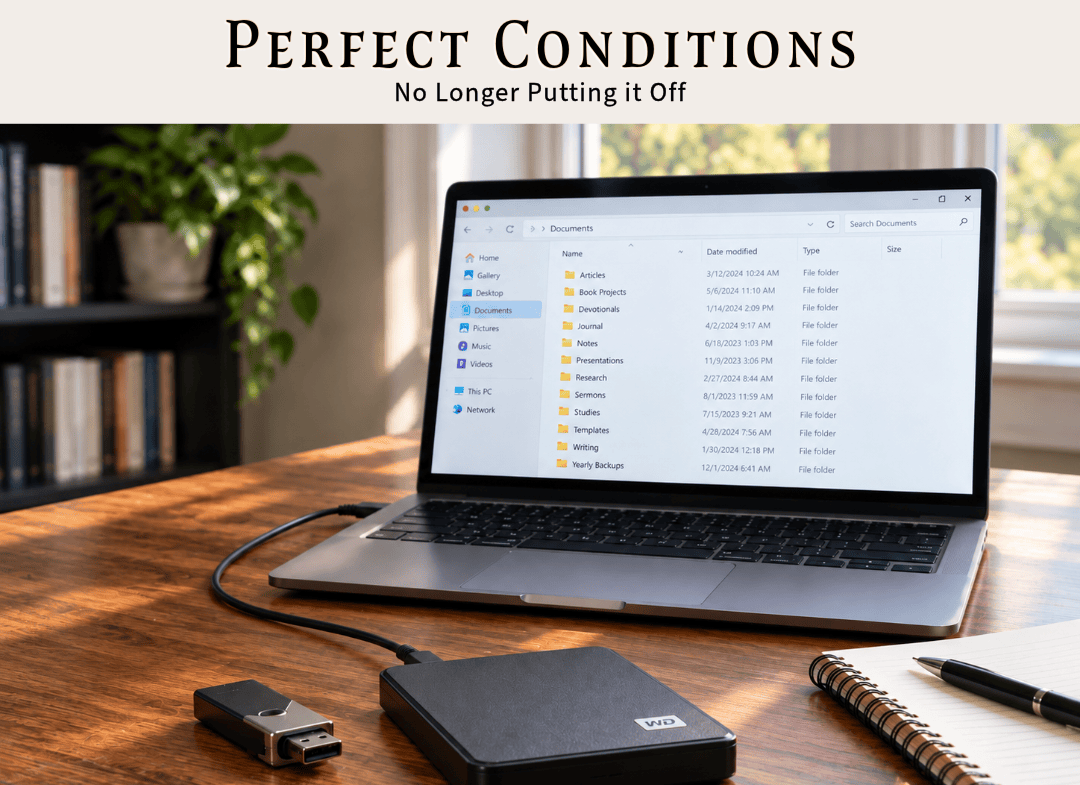
Perfect Conditions

No Longer Putting It Off

I don’t always want to face what is in front of me, but I usually feel better after I do.

If you wait for perfect conditions, you will never get anything done. Ecclesiastes 11:4

This past weekend I finally tackled a project I have been putting off for a very long time. Over the past twenty years, I have changed computers several times, and with each backup I accumulated multiple versions of my writings: sermons, teachings, studies, articles, and book projects. I would work on something, save it under a new name, come back later, add more content, and save it again. Eventually, I ended up with multiple versions of the same material scattered across different folders and drives. Some had material the others did not. Some were duplicates or partial versions. I kept saving everything, telling myself that one day I would go through it all, consolidate it, organize it, and clean it up. This weekend was finally that day.

It was laborious and tedious. I spent the whole day opening files, comparing them, checking word counts and page counts, combining material, deleting duplicates, and trying to figure out what belonged where. Some of my book projects had several different versions, each containing something a little different. As I was finishing the project, I was mentally tapped, but I was also relieved. It felt good to have finally completed this project, something I had avoided for so long. What had seemed overwhelming and impossible before I started was now finished. The mess was organized. Things I no longer needed were gone. Things that belonged together were together. And I had freed up almost 500 gigabytes of space on my hard drive.

As I thought about it, I realized how much doing that reminded me of my recovery. The things I do not want to deal with, I tend to avoid. Maybe something seems too difficult. Maybe I do not understand how to deal with it. Maybe I am afraid of the consequences or an outcome that I cannot control. What I am finding is that when I have the courage to face things, I am ultimately glad that I did. I feel better about who I am, and many times the outcomes or consequences I feared never materialize the way I imagined they would. Sometimes just facing something begins to take care of the problem itself. Sometimes there are unpleasant consequences, but eventually those pass too. And when it is over, I still feel better about who I am. Most of the time, like this past weekend, I reap a real benefit from confronting and dealing with things instead of avoiding them. Avoidance was old behavior.

Working the Steps of recovery has helped me learn that I do not have to want to do something before I do it. I do not have to like it, understand all of it, or know exactly how it is going to turn out. I can simply do the next right thing and deal with what is in front of me. There is something freeing about that. I am no longer carrying the weight of everything I am putting off or trying not to think about. This weekend, I finally brought order and structure to the chaos of all my writings on my computer. I also freed up a lot of space on my hard drive. In recovery, by facing things instead of avoiding them, I have brought order and structure into areas of my life and relationships that used to be chaotic too. I have also gained a lot more space in my life for new things. I may not always like what I have to face or want to deal with it, but I like who I am when I do. And that is the gift of recovery for me.

Reflection: What am I putting off because I am waiting for better conditions?

On Emotional Pause…

For years, I stayed emotionally on pause. Today I’m hitting play and learning that I matter too.

Learning to Hit Play

When I was a child, I saw things like a child. I spoke, thought, and reasoned like a child. But when I grew up, I put away childish things. 1 Corinthians 13:11

I read something in my devotional the other day that stuck with me. It said, “It was time to stop waiting for others to take care of me. The only person who can love me the way I want to be loved all the time is me.” That hit me on many different levels. My first thought was, I’m not a victim. When I sit around waiting for someone else to take care of me, notice what I need, tell me what to do, or make everything okay, I fall back and feel like a child again. The problem is that a lot of my emotional and psychological development was stunted when I was a child. It was like somebody hit the pause button, and it stayed there until I entered recovery as an adult, started doing step work with my sponsor, and finally hit play.

I’m learning in recovery how to self-parent. For me, that means taking responsibility for myself and my actions. It means protecting myself when I am in an unsafe situation, either by speaking up or removing myself. It means taking care of my health, going to the doctor when I need to, eating better, spending money on things I legitimately need, and expressing my wants and needs without feeling guilty for having them. I no longer wait for someone else to tell me what to do. I no longer sacrifice my own needs because I’m trying to please everyone else. Self-care is not selfishness. It is looking after the person God has entrusted me to care for. Me! I have taken care of others for so long, it is time for me to take care of me too.

It also means learning to love myself. Before recovery, if I am being honest, I hated myself. I hated how weak and vulnerable I was as a child. I hated that I let people walk all over me and take advantage of me. Yet I kept coming back for more because, deep inside, I believed I was not good enough. As I got older, I compensated with pride and arrogance. It was an attempt to convince other people, and myself, that I was strong and that I was good enough. It was all a facade. A counterfeit. I was doing the best I could with what I had, but it never worked. Then, early in recovery, I met the woman who would become my wife. One day she made sure she had my full attention and said, “You deserve to be loved and loved in the way you need it.” I started to weep. I had never heard anything like that before. Something broke inside me, but in a good way. It was like someone flipped on a light switch. I suddenly understood something I had never even considered before: I deserved to be loved just as much as anyone else.

Walking that out has not always been easy. Understanding it was. Once that switch was flipped, I started seeing things I had never seen before. I began learning that I am responsible for loving and caring for myself too. That does not mean I do not need other people or that their love does not matter. It does! It means I no longer make someone else responsible for proving that I have value. I can express what I need. I can receive love. I can give love. And I can treat myself like someone who matters. This is the gift of recovery for me.

Reflection

Where in my life do I still fall back and feel like a child?

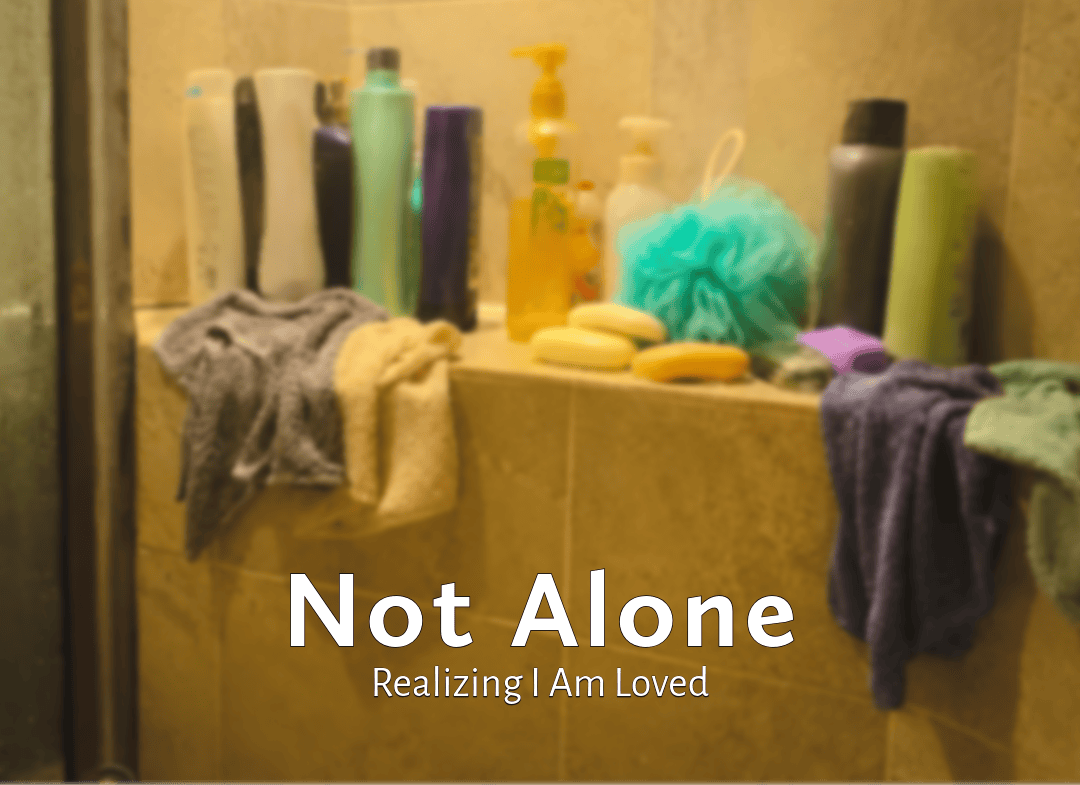
Not Alone

Realizing That I Am Loved

Sometimes the things that annoy me are the very things I would miss if they were gone.

And the Lord God said, “It isn’t good for man to be alone…” Genesis 2:18

Our upstairs bathroom is being worked on, so for the time being my wife, my teenage daughter, and I are all sharing one bathroom. Normally, they use the upstairs bathroom and I use the downstairs one. At first, I didn’t think sharing would be that big of a deal. Then they moved in with all their stuff.

Everywhere I looked, there was some kind of product. In the shower there were three or four kinds of shampoo, two or three different conditioners, three different bars of soap, a couple kinds of liquid soap, pouf balls, loofahs, and multiple washcloths. Apparently, you need all of these things just to take a shower. In the drawers there were four different brushes, three different combs, and all kinds of other things that had never been there before. At first, I was annoyed. Their stuff was in my way, and I had to move my stuff around to make room for theirs. So I started thinking about what recovery principles I could use to help me deal with it. Let go and let God came to mind. I thought about How important is it? And knowing this wasn’t permanent, This too shall pass was another.

Then one day, while I was taking a shower and looking at all those products, another thought struck me out of the blue: I’m not alone. Big revelation, right? All of those things in my bathroom meant there were other people here. I love it when that happens. It usually means I am about to learn something and grow. Which I did. I realized that I like not being alone. Don’t get me wrong, I value my alone time very much, but I don’t want to be alone all the time. I’m not sure how I would feel if I were. I have people in my life that I love and who love me. We are a close-knit family. Yes, we get on each other’s nerves occasionally. We have our scuffles and disagreements, but we work them out. I don’t just love my family, I really, really like them and enjoy spending time with them.

When I got out of the shower, I took a look around at all that stuff. I saw something different. I saw that I’m not alone. I saw that I have a family. I saw that I am loved. I still wouldn’t mind having my bathroom back, and I definitely look forward to it, but until then, all those bottles, brushes, soaps, and loofahs remind me of something much more important than having everything where I want it. I have people in my life who love me, and I am very grateful for that. And that is the gift of recovery for me.

Reflection: What things in my life annoy me but I would deeply miss if they were gone?

Feelings Are Not Shortcomings

But They Can Be Scary

For most of my life, I thought certain feelings meant there was something wrong with me. Recovery has been teaching me something very different: feelings are not shortcomings.

Elijah was a human being with a nature such as we have [with feelings, affections, and a mental and emotional state like ours]… James 5:17

I was reading from one of my devotionals the other day. One sentence stopped me in my tracks: “Feelings are not shortcomings, but my refusal to acknowledge and accept them is.” That sentence challenged something I had believed for most of my life. I grew up believing feelings were either good or bad. And if I had bad feelings, that meant there was something wrong with me. Feeling sad, left out, lonely, hurt, or not good enough were all things I thought were bad and that I should not feel. Good people didn’t feel those things or let them get to them. So I learned to stuff them. Growing up in an alcoholic family, what I thought and what I felt were not important. What mattered was what the alcoholic thought and felt. What kind of mood the alcoholic was in. I learned that my feelings were unimportant and even dangerous. It was safer for me not to have them, or at least not to let anyone know I had them.

When I first started recovery, I heard everyone talking about their feelings. So I thought I would try it, but feeling my feelings was scary. Sometimes it still is. When I allow myself to really feel hurt, sadness, loneliness, or rejection, I can feel flooded. I don’t always know what to expect. I don’t know where the emotion may go, how far it could go, or when it is going to stop. I don’t know how I am supposed to respond or if I am to respond at all. What if I start crying? What if I feel out of control? For years, stuffing my feelings felt safer than allowing myself to experience them at all. But I am learning there is a difference between having a feeling and being controlled by it. I don’t always get to choose the feeling that shows up, but I am responsible for what I do with it when it does. I can feel left out without deciding nobody wants me. I can feel not good enough without accepting that that is who I am. Feelings are not facts. But they are real. And pretending they are not there does not make them go away either.

God gave me emotions. Recovery is not teaching me to become emotionless. Asking God to remove my shortcomings does not mean I’m asking Him to remove my feelings. Sadness, loneliness, hurt, and even anger are not shortcomings or character defects. But what I do with those feelings may reveal my shortcomings. Having these feelings is not proof that something is wrong with me. It is proof that I am human and alive. For most of my life I thought the problem was that I had certain feelings, bad feelings. What I saw in this reading was that refusing to acknowledge and accept that I have those feelings was the problem. When I stuff, ignore, or deny my emotions because I don’t like them, I am letting them quietly control me.

I no longer have to be afraid of my feelings. I can acknowledge them, feel them, bring them honestly to God, and allow Him to show me what is true. Now I ask God to remove my shortcomings, and not my emotions. When I do, I find that He heals the pain and shows me how to respond differently to it. He doesn’t have to remove my emotions for me to change. And that is the gift of recovery for me.

Prayer

God, help me be honest about what I am feeling. Help me feel what I feel. Help me not to stuff it, avoid it, or be afraid of it. Show me how to respond. Amen.

The Test

Quietly Asking Without Asking

I was about to create a test for someone they didn’t even know they were taking.

But each one must carefully scrutinize and examine his own actions, attitudes, and behavior, and then he can have the personal satisfaction and inner joy of doing something commendable without comparing himself to another. Galatians 6:4

I miss my grown children. We live in different states now, and I would really like to stay more connected with them. Usually every Monday I send them a text and ask how things are going. How is the family? Did you do anything over the weekend? Anything new going on? They usually respond. Our exchanges are very nice, but most of the time I am the one who initiates them. I wish I heard from them more often without being the one to reach out first. Sometimes that hurts. Sometimes I wonder if things I did before recovery damaged our relationship. I know I made mistakes, and I know I cannot go back and change the past. I have made significant changes in my life and in the way I interact with people, especially my family. I am still not perfect, nowhere near it, but I have changed a lot. Even so, that doesn’t stop me from wondering if things would be different today if I had been different then.

This week I was getting ready to send my usual text when another thought came into my head. I’m not going to text them this time. I’m going to wait and see how long it takes for them to contact me. Almost as soon as the thought processed through my brain and into my conscious thinking, I recognized it. That was manipulation. That was the old me. I wasn’t simply deciding not to text them. I was setting up a test for them to take. One they didn’t even know they were taking. If they contacted me, I would feel wanted. If they didn’t, I would interpret their silence as proof that they didn’t care about our relationship as much as I did. What I was really going to do was try to get something from them without ever asking for it. I don’t want to live that way anymore. So I sent the text.

The truth is, I text my children because I love them. I text them because I miss them and because staying connected with them matters to me. I would love for them to initiate more often, and I am not going to pretend it doesn’t hurt when they don’t. Recovery doesn’t require me to deny how I feel. But it does help me identify and accept my true feelings. And it reminds me that I can choose how I act, but I have no control over how they do. I sent a text message just because I wanted to talk with them. I was not expecting anything in return. For me, that was doing the next right thing. When I do what I know is right and leave the outcome up to God, I have peace within myself and peace with God. And that is the gift of recovery for me.

Reflection: Have I ever expected something from someone without asking for it, then quietly tested them to see if they would give it to me anyway?

When Everything Bothers Me


A Hot Mess

When I start to think everything else is the problem, it usually isn’t everything else. It’s me.

Guard your heart above all else, for it determines the course of your life. Proverbs 4:23

Last night our Internet went out. It had been having sporadic problems for a few weeks, and usually I have to reboot everything. It is annoying, but eventually it comes back online. This time it didn’t work. I started troubleshooting, which is difficult when the thing you need to troubleshoot with is the Internet that isn’t working. Eventually I contacted customer support and found out there was routine maintenance in our neighborhood and the service would be down for about eight hours. That really irritated me because nighttime is when I usually do my writing. I didn’t like the answers I was getting, and I vented my frustration to them for several minutes before finally going to bed. The next morning the Internet was back, so I opened my laptop to write. Then it went out again. Now I was angry. Support told me there was an outage. I knew there was an outage. What I wanted to know was why. Why now? Why during my writing time? Don’t they know how important I am?

After I collected myself, I started asking a different question. Why was I so upset? The truth was, I didn’t even need the Internet to write. Everything I needed was already on my laptop. And if I did need to get online, I could use the hotspot on my phone. But that wasn’t the point. It was the principle. I was paying for something and I wasn’t getting it. I wasn’t getting what was rightfully mine, what I deserved. As I thought more about that, I realized this wasn’t just about the Internet. Lately, things that normally wouldn’t bother me at all were really upsetting me. Drivers riding my bumper irritated me. Unhappy clients at work irritated me. Employees who wouldn’t accept responsibility irritated me. It seemed like everybody around me had suddenly become more difficult. That is when I saw it. Something my sponsor has told me often: if everybody else is the problem, then maybe the problem isn’t everybody else. Maybe the problem is me. I am the common denominator.

HALT suddenly came to mind, a common recovery acronym reminding me not to become too Hungry, Angry, Lonely, or Tired. The answer surprised me, although it probably shouldn’t have. I was in the middle of fourteen straight days of working twelve to fourteen hours a day. I wasn’t eating properly, so I was hungry. My body was exhausted, so I was tired. I barely saw my family except in passing between work and sleep, so I was lonely. And all of those things were making me irritable and easily provoked. I was a hot mess. The Internet outage didn’t create what was going on inside me. It exposed it. I started troubleshooting my Internet problem and discovered that the Internet was not the only thing down. I was too.

I got some rest, ate a healthy meal, spent a little time with my family, and I felt less angry. HALT doesn’t mean everything around me is okay. The rude driver may really be rude. The client may really be unreasonable. The Internet may really be down when I am paying for it to work. But when everything around me starts bothering me, I am learning to pause, stop looking at everybody else, and check myself. Am I Hungry, Angry, Lonely, or Tired? If I identify even one of these, I need to address it. And when I do, I often find that the serenity I seek isn’t far off. If I honestly look at my part and take care of what is going on inside me, everything around me doesn’t seem to bother me as much. I can truly find peace in the midst of chaos. And that is the gift of recovery for me.

Prayer

Lord, help me recognize what is going on inside me before I react to everything going on around me. Help me take care of the things I can change and trust You with the things I can’t. Amen

I Was Wrong, But…

My Explanations

My explanations, no matter how true they were, were just excuses called by another name.

Confess your faults one to another, and pray one for another, that you may be healed. James 5:16

This weekend I made a mistake while umpiring a tournament. Near the end of the game I got one scoring scenario stuck in my head and reported the final score wrong. I knew the rule. I was tired, I was coasting a little, and in my mind this was a game that really didn’t matter. I just blew it. A coach challenged the score, the tournament director got involved, and it was corrected. The right team advanced. The situation was resolved, but I wasn’t.

When the tournament director asked me what happened and how I had reported the score, I started defending myself. I told them, “I did exactly what you told me to do.” They shot back, “No, that was an if scenario. That wasn’t the case here.” They were right. I was wrong.

Later I found myself complaining to my partner about it. I said I had been so focused on the tie scenario that even after one team pulled ahead, I still had the tie rule stuck in my head. I said it was only a consolation game anyway. What difference did it make? If it was that important, maybe the tournament director should have been there themselves. I kept spinning on something that had already been corrected. Then my partner said, “It’s my fault too. I was there, and I knew the rule too.” Then he added something that stopped me: “I just owned it and told them I screwed up.” I immediately saw what I had been doing. I had admitted I made a mistake, but I hadn’t really owned it. Every explanation I gave my partner was another way of saying, “I was wrong, but…” Even if what I was saying was true, none of it changed the fact that I made the mistake.

As I thought about why I reacted that way, I realized I was embarrassed. I have been umpiring a long time. I know the rules. I don’t make those kinds of mistakes. At least that is what I told myself. Because apparently, I do. Then I saw it. Pride. Instead of just saying I screwed up, I started explaining why I did it and pointing out what everyone else could have done differently. Before recovery, I would have kept telling anyone who would listen what everyone else could have done differently and never even considered what I could have done differently. Instead, the next day I called the tournament director and apologized. I apologized for challenging them, for the way I behaved, and for deflecting responsibility instead of admitting I screwed up.

I am not pleased with how I behaved, but making one mistake does not have to become another mistake. Once I see my part, I can own it without excuses, make amends where necessary, ask God to help me change and show me how to make it right. Then I can let it go. I don’t need to defend myself. I don’t have to explain why I did it. The most honest thing I can do is simply admit, “I was wrong. I screwed up.” Which I did. Although it may not feel or seem like it…that is the gift of recovery for me.

Reflection

When I take responsibility, do I still try to make myself look better by explaining why I did it?

Jumping to Conclusions

When Assumption Become Facts

I did not know what happened. I just decided I did.

The first one to plead his cause seems right, until his neighbor comes and examines him. Proverbs 18:17

I have this little cloth that I put over my laptop keyboard before I close it. It keeps the oils and dirt from the keyboard from transferring onto the screen. I use my laptop every day to write, so I take especially good care of it, including that little cloth. The other night when I was shutting my laptop down to put it away, I could not find the cloth. I looked everywhere for it but could not find it. I thought for a brief minute that maybe I misplaced it, but immediately I thought, No. I always put my stuff away. So I assumed maybe the cat took it and thought it was a toy. The next morning I still could not find it. I asked my wife if she had seen it and told her I thought the cat took it. She said she hadn’t seen it, but I could have hers. I did not want hers. I wanted mine. And if I am honest, I wanted to complain about the cat taking my cloth. I had convinced myself that was what happened.

At lunchtime, when I was at work, I pulled out my laptop to do some writing. I was sitting at my desk, looked to the right, and there it was. My keyboard cloth was sitting right there in front of me. It had been there the whole time. The cat had not taken it. I had left it at work. I was glad I had found it, but then it started bothering me. Not because the cloth was a big deal. It only cost a couple dollars. What bothered me was how quickly I had made an assumption and blamed my cat. Why did I do that? Why wasn’t my first thought that I lost it or misplaced it? Actually, that thought did cross my mind, but I dismissed it immediately because I always take care of my stuff and I always put my important things away. And typically, I do. But this time I didn’t. Then I remembered that I was interrupted at lunch the day before. I had to handle a situation right away and I closed my laptop and put it away hastily.

I started thinking about how often I did that before recovery. I made assumptions. I jumped to conclusions. I decided why people did things or what they meant, and I was usually wrong. Apparently I still do it, even after years of recovery. This is where inventory helps. It forces me to look for my part instead of immediately trusting my assumptions. It doesn’t always come from a deep-seated hurt or wound from my past. Sometimes it is real simple. I had decided it could not be me, so I looked somewhere else. I did not know what happened to it. I assumed the cat took it, and then I started reacting to my assumption as if it were true. Recovery gives me another choice. I can stop, find my part, and admit when I simply do not know. That is a huge step for me. Accepting that I do not have all the answers.

And by the way, I came clean. I told my wife I found the cloth at work and I did make amends to my cat.

Reflection

What am I not seeing? What am assuming without really knowing?

He is God. I am Not

Seeing His Leading

Sometimes God’s direction looks like disappointment before I recognize that He is leading me.

A man’s mind plans his way [as he journeys through life], But the Lord directs his steps and establishes them. Proverbs 16:9

Before recovery, I wanted to seek God, but I wanted to do it on my terms. I had been hurt by church leaders and had decided I would have a relationship with God without going to church. I was willing to follow Him as long as He did not lead me back there. When I started recovery, I knew I was supposed to get a sponsor. There was one man, whom I immediately gravitated toward. He talked openly about God, and it was obvious to me that his relationship with Him was real. Here was my guy. He was someone who genuinely knew God without all the church stuff that I was trying to avoid. So, I asked him to sponsor me. He said no. I was hurt and offended. I felt just like I did when I was hurt by those church leaders. But God had something else in mind.

A few days later I showed up for one of my regular meetings only to find out it had been canceled. I desperately needed a meeting. I was lonely and honestly felt like acting out. On the way home, I saw a sign for a new recovery meeting happening that night. There was only one problem. It was at a church. Ugh. I had purposely avoided any recovery meeting held in a church. It hurt too much to even think of walking back into a church. I reluctantly walked in. A man greeted me at the door and asked what brought me there. I said, “Umm… I wanted to come to a recovery meeting.” He smiled and said, “Great. I have been waiting for you.” I could not get those words out of my mind. I listened intently when he shared, and I related to what he said. I came back the next week and asked him to sponsor me. He agreed to be my “temporary sponsor.” He was the first person I ever truly, fully trusted.

Working honestly through the steps with my sponsor, God began healing past hurts and wounds. I was able to let go of the resentments I carried toward church, and eventually I even started attending church again. More importantly, I began to feel free and clean before God again. I was no longer afraid to come before Him and be vulnerable in His presence. I had not felt that kind of freedom with God in a very long time.

I have heard people say many times in recovery that God did for them what they could not do for themselves. Looking back, I can see Him doing that for me. I chose the sponsor who fit my plan, and he said no. The meeting I planned to attend was canceled. The meeting I would never have chosen was at a church, and the man God used to change my life was waiting for me there. What I could not see then was that God had been directing my steps the whole time. I am very grateful for my sponsor. My life is truly better because of the work we have done together. I believe it would never have happened if God had not been doing for me what I could not do for myself. I am deeply thankful to Him for that.

He is God, and I am not.

Reflection

Am I still trying to seek God on my own terms? Where do I see Him moving in my life?