I Was Wrong, But…

My Explanations

My explanations, no matter how true they were, were just excuses called by another name.

Confess your faults one to another, and pray one for another, that you may be healed. James 5:16

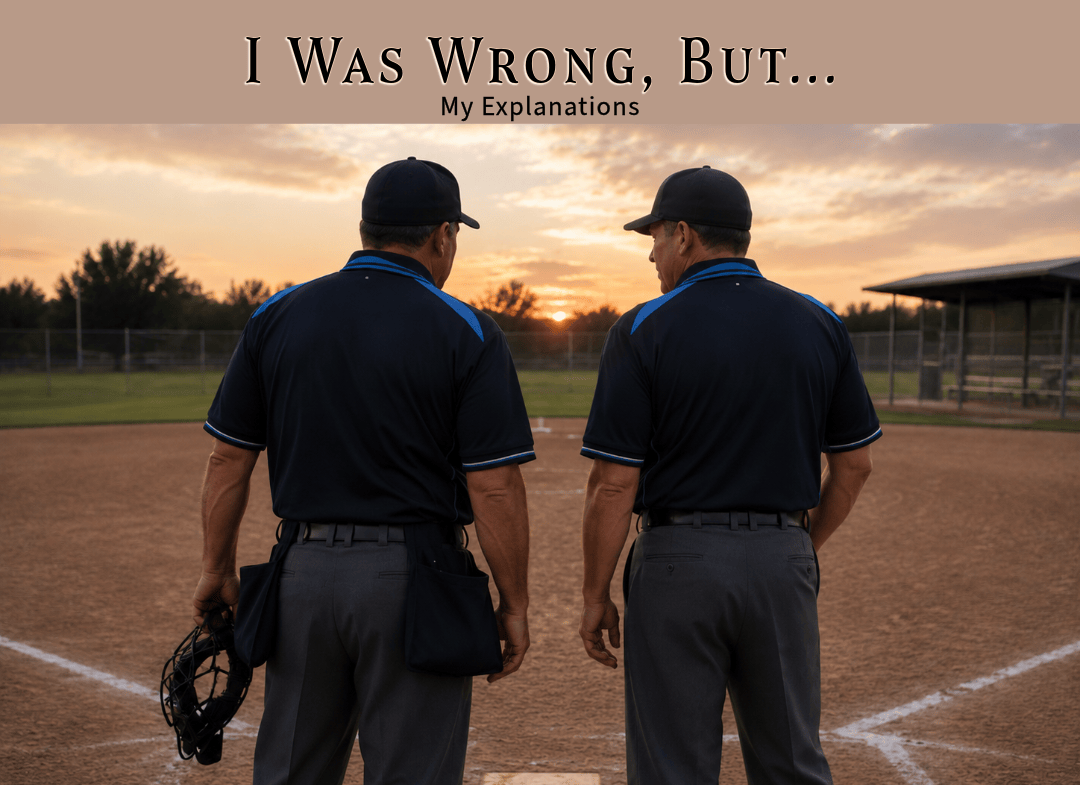
This weekend I made a mistake while umpiring a tournament. Near the end of the game I got one scoring scenario stuck in my head and reported the final score wrong. I knew the rule. I was tired, I was coasting a little, and in my mind this was a game that really didn’t matter. I just blew it. A coach challenged the score, the tournament director got involved, and it was corrected. The right team advanced. The situation was resolved, but I wasn’t.

When the tournament director asked me what happened and how I had reported the score, I started defending myself. I told them, “I did exactly what you told me to do.” They shot back, “No, that was an if scenario. That wasn’t the case here.” They were right. I was wrong.

Later I found myself complaining to my partner about it. I said I had been so focused on the tie scenario that even after one team pulled ahead, I still had the tie rule stuck in my head. I said it was only a consolation game anyway. What difference did it make? If it was that important, maybe the tournament director should have been there themselves. I kept spinning on something that had already been corrected. Then my partner said, “It’s my fault too. I was there, and I knew the rule too.” Then he added something that stopped me: “I just owned it and told them I screwed up.” I immediately saw what I had been doing. I had admitted I made a mistake, but I hadn’t really owned it. Every explanation I gave my partner was another way of saying, “I was wrong, but…” Even if what I was saying was true, none of it changed the fact that I made the mistake.

As I thought about why I reacted that way, I realized I was embarrassed. I have been umpiring a long time. I know the rules. I don’t make those kinds of mistakes. At least that is what I told myself. Because apparently, I do. Then I saw it. Pride. Instead of just saying I screwed up, I started explaining why I did it and pointing out what everyone else could have done differently. Before recovery, I would have kept telling anyone who would listen what everyone else could have done differently and never even considered what I could have done differently. Instead, the next day I called the tournament director and apologized. I apologized for challenging them, for the way I behaved, and for deflecting responsibility instead of admitting I screwed up.

I am not pleased with how I behaved, but making one mistake does not have to become another mistake. Once I see my part, I can own it without excuses, make amends where necessary, ask God to help me change and show me how to make it right. Then I can let it go. I don’t need to defend myself. I don’t have to explain why I did it. The most honest thing I can do is simply admit, “I was wrong. I screwed up.” Which I did. Although it may not feel or seem like it…that is the gift of recovery for me.

Reflection

When I take responsibility, do I still try to make myself look better by explaining why I did it?
A Trust Problem

Feeling Safe

My need to control uncovered a truth I was blind to. I didn’t trust God or the people who love me.

Whenever I am afraid, I will trust in You. Psalm 56:3

I was listening to a speaker and started meditating on what she said. She shared that one of the reasons she argued in relationships was because she felt out of control. As soon as I heard that, I knew that was me. It was almost like I could finish what she was saying without ever hearing it. I felt like there was a huge spotlight shining on me and God was saying “This is you pal.” I realized that my first reaction in conflict was to defend and argue my position and beliefs. And I know it was because I felt out of control. As I meditated on it more and thought back on my relationships, I realized that my initial reaction when I feel out of control was always to fight. I felt attacked and would immediately defend myself and argue my position because being in control made me feel safe.

Quite honestly this became a huge problem in my marriage. A few years back, my relationship with my wife wasn’t the greatest. Our communication was suffering. We loved each other very much, but we argued a lot. We both love God. We’re both in recovery. We were both trying to do our best. We would pray about our problems and sincerely want things to be different, but somehow we would find ourselves having the same arguments over and over again. Many of the arguments were over stupid things too, that really didn’t matter. Then those little things would turn into “a thing” themselves. It was insane. I would get frustrated and honestly couldn’t understand why we kept getting stuck repeating the same pattern. Last year, I decided to start applying some recovery principles to my marriage more intentionally. One of those principles was simply considering the possibility exists that my wife could be right. Another was accepting things as they are instead of insisting they be the way I wanted them to be. Many times that meant keeping my mouth shut and listening instead of immediately responding, defending myself, or acting like a victim. The results were remarkable. Our relationship improved dramatically. We argued less, enjoyed each other more, and experienced a level of peace that had been missing for a while. Secretly, I thought it was because I was being “recovery man” and I patted myself on the back, because in my mind I was working my recovery. Is that pride? Yes! I am embarrassed to admit I thought this way, but I am just being honest. I was told early on that true healing comes from being completely honest.

Initially, I made those changes because I wanted peace in my relationship and didn’t want to argue. I was practicing recovery principles, keeping my mouth shut more often, and trying not to react. In my mind, that was why things were getting better. And there is some truth to that. But as I reflected on what the speaker said, I began to see something I had missed. One of the recovery principles I was trying to practice was considering the possibility exists that my wife could be right. But it was only an intellectual acknowledgement, because I never really considered that she might actually be right about me. For years she told me that I wasn’t taking responsibility for my part in our conflicts. I heard her words, but I mostly dismissed them as her trying to work my program. I would apologize and not give it another thought, and secretly continue believing that the real problem was not me.

As I got honest with myself, I began to see that my need to defend myself and argue wasn’t really about being right at all. It was about trust. When I felt out of control, I felt unsafe, and when I felt unsafe, I tried to regain control by defending my position and convincing others to see things my way. What I am learning now is that I don’t have to do that. I can trust God. I can trust that the people who love me are not my enemies. I don’t have to prove my point or win every disagreement to feel safe. I can listen. I can consider that someone else might really be right, even about me. The more I learn to trust, the less I feel the need to control. And the less I try to control, the more peace I experience in my life, my marriage, and my relationships. What I once thought was a communication problem seems to really be a trust problem, and learning to trust is bringing a freedom I never found through arguing, defending, or trying to be right. And that is the gift of recovery for me.

Prayer

Father, thank You for showing me that I don’t always have to defend myself. Help me let go of the need to be in control. Teach me how to trust You when I am afraid, and to trust those who love me. Amen.