Accepting Life As It Is

Surrendering Control

I’m learning that peace is not found in controlling everything around me. It is found in learning to trust God in the uncertainty.

Father, if you are willing, take this cup away from me. However, not my will but your will be done. Matthew 26:39

I have two grown children whom I love very much. Unfortunately, they both live in another state, so I don’t get to see them as often as I would like. We talk a couple times a week, usually through text messages, and most of the time I am the one who initiates the conversation. Before recovery, that would have really bothered me. My thinking was very all or nothing. “If they won’t call me, then I won’t call them.” Or, “Why do I always have to be the one reaching out?” But through recovery I am learning to accept relationships as they are instead of demanding they happen on my terms. I am learning to stop rejecting people simply because things are not happening the way I want them to happen. That is what my sponsor says is learning to live in the gray. It is somewhere in between the all or nothing thinking that used to consume me.

Before recovery, I saw almost everything as black and white. Things were either right or wrong. Good or bad. Safe or unsafe. I liked certainty because certainty felt safe to me. If something fit neatly into a category, then I knew how to respond to it. I knew how to control it. Or at least I could plan and be ready in case things didn’t go as planned. It made me feel safe. But life rarely works that way. People are complicated. Relationships are complicated. Emotions are complicated. Things don’t always go as planned. Doing a fearless moral inventory has forced me to start facing the uncomfortable truth that much of life happens somewhere in the gray.

The gray makes me uncomfortable because I don’t know what will happen. I don’t know how to protect myself. I don’t know how to be prepared for or avoid potentially being hurt. Accepting the gray requires trust. It requires patience. It requires me to accept uncertainty instead of rushing to fix it or force it into a category that makes me feel better. Which I now do, although usually reluctantly. One of the things I have discovered through step work with my sponsor is that many times my attempts to “help” or “fix” people were not as selfless as I made them out to be. A lot of it was driven by my own need to feel in control. If I could manipulate and control the situation, calm the conflict, or get the outcome I wanted, it gave me relief. What I have learned since is that my need for control was really giving a dopamine release in my brain. That release temporarily soothed my anxiety and discomfort. It made me feel better, so I sought to feel better again. It was my addiction. I was trying to feel better by managing everyone and everything around me. That realization was hard for me to admit, but by staying honest with myself in my recovery I am learning to face my motives realistically instead of staying in denial about them.

Working through the steps has helped me realize that emotional sobriety or behavioral change is not found in controlling everything around me. It is found in learning how to live honestly, peacefully, and faithfully even when things feel uncertain. I still do not like the gray. I do not like not knowing what is going to happen. I do not like feeling unprepared or out of control. But I am learning how to accept being uncomfortable instead of trying to escape it. I am learning that as I relinquish control God is present in the gray ready to help. And strangely enough, by accepting the gray areas of life, I can now see and appreciate the vibrant areas of life that are full of color, depth and complexity. And that is the gift of recovery for me.

Prayer

Father, help me to stop fighting reality and demanding that life happen on my terms. Teach me to surrender the gray areas of my life to You. Help me to stop trying to control everything around me. Help me to trust You when I feel uncertain, uncomfortable, or afraid. Amen.

Learning How to Be There

Presence Over Control

I’m learning through my recovery that sometimes the most loving thing I can do is to stop trying to fix people and just be there with them.

Be happy with those who are happy. Be sad with those who are sad. Romans 12:15

I’ve heard it said that recovery is a selfish program. And honestly, it is. In the rooms of recovery I have learned that I need to start taking care of myself. Really taking care of myself. My whole self. Taking responsibility for my actions and facing my own issues. I had to learn that I needed to put on my own oxygen mask before trying to help everyone else with theirs. Before recovery, I was always trying to help everyone else get their oxygen while I was suffocating myself and could not breathe. I rarely focused on facing my own needs or healing. I focused almost entirely on what everybody else wanted, needed, or expected from me. Or at least what I thought they did. But I am learning that if I don’t take care of myself emotionally, mentally, and spiritually, I won’t have anything healthy to offer anybody else.

Somewhere along the way, I got part of that mixed up. My wife recently had surgery, and leading up to it, I wasn’t as supportive as I could have been. I meant to be and wanted to be, but I reverted to old behavior. I kept focusing on trying to help her “not be afraid.” I wanted to fix the fear she was feeling instead of simply recognizing that fear before surgery is normal. It’s human. Instead of just sitting with her in it, reassuring her, and being present, I kept trying to move her away from what she was feeling.

In recovery I am learning that sometimes people just need support, reassurance, and comfort. Sometimes they just need someone to be there. Sometimes they may need help that I actually have the ability and capacity to give. I have learned to stop trying to fix everybody else. If I want to fix anyone, I need to focus on fixing me. I can help without fixing or being in control. I can help even if things are not done my way. I can help by just being there and letting people be who they are. I am learning, slowly, that it is healthy to still care deeply about others even when I am unsure of outcomes. And that by doing that, I am taking care of myself too.

I am grateful and thankful for my recovery program and the tools I have learned. Fortunately, by using them, I was able to correct my behavior and do just that on the day of the surgery. I was supportive. I acknowledged the fear. We prayed about it together. I assured her she was not alone in this, not just with my words but with my presence. I was just there with her, and I let her guide the emotions and conversation instead of trying to control or redirect them. I truly felt supportive, like I was showing real compassion and care. I was showing her that she was important. In short, I was showing her love.

Working through the steps of recovery, I am learning that taking care of myself is important. But healthy recovery is not becoming emotionally distant from the people I love. Sometimes the people I love are afraid. Sometimes they are hurting. Sometimes they don’t need me to fix their emotions or talk them out of them. Sometimes they just need me to sit with them, care about what they’re feeling, and let them know they are not alone. That’s something I am learning a little more every day. And that is the gift of recovery for me.

Prayer

God, thank You for teaching me how to care for myself in healthy ways without becoming distant from the people I love. Help me to stop trying to control or fix everyone around me. Teach me how to be there and listen. Amen.

At Peace With Myself

I spent years trying to escape my thoughts. Recovery taught me how to face them honestly


You will keep him in perfect peace, whose mind is stayed on You, because he trusts in You. Isaiah 26:3

The topic at a meeting I attended recently was simple: “What do I feel when I’m alone?” As I listened to others share and thought about the question, I realized that I had spent most of my life trying not to answer that question. I stayed busy all the time, always doing something. Working, studying, reading, watching TV, playing video games, just going somewhere, anywhere. I consciously kept my mind busy and active so that I didn’t have to be alone with my thoughts and deal with my feelings. I didn’t have to think about how I felt. I didn’t have to feel “those” feelings. Because if ever I was alone and quiet, then the reality of what was really happening in my life would slap me in the face. And I just couldn’t face it. Really, I didn’t know how. My best thinking came up with this idea. I would literally exhaust myself on purpose until my body finally gave out and I fell asleep doing whatever it was I was still doing. Staying up as long as I could, until the wee hours of the morning, until I could no longer physically keep my eyes open or stay awake any longer. Then when I came to, usually around two or three in the morning, I would crawl myself into bed. It was the only way I could sleep. Because if I went to bed at a normal time, I would lay there alone with my thoughts. I would never fall asleep. My thoughts and feelings would haunt me, because I had no solution and no answer. I could find no way of escape. I never just sat quietly alone with my own thoughts. It was overwhelming. So, I avoided being alone. I was afraid. Scared. Hopeless.

I was trapped inside my own thoughts and emotions. This was a lie that I didn’t realize I was living. I thought by avoiding those thoughts and feelings, I was protecting myself, but what I was really doing was keeping myself trapped. Stuck in a world of denial and escapism. I just kept kicking that can down the road. Hoping that one day I would suddenly wake up and be all better. One day turned into years, decades and a lifetime of frustration and resentment. Until one day things did finally change, just not how I expected. There was nothing magical about it though. The pain finally got bad enough that I did something different. I went to a recovery meeting. I heard others share their experiences and in their stories it sounded like they were talking about me and how I felt. I felt like I was no longer alone. There was someone else who understood. Hope began to appear inside of me.

One of the things that helped me a lot in those early days was a simple little bookmark that I read every single day. It said: “Just for today I will have a quiet half hour all by myself and relax. During this half hour, I will try to get a better perspective of my life.” In the beginning, spending 30 minutes quiet and alone was a daunting task. I couldn’t do it. But I could do 5 minutes, then 10, then 20 and eventually 30. I grew to where sometimes I could even do more. Such a gift. Little by little, recovery taught me how to sit still without running from my thoughts and my feelings. I was really running from myself. Today, I cherish my quiet times and I actually look forward to them. They are no longer filled with fear and torment. They have become a place of solace for me. It’s where I get centered. It’s where I find peace, clarity, and perspective. Recovery taught me that being alone and being lonely are not the same thing. And that is the gift of recovery for me.

Prayer
Father, thank You that I no longer have to run from my thoughts and feelings. Thank You for the peace and freedom You have brought into my life through recovery. Help me continue to remain honest with myself and with You. Thank You for helping me feel safe. Amen.

My New Normal

Grateful For Peace

Recovery didn’t just change my habits. It changed what normal feels like.

You, Lord, give true peace to those who depend on You, because they trust You. Isaiah 26:3

When I sat down to write today’s devotional, I was completely stumped. I had nothing. No big realization. No powerful moment. No dramatic story. I started thinking back over my day, trying to figure out what I could possibly write about. But honestly, the day was uneventful. It was just a normal, calm, and peaceful day. Then I sensed that still small voice rising up inside me. I knew that was God revealing to me that most days these days are normal just like this one. And that’s life now. I was so encouraged by that.

I paused and pondered that thought for a minute. My life today is mostly made up of normal days. Quiet days. Peaceful days. Uneventful days. And as I reflected on that, I was so very grateful. A small smile crept across my face. What I now call normal used to seem impossible for me to ever achieve before. It always seemed unattainable. Like a proverbial dangling carrot out in front of me that I could never reach no matter how hard I tried. But somewhere along the way, a real actual change took place in my thinking and in my life.

Before recovery, my normal days were filled with chaos, anger, frustration, disappointment, confusion, and sadness. There was always some kind of crisis, conflict, or emotional exhaustion happening in my life. The peace I occasionally felt was temporary and fleeting. It never lasted. Calmness was unfamiliar and felt very uncomfortable because I was so used to living in survival mode. If my adrenaline wasn’t maxed out I felt like something was wrong. But my recovery program slowly changed all of that. By working the steps with my sponsor, listening to others, applying the principles, and following the recommended solution, my life began to change little by little.

Today, I have a new normal. My new normal is peace. My new normal is calm. My new normal is stability. Not every day is perfect by any means. Life still has its challenges, and some days bring bad news that try to steal my peace. But I have learned that it’s not always what happens that determines whether I keep my peace, but how I respond to it. Most days, though, are no longer filled with chaos and emotional turmoil. They are just normal days. And I am deeply grateful for that. That is the gift of recovery for me.

Prayer

Father, thank You for the peace You have brought into my life. Thank You that my life is no longer filled with constant chaos and confusion. Help me to continue trusting You and responding to life in healthy ways. Teach me to protect the peace You have given me and not take these normal peaceful days for granted. Amen.

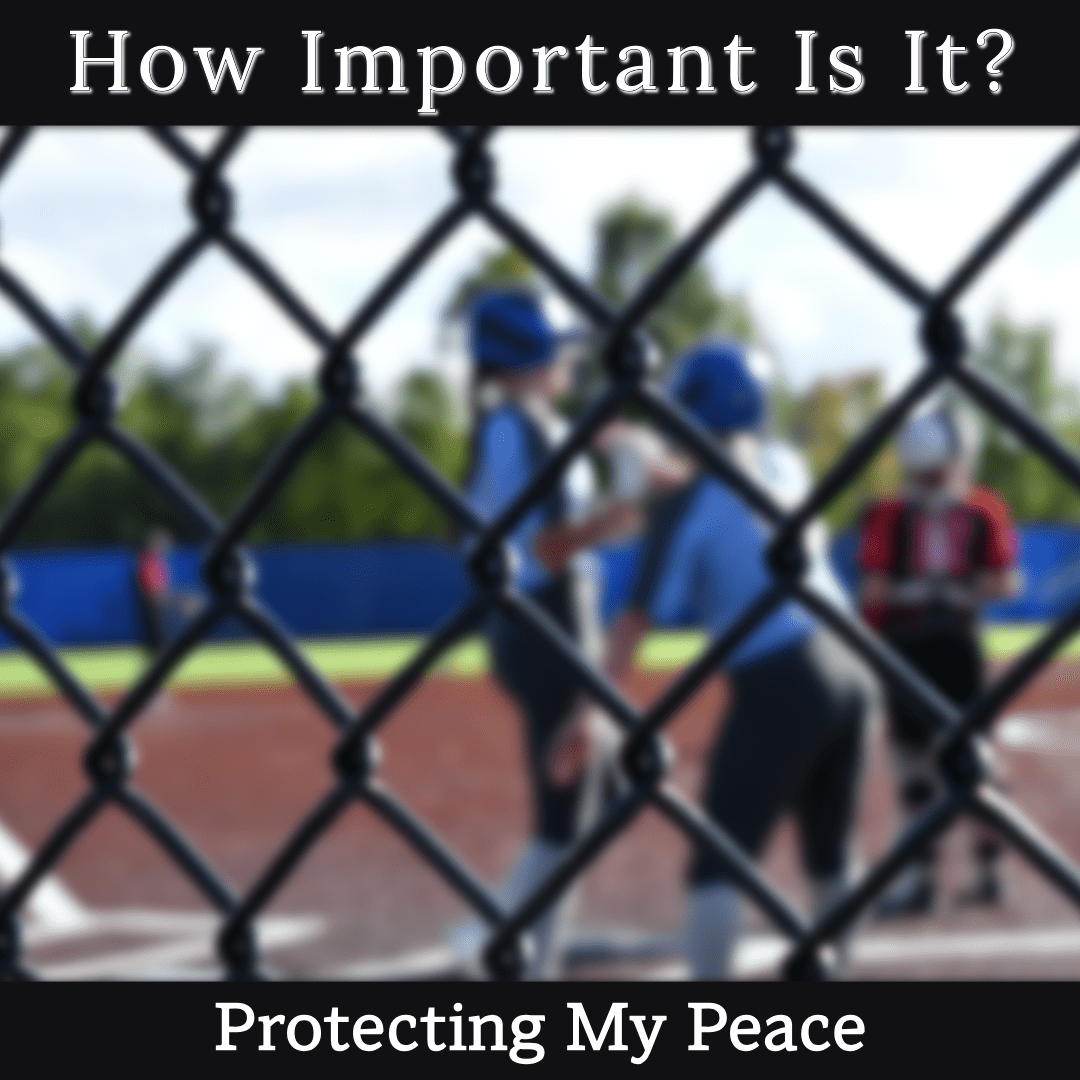
How Important Is It?

Protecting My Peace

One of the greatest gifts of recovery is learning what to let go of.

Set your minds on things above, not on earthly things. Colossians 3:2

Before recovery, I reacted to almost everything. If someone embarrassed me, challenged me, disrespected me, or hurt my feelings, I usually had one of two responses. I would either lash out and launch into a verbal barrage, using my intellect and vocabulary to hurt and insult people without them even realizing it until they went home and looked up the words I used. Or I would keep it all inside and carry it around for hours, days, or even longer. I replayed conversations and situations over and over in my mind. I built resentments. I lost sleep over things that really were not nearly as important as they felt in the moment.

The other day at my daughter’s softball game, one of the players got upset with me after I asked her to move in a little closer on the infield, something I regularly do with all the players. She started yelling at me, telling me she couldn’t do it. I let it go and figured I would deal with it later. Then her parent came over near the dugout and loudly yelled at me and the other coach, saying that I should not be talking to her daughter and that someone else should be. It was loud enough that everybody in the bleachers heard it. Honestly, it embarrassed me. I acted like I didn’t hear it, but inside I definitely felt it.

In that moment, one of the recovery slogans that has helped me many times over the years came into my mind: How important is it? When the girl and her parent each yelled at me, the first thing that came to mind was this slogan. That might not seem like a big deal to some people, but it is to me because before recovery my instinct would have been to react, defend myself, or lash back out. Instead, I realized this was just an upset child and an upset parent at a softball game. I did not have to let their chaos affect me and steal my peace. I didn’t have to defend myself, react, argue, or make a scene. Recovery has taught me that not every situation deserves my energy. Sometimes the healthiest thing I can do is let it go and keep my peace.

The realization didn’t really stand out to me until the next morning. My wife and daughter both commented on how calm and even tempered I had been in that situation. They noticed that I just let it go and didn’t react. The truth is, I would have never handled something like that this way before recovery. And what means the most to me is that I wasn’t trying to act different or make people think I had changed. I was just being me. That was my new instinct. As I reflected on it, I realized this was not just about one moment at a softball game. Recovery and working the steps have genuinely changed me from the inside out. It also doesn’t eat at me afterward the way it used to. When my mind tries to replay the situation, I just ask myself again, How important is it? And when I do that, I realize it usually is not important at all. I don’t lash out. I don’t lose my peace. I don’t build resentment or lose sleep over it either. That is the gift of recovery for me.

Prayer

Father, thank You for changing me from the inside out. Thank You that I do not have to react the way I used to. Help me to continue to walk in peace and wisdom. Help me to let go of what is not important and keep my mind focused on You. Amen

Freedom Through Honesty

Seeing What Was Already There

What I thought would destroy me was the very thing that led me to freedom.

You shall know the truth, and the truth shall make you free. John 8:32

Like most people in recovery, I first came because of a broken relationship. I was hoping to learn how to fix it. I remember when I had the aha moment. I was frustrated and telling my sponsor, “I’m getting mixed messages and I’m confused.” He smiled and said to me, “You’re not getting mixed messages. She said plainly she didn’t want to be with you anymore. How is that a mixed message?” I said, “Because we still live together.” He said, “That is not a mixed message. She told you her truth. You just don’t want to believe it.” When he said that, it finally sank in. Almost like it had been there the whole time, but was invisible to me. Looking back, I think he had probably been trying to help me see that for a while. I was so stuck in denial that I could not see it, even from him. I wasn’t confused. I wasn’t lacking information. I was choosing not to believe what was being said to me plainly. That day I realized something I wish I had learned much sooner. When people tell me their truth plainly, I need to believe them. They mean it. I could have saved myself so much frustration, anger, and pain if I had learned that one sooner.

What I slowly began to realize in recovery was that I was not confused nearly as much as I was in denial. Denial had such a grip on me that it was easier to believe what I wanted to be true than what I could clearly see right in front of me. It was almost like I had brainwashed myself into believing my version of reality instead of accepting what was actually happening. Facing reality meant facing pain, grief, and loss, and at the time I did not think I could handle that. I kept hoping things would change. I kept believing that if other people would just change their thinking, change their behavior, or come around to my point of view, then everything would be okay. So I poured enormous amounts of energy into trying to manage outcomes, force conversations, control situations, and hold things together that had already fallen apart. The more I fought reality, the more exhausted, frustrated, angry, and emotionally drained I became. I even pushed away one of the closest friends I ever had because he tried to tell me the truth.

Recovery has taught me to open my eyes and look honestly at what is happening in my own life. What surprised me was that accepting painful truth actually brought me more peace and serenity than denial ever did. What was uncomfortable and painful was actually the very thing that led me to freedom.

As I continued working my recovery, I started realizing this way of thinking went all the way back to my childhood. Growing up in an alcoholic home, pretending things were okay often felt safer than admitting they were not. Denial became normal to me. But recovery taught me that honesty is safer than illusion. Today, I still do not enjoy painful truths or difficult situations, but I try not to explain them away anymore either. I try to face what is real, bring it honestly to God, and trust Him enough to walk me through it instead of hiding from it. I have learned that acceptance brings far more peace than denial ever did. And that is the gift of recovery for me.

Prayer

Father, thank You for bringing me through my denial and revealing the truth to me. Give me the courage to face difficult truths honestly. Help me to trust You in the midst of them. Thank You for the comfort You give me to help me through it. Amen.

One Step at a Time… Again

Back to Basics

Drift doesn’t announce itself. It just shows up quietly. Before I even notice.

So, if you think you are standing firm, be careful that you don’t fall! 1 Corinthians 10:12

This week after meeting with my sponsor, I realized something that caught me off guard. For the first time, I hadn’t completed all my work and assignments. I had been so busy that I completely forgot to finish it. It wasn’t a relapse. It wasn’t a slip. It wasn’t even a major issue. But it got my attention. I didn’t like it, not at all. It borderline scared me that I could drift and be completely unaware of it. It made me stop and think. Why did I forget to finish my work? I didn’t even think about it. That’s when I have to stop and be honest with myself. Something has changed, and if I don’t catch it here, it will only grow and get worse.

I’ve learned to pay attention when something feels a little off. I look to see if I’m too busy, a little more distracted, a little less focused, or starting to think maybe the old way could work. That’s when I need to ask myself some questions. Am I still attending the same number of meetings? Am I still doing my step work? Am I still praying and seeking God? When I really look, I usually find something in these basic areas has shifted. It’s a symbiotic relationship. It’s simple cause and effect. When my recovery disciplines start to slip, my thinking soon follows. And vice versa. That awareness has become a check and balance system for me.

This is where this mindset helps me keep going. If I’ve done this before, I can do it again. I don’t have to feel discouraged or beat down. I don’t have to entertain lies. I don’t have to feel like I’ve lost everything. This stuff really works if I apply it to my life. So I go back to the basics, to what got me here. One moment. One hour. One day at a time. That’s how I started, and that’s how I continue. The journey of a thousand miles begins with one step… the next right step again.

I don’t say this because I’ve relapsed or slipped. I say this because I don’t want to. I’ve seen this work in my own life. I know that I know that I know that I know that if I do my recovery disciplines, they will work. I feel better about myself. I know I am changing. That brings me peace, happiness, and serenity. That gives me confidence. It allows me to throw my shoulders back, lift my head high, have a smile on my face, and keep going on. My life isn’t over. I’m still moving forward. I’m still growing. And that is the gift of recovery for me.

Prayer
Father, thank You for helping me see when things start to drift. Help me stay aware and honest with myself. Show me where I’ve slipped and give me the willingness to go back to the basics. Keep me grounded in the disciplines that brought me here. I don’t want to go backward. I want to keep moving forward with You, one step at a time. Amen.

I’m Not Who I Was

Not Defined By My Past

My identity isn’t who I was then. It’s who I am now.

If anyone is in Christ, he is a new creation; the old has gone, the new has come.
2 Corinthians 5:17

I’ve lived long enough to know what it feels like to be hurt. I’ve experienced difficulties, pain and trauma, even some health issues and concerns. People have hurt and mistreated me. I have been tricked, lied to and taken advantage of. I have survived experiences that left a lasting mark. They’ve caused wounds, and those wounds have left scars behind. But none of those things define me. They are unfortunately just the toll of life.

What I love about recovery is that it gives me practical tools and new skills to use. They help me heal and recover from the wounds and scars. It’s not salve that magically heals everything, nor is it a catch-all for every problem or situation. But it provides me with a different way of thinking. It teaches me to approach life differently. I am not a victim. I am not damaged or broken. I am not ruined or irreparable because of the things that have happened to me. Instead, I approach life as a whole person who has had bad things happen to me. And when I see myself that way, I’m able to confront, deal with and recover from the damage that was left behind.

I call that emotional collateral damage. It is what has happened to me as a result of the trauma and abuse that I experienced as a child. Those wounds, although sometimes still very painful, can be healed completely. It’s not like a surgery where they go in and remove the problem organ, and it’s all gone in one moment. This kind of healing is a process. It takes time. The damage and scars didn’t develop suddenly overnight and they’re not going to go away suddenly overnight either. This is what the Bible describes as the renewing of the mind and the saving of the soul. It’s a process that takes time as I grow into the full nature of a child of God.

And that’s where I live today. I’m not pretending those things didn’t happen, but I’m not letting them define me anymore either. I’m learning how to deal with what’s been left behind, one layer at a time. Sometimes that looks like choosing a different response when I feel hurt. Sometimes it’s simply talking about what I’m feeling instead of holding it in. Some days are harder than others. Some wounds are still tender and hurt when something hits them. But I’m not stuck there like I used to be. I’m healing. Not all at once, but steadily. I’m not who I was, and I’m not stuck where I’ve been. I’m moving forward into what God has for me.

Prayer
Father God, thank You for being my healer. Help me to face the hurts from my past instead of avoiding them. Give me strength to walk through them. Guide me and help me as I continue moving forward in You. Amen.

How I Stay Safe

Noticing The Little Things

I didn’t notice it… until it wasn’t there.

Whoever walks in integrity walks securely, but whoever takes crooked paths will be found out. Proverbs 10:9

When I got out of the shower this morning, I stepped onto the floor and my foot slipped. For a moment I thought I was going to fall and hit my head on the tub. It scared me. It caught me off guard. I’ve never done that before. I wondered, why did I slip? I shower every day, and I had never slipped like that before. Then I realized something. The mat that’s normally outside the shower wasn’t there. My wife had taken it to wash it. I’m grateful she takes care of those things, but it hit me. That mat has been there every day, keeping me from slipping, and I’ve never once really noticed it. I didn’t think about it. I didn’t appreciate it. Until it wasn’t there.

It made me start thinking about how many things in my life are like that. The small, consistent things that I don’t pay attention to, but they’re actually holding me up and keeping me safe. In my recovery, it’s things like: my daily time with God, journaling, attending meetings, talking things out, sharing honestly. None of those feel big in the moment. They just feel like part of my daily routine. But I’ve noticed when they’re missing, that’s when I start to slip, just like I did on that floor. That’s when I feel it. I’m not always aware and grateful in the moment for them. I just expect them to be there.

Today I’m grateful for the little things. The things that don’t get noticed but make all the difference. The things that keep me grounded and from falling back into old patterns. They may seem small, but they’re not. They are what keep me safe, and keep me from slipping, just like that mat did. They are the important things. And when I stay consistent with them, I don’t just avoid slipping, I stay safe and I keep growing. And that’s the gift of recovery for me.

Prayer
Father, thank You for the little things in my life that I don’t even notice. The things that keep me safe. Help me stay aware, stay consistent, and not take them for granted. Help me continue doing the small things every day that keep me safe. Amen.

Feelings Follow Actions

Take The Next Step

Change didn’t start when I felt better. It started after I acted.

For we walk by faith, not by sight. 2 Corinthians 5:7

For most of my life I built a wall so I would not have to feel my feelings. I did not want to deal with those unpleasant emotions that made me feel so uncomfortable. I had learned how to shut things down and keep on moving. But when I came into recovery, and once I started working the steps, that door opened. And like a floodgate being released, all of those feelings and emotions I had been holding back for years suddenly started coming out. I was trying to feel them and experience them, but I did not know how. I didn’t know what to do with them. And many times they were confusing too, because they would intermingle and come at the same time. I remember a moment when I received some great amazing news and some horribly bad news within about 30 minutes of each other. My wife and I had just found out we were pregnant after several years of trying. We were elated and so happy. It was wonderful. And then a little later, I received a call that my dad had passed away. I was sad and angry. And then confused. Life and death all in less than an hour’s time. I felt happy and angry and sad all at the same time. I called my sponsor to get some help. He simply said, “Those are and feelings.” I began to realize that it was good that I was no longer running from my feelings. I was finally experiencing my emotions and acknowledging that they were real. But I also started to see how much of a roller coaster life becomes if I allow my emotions to become the determining factor for everything I do.

I’ve heard it said many times in the rooms of recovery, and I have found it to be true in my own life, that you can’t think your way into better behavior, but you can act your way into better thinking. And over time I began to see that the same thing is true with feelings. I cannot feel my way into better behavior, but I can act my way into better feelings. When I let my emotions dictate my actions, my life becomes unstable and reactive. I start making decisions based on how I feel in the moment, and that usually doesn’t lead me anywhere good. But when I choose to take healthy actions first, even when I don’t feel like it, something begins to shift. My behavior starts to change. And as my behavior begins to change, something starts to shift in my thinking. And as my thinking begins to change, my feelings begin to follow. Those simple actions, the ones that don’t seem like much in the moment, begin to calm the storm inside me.

Step Two says that we came to believe that a Power greater than ourselves could restore us to sanity. For me, the action in that step is in the word came. I would have never started believing any of this if I had not come in the first place. I had to get up out of my feel-sorry-for-myself life and take myself down the road to a place where I could hear how to change. Not every action in recovery is grand or dramatic. Many of them are simple and even mundane. Showing up. Listening. Taking the next right step. But those small actions begin to change my behavior, and when my behavior changes it is amazing how my feelings begin to change too. I came, and then I began to believe. And as I kept showing up and taking those simple actions, I started to feel different too.

Prayer
Father, help me to stop letting my feelings run my life. Teach me to walk by faith and take the next right step, even when I don’t feel like it. I surrender the outcome to You. Amen.

Recovered or Healed?

Walking It Out

Therefore if anyone is in Christ, he is a new creation; old things have passed away; behold, all things have become new. 2 Corinthians 5:17

I was recently asked this question by a former sponsee, and it really got me thinking. Am I healed, or am I still recovering? It feels like one of those questions that should have a simple answer, but the more I sat with it, the more I realized there is something deeper going on.

When I look at Jesus, I see that when He healed people, He made them whole. He did not partially heal them. But then I also think about the blind man in Mark 8. Jesus laid His hands on him, and at first the man said he saw men walking around like trees. Then Jesus touched him again, and he saw clearly. That tells me something important. What Jesus does is complete, but it does not always show up all at once the way I expect it to. That is a process, even when the source is perfect.

I know what it means to be free from something. There are struggles I used to have that are completely gone. Not managed. Not controlled. Gone. They are not even a thought anymore. But there are other things that still show up in my life. I still feel not good enough sometimes. I still get my feelings hurt. I still feel left out at times. I still find myself wanting to control things or give advice when it was never asked for. Not like before, but it is still there. So am I healed? Yes. But I am also learning how to live in that healing every day.

What I have found in recovery is a place where this actually becomes real. Scripture tells us to confess our faults to one another and pray for one another, but I did not experience that in church the way I have in recovery. In recovery, there are ground rules. Honesty. Confidentiality. Accountability. People sharing what is really going on, not what sounds right. And something happens in that environment. Healing continues to show up. Not because something new is being given, but because I am no longer hiding my true self. It is a place where I can be honest and not feel exposed. A place where I can actually walk this out daily.

For me, this is what it comes down to. In Christ, I am made whole. That part is finished. But I am still being changed as I learn to think differently, to be honest, and to live differently each day. I am not trying to become healed. I am learning how to live as someone who already is. And that is the gift of recovery to me.

Prayer
Father, help me live from what You have already done in me. Teach me to stay honest, to stay open, and to walk this out one day at a time. Thank You. Amen.

Keep Coming Back

It Works

Just showing up and taking the next right step is enough.

Let us not become tired of doing good. At the right time we will gather a crop if we do not give up. Galatians 6:9

Keep coming back is something I heard early in recovery, and if I’m honest, I didn’t really understand it at first. I wanted answers right away. I wanted relief right away. Sitting still felt uncomfortable, and the process felt too slow. But something kept me coming back. Maybe it was a small sense of relief, or maybe it was just that I didn’t have anything else that was working. So I came back. Then I came back again.

I remember talking with my sponsor one day about fear. He gave me an acronym that has stayed with me ever since. Face Everything And Recover. That was a whole lot better than the way I used to live, which was Forget Everything And Run. I was a runner. I ran from problems, from hard conversations, from anything that made me uncomfortable. My running looked like avoiding and ignoring. Pretending things were not there. Thinking if I did not acknowledge them, they would just go away. Crazy thinking. That is exactly why I needed to be restored to sanity.

Even now, I still need that reminder. Life still brings difficult moments, and my first instinct is sometimes to go back to old ways, avoid it and ignore it. But today I know what to do. Instead of running away, I run toward. I go back to the basics. I go to a meeting. I call my sponsor. I do stepwork. I journal. I remind myself that I do not have to fix everything today. I just need to take the next right step and keep moving forward. I am not perfect, but I am making progress. I just have to keep coming back. And every time I do, things get a little better.

Prayer
Father, help me to keep showing up, even when I don’t feel like it. Teach me to run toward You instead of away. Give me the willingness to take the next right step today. Amen.

Learning To Grow Up

No More Proving

I’m learning that my worth isn’t tied to what I do. I don’t have to earn love and acceptance. I’m starting to see I can slow down, rest, and still have value.

When I was a child, my words and my feelings and my thoughts were those of a child; now that I am a man, I have no more use for the ways of a child. 1 Corinthians 13:11

I was doing some step work and writing about having boundaries with myself, and it started taking me deeper than I expected. I began asking myself tougher questions. They were hard to ask and even harder to answer. My first instinct was to just move on and be content with the awareness, but I had that little nudge inside me telling me I was close to something and I just need to keep going. Why do I push myself past exhaustion? Why do I feel like I always have to be doing something? Is that tied to my character defects? Feeling like I am not good enough? Rejection? Do I feel like I have to do good in order to be loved? When I honestly work the steps, I learn more about why I do the things I do. As I slow down and look at my motives, I start to see there is something deeper driving me. This stuff is real, and it really helps me. I understand why they call it a “Fearless” moral inventory. Fear almost stopped me from pursuing these feelings.

I can see how easily I place my value and worth on what I do. I want to be successful and productive. And if I am honest, since I am not financially wealthy, there is a part of me that thinks maybe I would be considered successful by doing good things, helping others, and ministering through my writing. None of those things are wrong, but I can see how I have tied my worth to them. If I am producing, I feel okay. If I am not, something feels off. I rationalize that even if what I do doesn’t produce wealth financially, maybe I would still be considered successful by enriching others’ souls. The amazing thing about step work is that once I uncover the truth about why I do what I do and find my part, I begin to see what I can do to change unwanted behaviors. Most of the time, the change first shows up in how I am thinking, not in what I am doing. It is learning to see myself and others differently. I begin to be open-minded and realize that most of my problems come from inside of me, from how I perceive what is happening in my life. There is no looking for fault or blame but simply taking responsibility to change.

I did not cause the psychological damage that was done to me, and I was powerless to stop it as a child. But I am not a child anymore. My desire now is to stop reacting like one emotionally. That is where recovery becomes practical. It teaches me how to pause, how to look at what is really driving me, and how to make a different choice. I can see now that I have been trying to prove my worth by what I do. I do not have to prove my worth or value anymore. My identity is in God. My value and worth come from Him. I rest knowing that He loves and accepts me because He is good, not because I am. I am learning how to grow up, not just physically, but emotionally and spiritually. And even now, as I write this, I feel like I am close to something new. I sense a new awareness emerging. I am just starting to see my motives more clearly. And as I learn to rest in God, I begin to accept myself as I am. That is me growing up.

Prayer

Father, help me stop trying to prove my worth. Teach me to rest in who You say I am. Thank You. Amen.

Safe With Me

Trusting Myself

How I treat myself matters. Recovery is teaching me to take better care of myself.

No one abuses his own body, does he? No, he feeds and pampers it. That’s how Christ treats the church, Ephesians 5:29

Lately I have been overextending myself. In my mind I think I am like the energizer bunny and I can just keep going and going. My body though has a different response, and if I am not careful, I will run myself into the ground. I get run down and more susceptible to getting sick. It starts by staying up way too late trying to get everything done I want to do. Even in practicing my recovery, I stay up late reading, writing, and editing. I am also trying to write a book. Consequently, I don’t get enough sleep, and I am tired the next day, not always at my best and not performing at my best. I also find that I can be less patient and short with people. My intent and heart is good, but I am not practicing healthy boundaries with myself. My intentions do not justify my actions. I am not treating myself with care and respect.

I was reading some literature this past weekend. In it the person mentioned that they set boundaries with themself. I paused. I had to reread it a few more times. It didn’t quite click with me at first, but I knew there was something there. Something I needed to hear and see. As I sat with it, I began to connect it to my own life. I have learned about boundaries, and I have set them with other people. But I never thought about setting a boundary with myself. I used to think boundaries were only about other people. Who I let into my life and how I allowed them to treat me. Boundaries helped me determine what I would tolerate and what I would say no to. But I am learning that some of the most important boundaries are the ones I need to set with myself. Was I being too hard on myself? Why do I push myself past exhaustion? Am I trying to prove something? I did not realize that I was the one who was mistreating me.

As I prayed and meditated on this, I began to see how I talk to myself and how I treat myself. I would replay mistakes and blame myself, and that would lead to shame. I would expect perfection and then feel disappointed and discouraged when I couldn’t live up to such an unrealistic expectation. I am simply being human. Sometimes I would excuse behavior I knew was not healthy. I was being codependent with myself. I crossed my own lines constantly. A healthy boundary with myself means I take responsibility for my actions without condemning myself. I rest without feeling guilty. I tell myself the truth without exaggeration. I am learning to stop crossing my own lines and calling it okay.

When I run myself down, I feel it. I feel it in my body, in my attitude, and in how I treat other people. This is not just about being tired. It is about how I am choosing to treat myself. I don’t want to keep living like that. I want to feel safe with myself so that I can trust myself. I am learning to slow down, to stop when I need to stop, and to take care of myself in a way that actually supports my recovery. That means I don’t keep pushing past my limits and calling it good. I am responsible for how I treat myself.

Prayer
Father, help me treat myself the way You treat me. Show me where I push too far. Teach me to slow down, to rest, and to live in a way that supports my recovery. I want to be safe with myself so I can trust myself. Thank You. Amen.

I Had To Ask

Humility Opens the Door to Help

Knowing I needed help was not enough. Healing began when I became willing to ask for it.

Confess your sins to each other and pray for each other so God can heal you. When a believing person prays, great things happen. James 5:16

I was sharing with someone this week about my experience when I first entered recovery and was wanting a sponsor. I remember I kept wondering and couldn’t figure out why no one asked me if they could sponsor me. It was a beginner’s meeting, and I was a beginner. I was surrounded by people who clearly understood why I was there and what I was going through. The rooms were full of experience, strength, and hope. I had opened up in meetings and shared my story and the reason I was there, so people knew I needed help. But week after week went by and no one asked me if they could sponsor me. I could not figure it out. It took me a few weeks, but I finally realized that although I needed help, I had to ask for it. I had not asked.

Asking for help is a requirement. It is not optional. It is not a weakness either. It is actually a strength. And it is a basic principle of the program. For so long before recovery I was never humble enough to ask for help. Even when I desperately needed and wanted help, I could not bring myself to ask. My pride was holding me back. Fear of rejection was a major reason. It felt safer to struggle quietly than to risk hearing no.

In recovery I began to learn something different. Asking for help is not a weakness. It is a strength and a basic principle of the program. Recovery is not for those who need it. Every person I have met needs it. Recovery is for those who want it and are willing to humble themselves and ask for help.

Once I finally asked, something changed in me. That first time was so very hard. But when I did, help immediately came. It was just what I needed too. Everything else after that seemed to get easier as well. It was like a light switch got flipped on in my thinking. It had been there the whole time but had been off with a “Do not touch” sign on it. I had already asked for help once and I got it. So I thought, maybe it could happen again? I did. And it did. Now I know I can flip that switch whenever I need to. The help and the experience of others had been there all along. The availability of help was never a problem. My willingness to reach for it was.

Recovery keeps reminding me that I was never meant to carry life alone. Learning to humble myself and ask for help has been one of the ways God has guided me toward healing. That willingness to reach out is part of the gift of recovery for me.

Prayer

Father, thank You for showing me that I do not have to carry life alone. Help me stay humble to ask for help when I need it. Help me surrender my pride and my fear, and teach me to trust the people You place in my life. Thank You for the healing that comes when I reach out. Amen.